Publishing research is one of the most significant milestones in an academic career. Whether you are a postgraduate student, doctoral scholar, faculty member, or independent researcher, choosing a trustworthy journal directly influences the visibility, credibility, and impact of your work.
In recent years, Open Access publishing has transformed scholarly communication by making research freely available to readers worldwide. At the same time, researchers must carefully distinguish between legitimate peer-reviewed journals and journals that fail to maintain rigorous editorial standards.
This comprehensive guide explains how to identify reliable International Peer Reviewed Journals with Open Access Publication Opportunities, understand the peer-review process, evaluate journal quality, compare major indexing databases, and confidently choose the right publication venue in 2026.
Table of Contents
- What Are International Peer Reviewed Journals?
- What Is Open Access Publishing?
- Benefits of Publishing in Open Access Journals
- Why Researchers Prefer International Journals
- Characteristics of Trustworthy Peer Reviewed Journals
- Helpful IJMRE Resources
What Are International Peer Reviewed Journals?
International peer-reviewed journals publish original scholarly research after independent experts evaluate each manuscript for originality, methodology, technical quality, ethical compliance, and academic contribution.
Unlike informal websites or non-reviewed publications, peer-reviewed journals follow structured editorial workflows designed to improve research quality before publication.
A typical peer-review process includes:
- Initial editorial screening
- Scope verification
- Assignment to qualified reviewers
- Technical evaluation
- Revision by authors
- Editorial decision
- Final publication
Because manuscripts undergo expert evaluation, peer-reviewed journals remain one of the most trusted sources of scientific knowledge across disciplines.
What Is Open Access Publishing?
Open Access (OA) publishing allows anyone to read, download, and cite scholarly articles without requiring a subscription. This publishing model promotes global knowledge sharing and increases the accessibility of research findings for students, educators, researchers, policymakers, and industry professionals.
Open Access does not mean that a journal lacks peer review. Many respected Open Access journals maintain rigorous editorial standards comparable to traditional subscription journals.
| Feature | Open Access Journal | Subscription Journal |
|---|---|---|
| Reader Access | Free worldwide | Subscription required |
| Research Visibility | Generally higher | Limited by institutional access |
| Global Reach | Excellent | Moderate |
| Peer Review | Depends on journal policy | Depends on journal policy |
Why Researchers Prefer Open Access Publication Opportunities
The popularity of Open Access publishing continues to grow because it removes barriers between research and readers. Articles become immediately available to researchers across universities, industries, government organizations, and developing countries.
Major advantages include:
- Greater research visibility
- Broader international readership
- Higher potential for citations
- Improved interdisciplinary collaboration
- Faster knowledge dissemination
- Better accessibility for educators and students
- Support for public access to publicly funded research
Why International Journals Matter
Publishing in an international journal extends the reach of your research beyond regional boundaries. International journals often attract submissions from multiple countries, encouraging broader academic discussion and collaboration.
Researchers frequently choose international journals because they:
- Reach a global audience.
- Encourage international collaboration.
- Increase research visibility.
- Improve professional recognition.
- Support academic career advancement.
- Provide diverse reviewer expertise.
Characteristics of Trustworthy Peer Reviewed Open Access Journals
| Characteristic | Why It Matters |
|---|---|
| Clearly stated peer-review process | Ensures quality evaluation. |
| Transparent editorial board | Demonstrates academic leadership. |
| Publication ethics policy | Protects research integrity. |
| Detailed author guidelines | Improves manuscript preparation. |
| Regular publication schedule | Indicates editorial consistency. |
| Professional journal website | Improves author confidence. |
Helpful IJMRE Resources
Before selecting a journal, these guides can help you understand indexing, peer review, ethics, and journal evaluation:
What's Next?
In Part 2, we will compare Google Scholar, DOAJ, Scopus, and Web of Science, explain how peer review works in detail, discuss why researchers increasingly choose Open Access journals, and provide practical strategies for evaluating international journals before submitting your manuscript.
How Peer Review Protects Research Quality
Peer review is the foundation of scholarly publishing. Before an article is accepted, independent experts in the same academic discipline evaluate the manuscript for originality, methodological quality, accuracy, ethical compliance, and its contribution to existing knowledge.
The primary goal of peer review is not simply to approve or reject manuscripts—it is to improve research quality through constructive academic feedback.
Typical Peer-Review Workflow
- Manuscript submission
- Initial editorial screening
- Scope and plagiarism check
- Reviewer assignment
- Technical evaluation
- Author revisions
- Final editorial decision
- Publication
Researchers who understand this process are better prepared to respond to reviewer comments professionally and improve the quality of their manuscripts before publication.
Learn more here:
Google Scholar vs DOAJ vs Scopus vs Web of Science
Many researchers mistakenly assume these platforms serve the same purpose. In reality, each supports scholarly publishing in a different way.
| Platform | Primary Purpose | Best Used For |
|---|---|---|
| Google Scholar | Academic search engine | Finding scholarly articles and citations |
| DOAJ | Directory of Open Access Journals | Locating trusted Open Access journals |
| Scopus | Citation and abstract database | Research evaluation and citation analysis |
| Web of Science | Citation indexing platform | Tracking research impact and scholarly literature |
Rather than choosing journals solely because they appear in one database, researchers should evaluate editorial quality, peer-review standards, journal scope, and ethical publishing practices.
Why Open Access Publishing Continues to Grow
Open Access publishing has expanded rapidly because researchers increasingly value visibility, accessibility, and international collaboration. When articles are freely available, educators, researchers, policymakers, healthcare professionals, engineers, and students can benefit without subscription barriers.
Major advantages include:
- Immediate worldwide accessibility
- Improved knowledge sharing
- Greater interdisciplinary collaboration
- Higher potential readership
- Better educational accessibility
- Increased opportunities for international cooperation
The success of Open Access depends on maintaining strong editorial policies and rigorous peer review rather than simply offering free access.
How to Evaluate an International Peer Reviewed Journal
Before submitting your manuscript, evaluate each journal using objective criteria rather than promotional claims.
| Evaluation Criterion | Questions to Ask |
|---|---|
| Journal Scope | Does the journal publish research in my discipline? |
| Peer Review | Is the review process clearly described? |
| Editorial Board | Are qualified editors listed transparently? |
| Publication Ethics | Does the journal publish ethical guidelines? |
| Author Guidelines | Are submission instructions complete? |
| Publication Schedule | Is the journal published regularly? |
| Website Quality | Is journal information current and professional? |
Common Misconceptions About Open Access Journals
| Misconception | Reality |
|---|---|
| Open Access journals are not peer reviewed. | Many Open Access journals use rigorous peer review. |
| Free access means lower quality. | Quality depends on editorial standards, not the access model. |
| Every indexed journal is equally trustworthy. | Researchers should always evaluate editorial transparency and ethics. |
| Fast publication always indicates efficiency. | Unrealistically fast acceptance may require careful evaluation. |
Expert Advice for Researchers
Journal editors consistently recommend that authors begin evaluating journals before completing the final manuscript. Early journal selection allows researchers to prepare manuscripts that align with formatting requirements, reporting standards, and editorial expectations.
Good publication practices include:
- Study recently published articles.
- Read the journal's aims and scope carefully.
- Verify peer-review procedures.
- Follow author guidelines precisely.
- Prepare a professional cover letter.
- Proofread the manuscript thoroughly.
- Ensure all references are accurate.
Recommended IJMRE Resources
- How to Check Whether a Journal Is Scopus Indexed and Peer Reviewed
- Peer-Reviewed Journals vs Scopus vs Web of Science
- How to Search Journals in the DOAJ Database
- How DOAJ Helps Researchers Find Trusted Open Access Journals
- DOAJ vs Scopus: Which Database Should Researchers Consider?
- Common Mistakes Researchers Make While Selecting DOAJ Journals
- Why Authors Should Publish in Top Peer-Reviewed Journals Instead of Fake Scopus Journals
- How to Avoid Fake Scopus Journals
Coming Up in Part 3
In Part 3, you'll learn how to select the best international peer-reviewed Open Access journal, compare multidisciplinary and specialized journals, avoid common journal selection mistakes, understand publication ethics, and follow practical strategies that improve your chances of successful publication.
How to Choose the Right International Peer Reviewed Open Access Journal
Selecting the right journal should begin long before your manuscript is completed. Many researchers spend months conducting high-quality research but lose valuable time by submitting to journals that are outside their research area or do not match their manuscript's objectives.
A well-matched journal increases the likelihood of constructive peer review, reduces unnecessary revisions, and helps your research reach the appropriate academic audience.
A Step-by-Step Journal Selection Strategy
| Step | Action | Benefit |
|---|---|---|
| 1 | Clearly define your research topic. | Identifies journals with matching scope. |
| 2 | Study recently published articles. | Confirms topic compatibility. |
| 3 | Review author guidelines. | Improves submission quality. |
| 4 | Verify peer-review policies. | Ensures editorial transparency. |
| 5 | Evaluate publication ethics. | Protects research integrity. |
| 6 | Prepare your manuscript accordingly. | Reduces avoidable revisions. |
Multidisciplinary vs Specialized Journals
One of the most common questions researchers ask is whether they should publish in a multidisciplinary journal or a specialized journal. The answer depends largely on the nature of the research.
| Multidisciplinary Journals | Specialized Journals |
|---|---|
| Accept research from multiple disciplines. | Focus on one specific academic field. |
| Suitable for interdisciplinary studies. | Ideal for highly specialized topics. |
| Broader readership. | Highly targeted audience. |
| Encourages cross-disciplinary collaboration. | Offers deeper subject-specific discussions. |
If your research combines artificial intelligence, engineering, education, healthcare, environmental science, management, or computer science, a multidisciplinary journal may provide broader visibility.
Recommended reading:
How to Avoid Low-Quality or Misleading Journals
The increasing popularity of Open Access publishing has also led to the emergence of journals with poor editorial practices. Researchers should carefully evaluate journals before submitting manuscripts.
Warning signs may include:
- Unrealistically fast acceptance guarantees.
- No clear description of peer review.
- Missing editorial board information.
- Poor website quality.
- Incomplete publication ethics policies.
- Aggressive spam email invitations.
- False or unverifiable indexing claims.
A trustworthy journal should be transparent about its editorial workflow, peer-review process, publication schedule, and ethical policies.
Why Publication Ethics Matter
Publication ethics protect the integrity of scholarly communication. Every author shares responsibility for ensuring that published research is original, transparent, reproducible, and accurately reported.
Responsible publishing includes:
- Submitting original work.
- Avoiding plagiarism.
- Reporting data honestly.
- Properly citing previous research.
- Declaring conflicts of interest.
- Following authorship guidelines.
- Respecting peer-review confidentiality.
Ethical publishing strengthens both individual careers and the broader academic community.
Using Generative AI Responsibly
Artificial intelligence has become a useful assistant for researchers, but it should never replace critical thinking or scientific responsibility.
| Recommended AI Use | Not Recommended |
|---|---|
| Grammar improvement. | Generating fake research data. |
| Improving readability. | Inventing references. |
| Language editing. | Fabricating experimental results. |
| Organizing content. | Submitting unverified AI-generated text. |
Authors remain responsible for every statement, figure, citation, and conclusion included in their manuscripts.
Read more:
Expert Tips for Successful Publication
- Choose the journal before writing the final manuscript.
- Read at least five recently published articles from your target journal.
- Write a concise and informative title.
- Prepare a structured abstract.
- Use relevant keywords naturally.
- Follow the journal's formatting requirements.
- Respond professionally to reviewer comments.
- Revise your manuscript thoroughly before submission.
Recommended IJMRE Articles
- Best Peer-Reviewed Multidisciplinary Research Journals
- Best Peer-Reviewed Multidisciplinary Journals for Researchers
- International Journal of Multidisciplinary Research: Best Platforms for Publishing
- Best International DOAJ, Google Scholar & Peer-Reviewed Journals
- Google Scholar Education Journals in 2026
- Mechanical Engineering Research Journals in 2026
- Best Peer-Reviewed AI Journals for Publishing Artificial Intelligence Research
Coming Up in Part 4
In Part 4, you'll find a comprehensive pre-submission checklist, publication workflow, author best practices, common reasons manuscripts are rejected, practical solutions, and guidance on maximizing the visibility and impact of your published research in international peer-reviewed Open Access journals.
Pre-Submission Checklist for International Peer-Reviewed Open Access Journals
Before submitting your manuscript, take time to complete a thorough quality review. Even excellent research can experience unnecessary delays if important submission requirements are overlooked. The following checklist helps authors prepare manuscripts that align with the expectations of reputable international peer-reviewed journals.
| Checklist Item | Status |
|---|---|
| Journal scope matches your research topic | ☐ |
| Title clearly reflects the research | ☐ |
| Abstract summarizes objectives, methods, results, and conclusions | ☐ |
| Keywords are relevant and searchable | ☐ |
| References are complete and correctly formatted | ☐ |
| Figures and tables are high quality | ☐ |
| Grammar and language have been reviewed | ☐ |
| Plagiarism screening completed | ☐ |
| Ethics statement included where applicable | ☐ |
| Cover letter prepared | ☐ |
Typical Publication Workflow
Understanding the publication workflow helps researchers set realistic expectations and prepare effectively for each stage of the editorial process.
| Stage | Description |
|---|---|
| Manuscript Preparation | Complete research, writing, and formatting. |
| Journal Selection | Choose a journal aligned with your research. |
| Initial Editorial Review | Editors assess scope, formatting, and originality. |
| Peer Review | Independent reviewers evaluate the manuscript. |
| Revision | Authors address reviewer comments. |
| Final Editorial Decision | Acceptance, revision, or rejection. |
| Publication | The accepted article becomes available online. |
Every stage contributes to maintaining the quality and integrity of scholarly publishing.
Common Reasons Manuscripts Are Rejected
Journal rejection is a normal part of academic publishing. Understanding common reasons for rejection can help authors improve future submissions.
| Reason | How to Avoid It |
|---|---|
| Mismatch with journal scope | Review the journal's aims and scope carefully. |
| Weak research methodology | Provide clear and reproducible methods. |
| Poor manuscript organization | Follow a logical scientific structure. |
| Insufficient literature review | Include recent and relevant references. |
| Formatting errors | Follow author guidelines precisely. |
| Language problems | Proofread carefully or seek language editing. |
| Ethical concerns | Maintain originality and transparency. |
How to Increase the Visibility of Your Published Research
Publishing an article is only the beginning. Researchers can improve the visibility and accessibility of their work through responsible academic communication.
- Create a descriptive, keyword-rich title.
- Write a clear and informative abstract.
- Select relevant keywords.
- Cite recent and authoritative literature.
- Maintain updated researcher profiles.
- Share publications through institutional repositories where permitted.
- Present research at conferences and academic events.
- Collaborate with researchers from different institutions and countries.
Research visibility grows through consistent scholarly engagement rather than short-term promotional tactics.
Long-Term Benefits of Publishing in Reputable Open Access Journals
| Benefit | Impact |
|---|---|
| Global Accessibility | Readers worldwide can access your work. |
| Academic Visibility | Research becomes easier to discover. |
| Knowledge Sharing | Supports international collaboration. |
| Educational Value | Benefits students and educators. |
| Research Impact | Facilitates wider scholarly discussion. |
| Professional Recognition | Strengthens academic reputation. |
Best Practices for Successful Academic Publishing
Experienced researchers consistently follow a set of practices that improve publication outcomes:
- Begin journal selection early in the research process.
- Read several recently published articles from your target journal.
- Write for your intended academic audience.
- Ensure all figures and tables support your conclusions.
- Keep references accurate and up to date.
- Respond politely and thoroughly to reviewer comments.
- Revise your manuscript multiple times before submission.
- Maintain complete transparency throughout the research process.
Recommended IJMRE Resources
- International Journal of Multidisciplinary Research and Explorer (IJMRE)
- Multidisciplinary Research Journal
- Peer-Reviewed Articles in Scientific Report Journal
- Why Researchers Prefer Multidisciplinary Journals for Publication
- Google Scholar Journal Indexing: Why It Matters
- How to Select the Right Peer-Reviewed Journal for Publication
- Research Paper Publication Guide for Beginners
- Best International DOAJ, Google Scholar & Peer-Reviewed Journals
Key Takeaways
- Choose journals based on relevance, quality, and editorial standards rather than publication speed.
- Understand the peer-review process before submitting your manuscript.
- Evaluate Open Access journals carefully using transparent criteria.
- Follow ethical publishing practices at every stage of your research.
- Prepare your manuscript according to the journal's author guidelines.
- Focus on producing research that contributes meaningful knowledge to your field.
Coming Up in Part 5
The final section includes 20 frequently asked questions (FAQs), a comprehensive article summary, final conclusions, an SEO-optimized slug, and a premium AI image prompt for creating a professional featured image suitable for an academic publishing website.
Frequently Asked Questions (FAQs)
1. What are international peer-reviewed journals?
International peer-reviewed journals are scholarly publications that evaluate submitted manuscripts through independent expert review before publication. They publish research from authors worldwide and follow established editorial and ethical standards.
2. What is Open Access publishing?
Open Access publishing allows readers to access scholarly articles online without subscription fees. Depending on the journal's policies, authors may or may not pay publication charges.
3. Are all Open Access journals peer reviewed?
No. Many reputable Open Access journals conduct rigorous peer review, but researchers should always verify the journal's editorial policies before submitting a manuscript.
4. Is Google Scholar a journal?
No. Google Scholar is an academic search engine that indexes scholarly literature from various publishers, universities, and repositories.
5. What is the difference between DOAJ and Google Scholar?
Google Scholar is a search engine for scholarly content, while DOAJ (Directory of Open Access Journals) is a curated directory of Open Access journals that meet specific quality and transparency standards.
6. How do I identify a trustworthy journal?
Review the journal's aims and scope, editorial board, peer-review process, publication ethics, author guidelines, publication history, and website transparency.
7. Should I publish in multidisciplinary journals?
If your research spans multiple disciplines or has broad applications, multidisciplinary journals can provide wider visibility and reach diverse academic audiences.
8. Why is peer review important?
Peer review helps improve research quality, validates methodology, identifies errors, and ensures that published findings meet scholarly standards.
9. Can students publish in international journals?
Yes. Undergraduate, postgraduate, and doctoral students can publish high-quality original research if it meets the journal's editorial and peer-review standards.
10. Does Open Access improve research visibility?
Open Access makes research freely available worldwide, increasing accessibility and enabling broader academic and professional engagement.
11. How long does peer review usually take?
The review timeline varies depending on the journal, reviewers, and manuscript complexity. Authors should expect the process to take several weeks to several months.
12. What causes manuscript rejection?
Common reasons include poor journal selection, weak methodology, formatting issues, insufficient novelty, language problems, ethical concerns, and failure to follow author guidelines.
13. Should I use AI to write my research paper?
AI may assist with language editing, grammar improvement, and manuscript organization. However, authors remain fully responsible for the originality, accuracy, citations, data, and conclusions presented in their work.
14. How important are journal guidelines?
Following author guidelines improves submission quality, reduces editorial delays, and demonstrates professionalism during the publication process.
15. What should I check before submission?
Verify journal scope, manuscript formatting, references, plagiarism, ethics compliance, figures, tables, keywords, and supporting documents before submitting.
Article Summary
Publishing in International Peer Reviewed Journals with Open Access Publication Opportunities allows researchers to share high-quality scholarly work with a global audience while benefiting from transparent editorial evaluation and broad accessibility.
Throughout this guide, we explored the principles of peer review, Open Access publishing, journal evaluation, publication ethics, multidisciplinary research, responsible use of AI, common submission mistakes, and practical strategies for selecting trustworthy journals.
Successful academic publishing begins with choosing the right journal, preparing a well-structured manuscript, adhering to ethical standards, and following the journal's submission requirements. Researchers who invest time in careful journal selection significantly improve the visibility, credibility, and long-term impact of their work.
Conclusion
The landscape of scholarly publishing continues to evolve as Open Access becomes increasingly important for global knowledge sharing. Researchers now have more opportunities than ever to publish in reputable international peer-reviewed journals that support accessibility, transparency, and academic collaboration.
Rather than focusing solely on publication speed or promotional claims, authors should prioritize journals with established editorial practices, rigorous peer review, ethical publishing standards, and a clear alignment with their research objectives.
A carefully selected journal not only increases the chances of successful publication but also helps ensure that valuable research reaches the scholars, educators, professionals, and policymakers who can build upon those findings.
SEO-Optimized Slug
international-peer-reviewed-journals-open-access-publication-opportunities
AI Featured Image Prompt
Prompt:
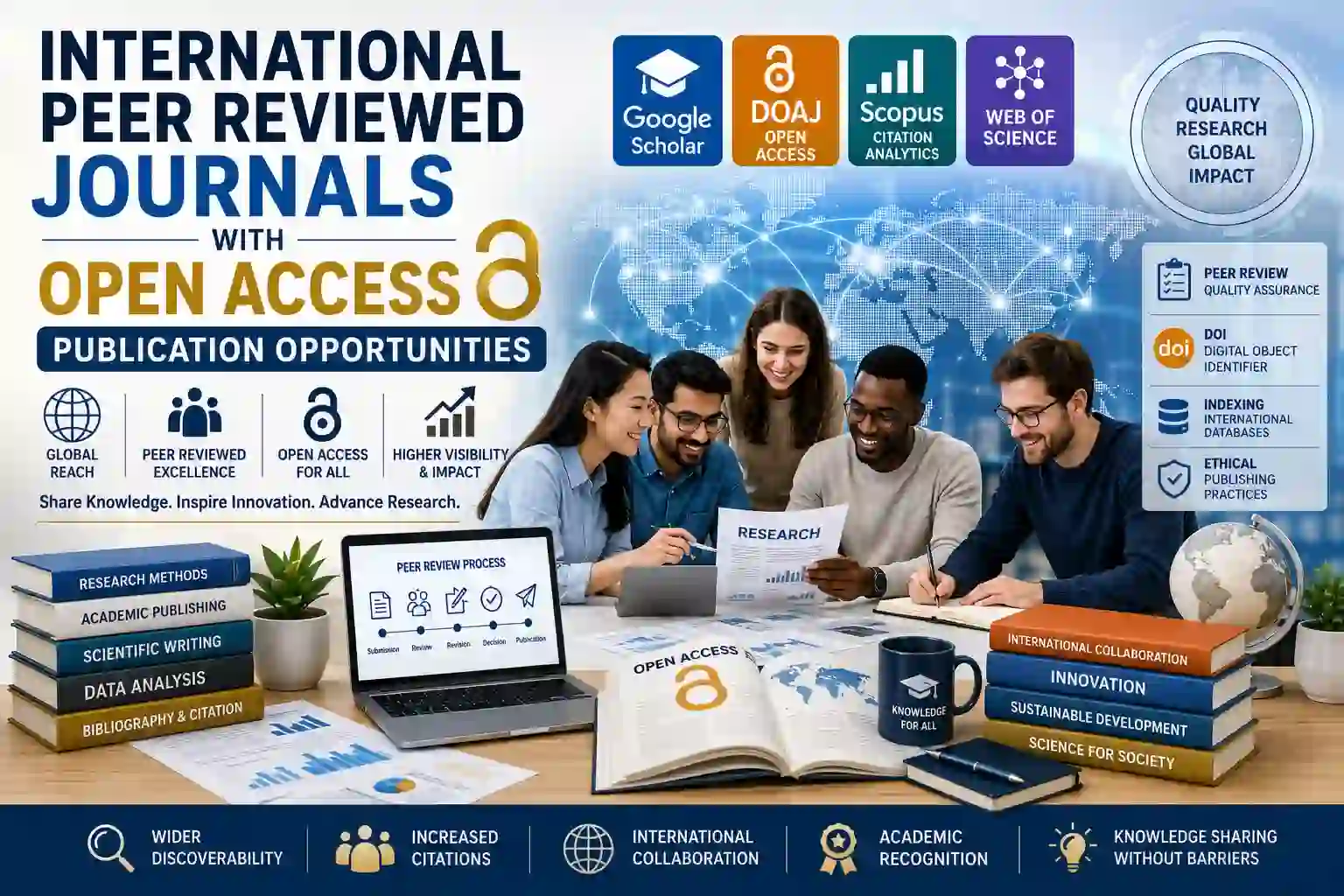
Create a premium, modern blog featured image in a 16:9 ratio (1920×1080) for the title "International Peer Reviewed Journals with Open Access Publication Opportunities". Show a diverse group of international researchers collaborating in a contemporary university library and digital research workspace. Include laptops displaying academic journal dashboards, peer-review documents, open-access symbols (without copyrighted logos), citation graphs, research papers, books, DOI icons, AI-assisted writing tools, global research network connections, graduation caps, digital libraries, and scientific publication elements. Add subtle visuals representing Google Scholar-style academic search, DOAJ-inspired Open Access concepts, Scopus-style citation analytics, and Web of Science research metrics without using copyrighted logos. Use blue, white, silver, and gold color tones with clean space for the blog title, realistic lighting, editorial-quality design, and a professional academic publishing aesthetic suitable for an international research journal website.
Final Thoughts
Publishing in a reputable international peer-reviewed Open Access journal is more than achieving acceptance—it is about contributing meaningful, ethical, and accessible knowledge to the global research community. By selecting journals carefully, preparing manuscripts thoroughly, and following best publishing practices, researchers can maximize the visibility, credibility, and lasting impact of their scholarly work.