ISSN (Online): 2833-7298
ISSN (Print): 2833-7301
Publication Fees: Free (Free up to 10 pages; USD 5 per additional page)

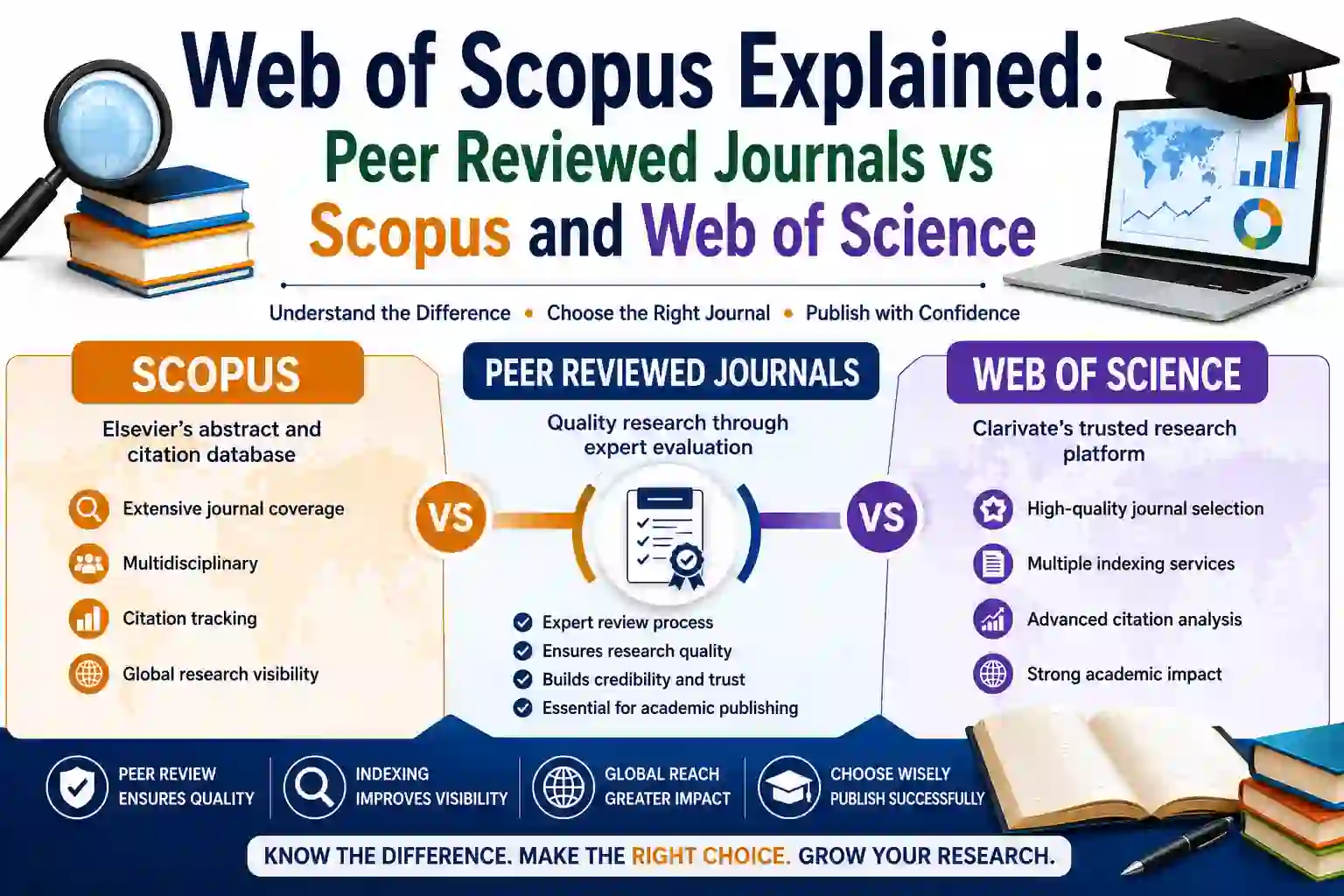
Many researchers search for “Web of Scopus” when they want to verify journals, understand academic indexing, or compare Scopus with Web of Science. However, “Web of Scopus” is not the official name of a separate academic database.
In most cases, the phrase refers to confusion between Scopus and Web of Science, two major research information and citation platforms. It can also be confused with the concept of a peer-reviewed journal, which describes a publishing and editorial process rather than an indexing database.
This guide explains what researchers usually mean by “Web of Scopus,” how Scopus differs from Web of Science, how both differ from peer-reviewed journals, and how authors can verify journal information before submitting a manuscript.
Researchers looking for information about multidisciplinary publishing can also visit the multidisciplinary research journal section.
“Web of Scopus” is not the official name of a separate database. It is a commonly used search phrase that may refer to Scopus, Web of Science, or the relationship between journal indexing and peer review.
Researchers may use this phrase when searching for:
Therefore, if you see the phrase “Web of Scopus” online, it is important to identify whether the information actually refers to Scopus or Web of Science.
No. “Web of Scopus” should not be treated as the official name of an independent indexing database.
For journal verification, researchers should use the official information provided by the relevant indexing service rather than relying on websites that use the phrase “Web of Scopus” without explaining what database they mean.
The distinction is simple:
| Term | Meaning |
|---|---|
| Scopus | An abstract and citation database |
| Web of Science | A research discovery and citation database platform |
| Peer-reviewed journal | A scholarly journal that evaluates submitted manuscripts through peer review or editorial processes |
| Web of Scopus | An informal or incorrect phrase, not the official name of a separate database |
Scopus is an abstract and citation database used for scholarly literature discovery, citation analysis and research evaluation.
Researchers may use Scopus-related information to:
Scopus coverage should always be verified using the official Scopus source information rather than relying only on a journal's own indexing claim.
Authors can also read the Scopus indexed journals guide for additional information about journal verification and selection.
Web of Science is a research information and citation platform that includes the Web of Science Core Collection and other resources.
The Web of Science Core Collection includes journal indexes such as:
Web of Science uses an editorial selection and curation process. Clarivate states that its journal evaluation process uses 28 criteria, including 24 quality criteria and four impact criteria. New journal submissions are evaluated first against the quality criteria.
Researchers can verify Web of Science coverage using the Master Journal List, which Clarivate identifies as the authoritative source for coverage information.
A peer-reviewed journal is a scholarly publication that uses peer review as part of its manuscript evaluation process.
Depending on the journal and discipline, submitted manuscripts may be evaluated for factors such as:
Peer review and indexing are therefore different concepts. Peer review describes how scholarly work is evaluated before publication, while indexing describes inclusion of publications or sources within a database.
Authors can learn more about evaluating peer-reviewed publications in the guide to peer-reviewed articles in scientific journals.
The following comparison helps explain the difference between these terms.
| Feature | Scopus | Web of Science | Peer-Reviewed Journal |
|---|---|---|---|
| What is it? | Abstract and citation database | Research discovery and citation platform | Scholarly publication |
| Main purpose | Literature discovery, source information and citation analysis | Literature discovery, citation analysis and curated indexing | Evaluation and publication of scholarly manuscripts |
| Is it a journal? | No | No | Yes |
| Can journals be peer reviewed? | Scopus coverage and peer review are separate concepts | Web of Science evaluation includes peer-review-related criteria | Yes |
| Citation information | Yes | Yes | Not necessarily |
| Journal verification | Use official Scopus source information | Use the Web of Science Master Journal List | Check the journal's stated peer-review policy and published practices |
| Same as “Web of Scopus”? | No | No | No |
Scopus and Web of Science are different platforms, although both are used for scholarly literature discovery, citation analysis and journal coverage.
| Aspect | Scopus | Web of Science |
|---|---|---|
| Platform/provider | Elsevier | Clarivate |
| Primary role | Abstract and citation database | Research discovery and citation database platform |
| Source selection | Uses a title/source selection process | Uses editorial evaluation and curation |
| Citation tracking | Yes | Yes |
| Journal metrics | Includes source metrics such as CiteScore | Includes journal-level metrics such as Journal Impact Factor for eligible journals |
| Journal coverage verification | Scopus source information | Web of Science Master Journal List |
Neither platform should be confused with the peer-review process itself. A database provides indexing, discovery and citation-related functions, while peer review is part of a journal's editorial process.
Researchers may confuse the two platforms because both are associated with academic literature, journal coverage and citation analysis.
Searches may combine terms such as:
This overlap can lead to informal phrases such as “Web of Scopus.” Understanding the official names and functions of each platform makes journal verification easier.
No. Scopus and peer review describe different parts of scholarly publishing.
A journal may have a peer-review policy, while indexing is a separate matter. Conversely, a database may contain information about journals, articles, conference proceedings or other scholarly materials.
When choosing a journal, authors should therefore check both the journal's peer-review policy and any indexing claims separately.
For a detailed explanation, see Scopus journals vs peer-reviewed journals.
Authors should not rely solely on a badge, logo or statement on a journal website claiming Scopus coverage. Verify the journal through the relevant official source.
Write down the journal's complete title and check the spelling carefully. Similar journal titles can create confusion.
Use the journal's ISSN as an additional identifier when checking its database record. An ISSN helps distinguish journals with similar or identical titles.
Check the journal using the official Scopus source information. Do not treat a third-party website's claim as proof of current coverage.
Indexing status can change over time. Authors should verify the current source information rather than relying on an old screenshot, certificate or archived claim.
Check whether the journal title, ISSN, publisher and other identifying information correspond to the journal you are considering.
Researchers who want a detailed verification process can read how to check whether a journal is Scopus indexed and peer reviewed.
For Web of Science, researchers should use the Master Journal List to check journal coverage.
Clarivate states that the Master Journal List provides information about Web of Science coverage and should be considered the authoritative source for coverage information.
Authors should check:
Do not assume that a journal is covered in SCIE, SSCI or AHCI merely because its website displays a general “Web of Science” claim. The specific collection matters.
Scopus indexing and peer review should not be treated as synonyms.
Authors should separately examine:
This approach gives authors a more complete picture than relying on an indexing claim alone.
Some journals or websites may make misleading indexing claims. Before submitting a manuscript, authors should independently verify important information.
Check:
For more guidance, read How to Avoid Fake Scopus Journals.
No. An ISSN identifies a serial publication; it does not by itself prove Scopus or Web of Science coverage.
Similarly, having a DOI does not by itself prove that a journal is indexed in a particular database.
Authors should treat ISSN, DOI, peer review and indexing as separate aspects of journal evaluation.
Indexing and peer review serve different purposes. A peer-review process provides a mechanism for evaluating manuscripts before publication, while indexing databases help researchers discover and analyze scholarly literature.
When selecting a journal, authors should therefore look beyond a single database claim and examine the journal's:
Authors can also read how to select the right peer-reviewed journal for publication.
Many contemporary research projects combine concepts from more than one academic discipline. Examples include:
For interdisciplinary manuscripts, a journal's scope is particularly important. Authors should confirm that the journal regularly publishes work relevant to the subject, methodology and academic community represented by their manuscript.
Researchers can learn more through the guide to peer-reviewed multidisciplinary research journals.
No single database label should be used as the only criterion when selecting a journal.
A practical journal evaluation should consider several factors together:
| Factor | What Authors Should Check |
|---|---|
| Scope | Does the journal publish research in your subject area? |
| Peer review | Is the review process clearly explained? |
| Indexing | Can claimed database coverage be independently verified? |
| Editorial board | Are editors and affiliations clearly identified? |
| Ethics | Are publication ethics and research integrity policies available? |
| Fees | Are submission, publication and other charges clearly stated? |
| Publication schedule | Does the journal follow its stated publication frequency or schedule? |
| Website information | Are journal policies, contact information and published content transparent? |
An ISSN is an identifier. It is not evidence that a journal is indexed in Scopus or Web of Science.
A logo or indexing badge on a journal website should not replace verification through the relevant database.
Peer review is part of the publication process. Indexing is database coverage. They should be evaluated separately.
Database coverage can change. Authors should verify current information before submission.
A journal's indexing status does not mean that every manuscript is suitable for that journal. The scope and recently published content should be examined before submission.
A simple checklist can help researchers reduce avoidable mistakes:
“Web of Scopus” is not the official name of a separate academic database. The phrase is commonly used when people are referring to Scopus, Web of Science, or journal indexing more generally.
No. Researchers should distinguish between the official Scopus database and the Web of Science platform rather than treating “Web of Scopus” as a separate database.
No. Scopus and Web of Science are different research information and citation platforms with their own coverage and evaluation systems.
No. Scopus is a database. Journals are publications that may be covered by indexing databases.
Scopus coverage and peer review are separate concepts. Authors should check the individual journal's peer-review policy rather than treating database coverage as a substitute for that evaluation.
Use the official Scopus source information and verify the journal's title and ISSN. Do not rely only on a journal's website, logo or third-party indexing list.
Use Clarivate's Web of Science Master Journal List and verify the journal's title, ISSN and relevant collection.
No. An ISSN identifies a serial publication. It does not by itself prove peer review, Scopus coverage, Web of Science coverage or journal quality.
Scopus is a research database, while a peer-reviewed journal is a scholarly publication that evaluates manuscripts through a peer-review process. They are different concepts.
“Web of Scopus” is not the official name of a separate academic database. Researchers using this phrase are usually looking for information about Scopus, Web of Science, or journals that are indexed and peer reviewed.
The key distinction is straightforward: Scopus and Web of Science are research information and citation platforms, while peer review is an editorial process used to evaluate scholarly manuscripts.
Before submitting a research paper, authors should verify journal coverage through the appropriate official database, examine the journal's peer-review process, confirm its scope, check publication ethics and review the current fee and author policies.
Understanding these differences can help researchers avoid misleading indexing claims and select journals that are appropriate for their research.
The International Journal of Multidisciplinary Research and Explorer (IJMRE) is a non-profit, open-access journal that does not charge any submission, processing, or publication fees. Donations made through this button are entirely voluntary and are used solely to support the maintenance, technical infrastructure, and continued accessibility of open research. Contributions do not influence editorial decisions or the peer review process in any way.