ISSN (Online): 2833-7298
ISSN (Print): 2833-7301
Publication Fees: Free (Free up to 10 pages; USD 5 per additional page)

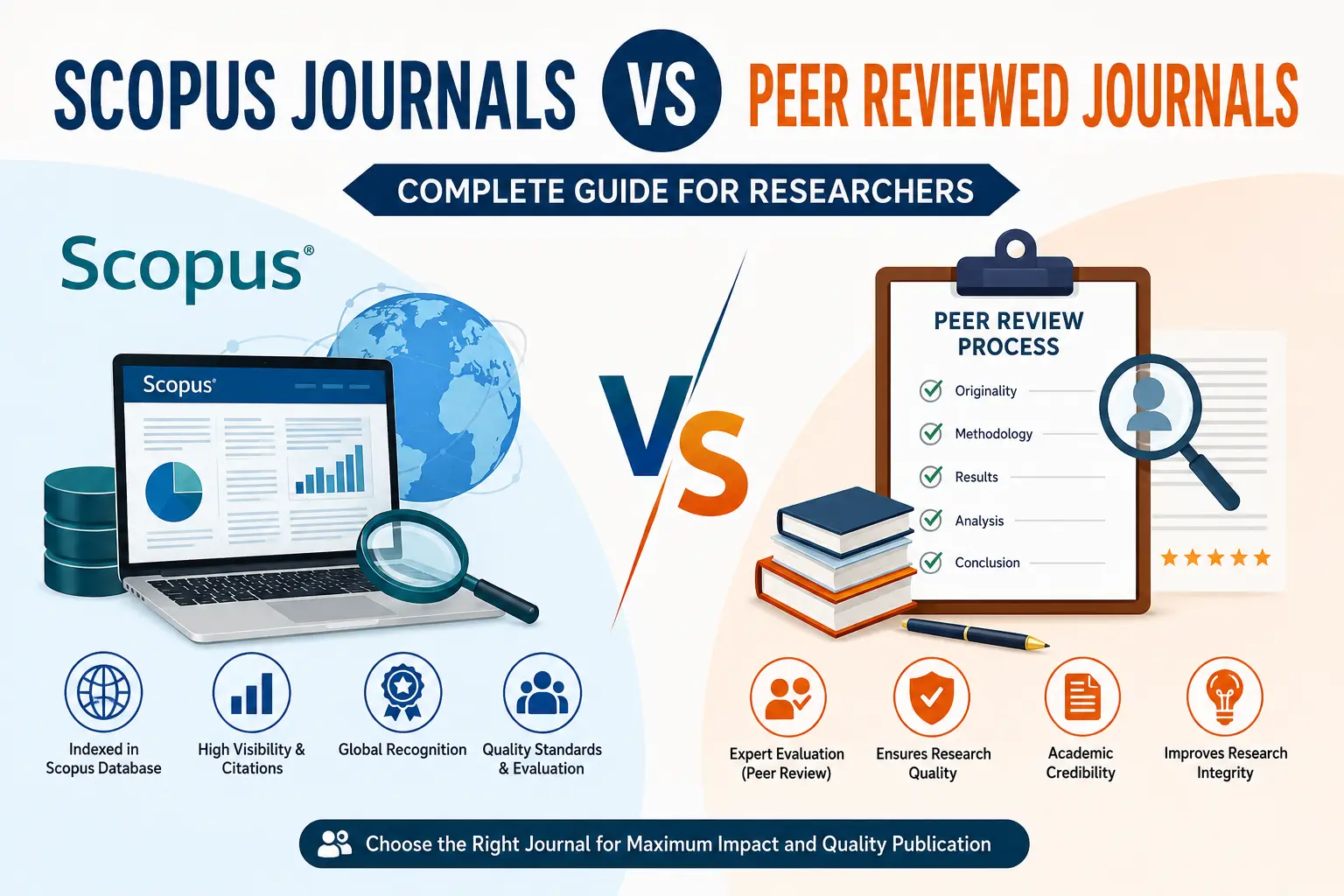
Researchers and academic authors often become confused between Scopus journals and peer reviewed journals. Many authors believe both terms have the same meaning, while others assume that every peer reviewed journal is indexed in Scopus. In reality, these terms represent different aspects of academic publishing.
Understanding the difference between Scopus indexed journals and peer reviewed journal articles is important before submitting a manuscript for publication. This guide explains the meaning, importance, benefits, and differences between these journal categories to help researchers select the right publication platform.
Researchers looking for a multidisciplinary research journal should understand how indexing and peer review impact research visibility and academic credibility.
Scopus journals are journals indexed in the Scopus database managed by Elsevier. Scopus is one of the largest abstract and citation databases for academic literature, including:
A journal included in the Scopus database journal list undergoes quality evaluation based on:
Researchers often prefer Scopus indexed journals because universities, institutions, and academic bodies recognize them for:
Many authors searching for peer reviewed articles also verify whether the journal is indexed in Scopus for better academic recognition.
A peer reviewed journal is a journal in which submitted manuscripts are evaluated by subject experts before publication. This process is known as peer review.
The peer review process helps ensure that:
Most high-quality peer reviewed research articles are checked by independent reviewers who provide recommendations regarding:
A peer reviewed academic journal may or may not be indexed in Scopus. Peer review focuses on research quality, while Scopus indexing focuses on database inclusion and journal performance.
Authors can also review examples of peer reviewed articles in scientific report journals to better understand publication standards and article formatting.
| Feature | Scopus Journals | Peer Reviewed Journals |
|---|---|---|
| Definition | Journals indexed in Scopus database | Journals using expert review process |
| Main Purpose | Indexing and international visibility | Research quality evaluation |
| Peer Review Required | Usually yes | Always yes |
| Database Inclusion | Included in Scopus database | May or may not be indexed |
| Academic Recognition | High international recognition | Quality-focused recognition |
| Citation Tracking | Available in Scopus | Depends on indexing |
| Research Visibility | Very high | Depends on journal indexing |
Most Scopus indexed journals follow a peer review process because Scopus requires journals to maintain academic publishing standards. However, authors should still verify the journal’s editorial policy before submission.
Some journals may claim to be peer reviewed without maintaining strong review practices. Therefore, researchers should always check:
Authors can verify a journal’s indexing status by checking the official Scopus journal list. Important details to verify include:
Always verify journal indexing from official sources because many fake journals falsely claim to be indexed in Scopus.
Before submitting your manuscript, it is also recommended to review the journal homepage and publication policies available on the IJMRE journal website.
Many researchers today prefer multidisciplinary journals because modern research often combines multiple academic fields such as:
A multidisciplinary peer reviewed journal provides broader research exposure and encourages collaboration across disciplines.
Researchers interested in multidisciplinary publication opportunities can explore the multidisciplinary research journal section for detailed submission information.
Before submitting your manuscript, consider the following factors:
Understanding the difference between Scopus journals and peer reviewed journals is essential for every researcher. A peer reviewed journal ensures research quality through expert evaluation, while a Scopus indexed journal provides international visibility and database recognition.
For better academic impact, authors should always select journals that maintain strong peer review standards and transparent publication ethics. Proper journal selection helps researchers improve research credibility, visibility, and academic growth.
If you are searching for a reliable platform for publishing peer reviewed journal articles, visit the IJMRE journal website to learn more about multidisciplinary research publication opportunities.
Scopus journals, peer reviewed journals, scopus indexed journals, peer reviewed journal articles, multidisciplinary journals, peer review, scopus database journal, scholarly articles, reviewed journal, academic journals, research publication, scopus journal list
The International Journal of Multidisciplinary Research and Explorer (IJMRE) is a non-profit, open-access journal that does not charge any submission, processing, or publication fees. Donations made through this button are entirely voluntary and are used solely to support the maintenance, technical infrastructure, and continued accessibility of open research. Contributions do not influence editorial decisions or the peer review process in any way.