ISSN (Online): 2833-7298
ISSN (Print): 2833-7301
Publication Fees: Free (Free up to 10 pages; USD 5 per additional page)

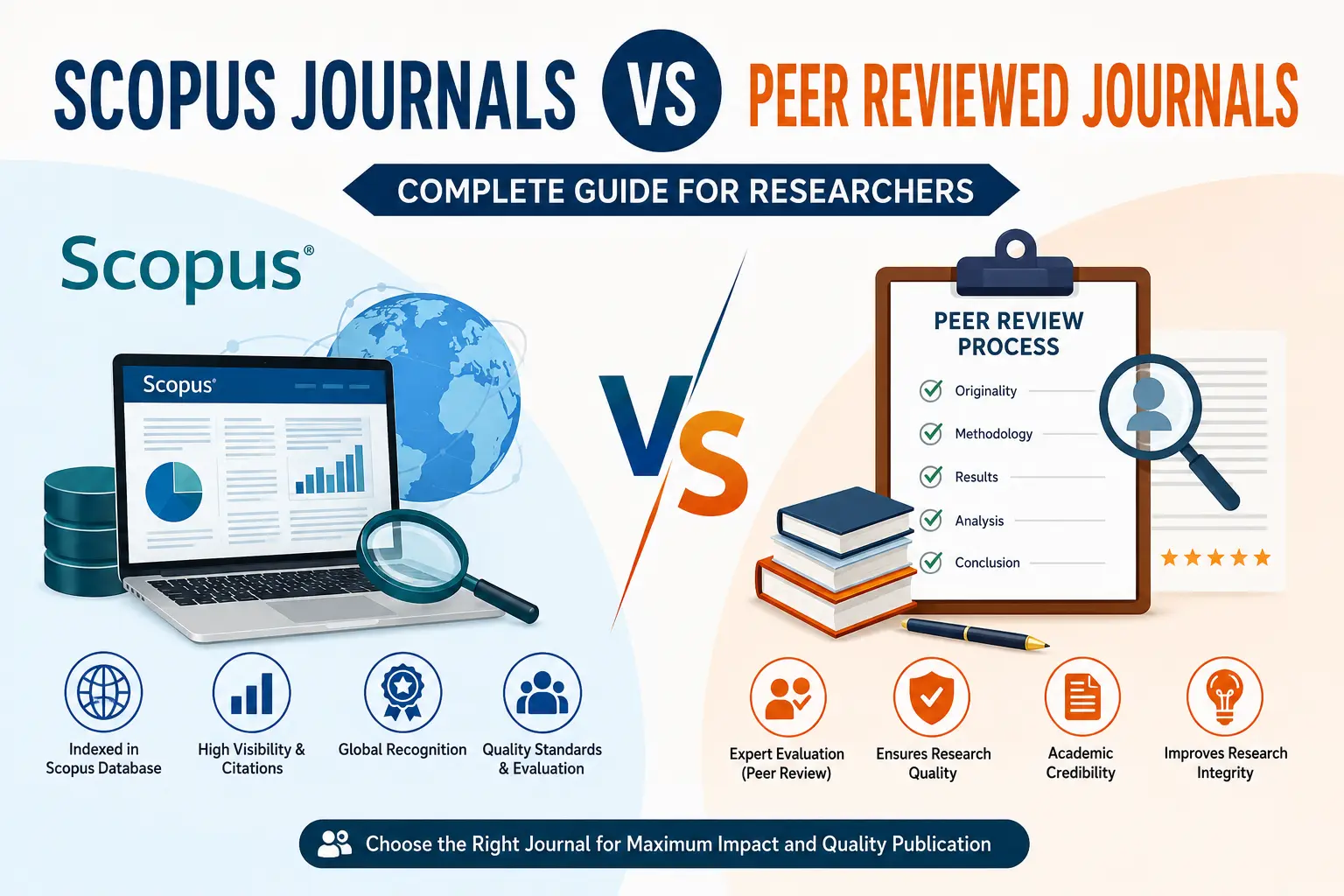
Choosing the right academic journal is an important decision for researchers, scholars and postgraduate students. Two terms that frequently create confusion are Scopus indexed journals and peer-reviewed journals. Although these terms are closely related, they do not have the same meaning.
A peer-reviewed journal evaluates submitted manuscripts through expert assessment before publication. Scopus indexing, on the other hand, means that a journal's publications are included in the Scopus abstract and citation database. A journal can follow a peer-review process without being indexed in Scopus.
Understanding the difference between Scopus indexed journals and peer-reviewed journals helps researchers evaluate publication opportunities, verify journal credentials and make informed submission decisions. This guide explains their meanings, differences, benefits and verification methods.
Researchers exploring publication opportunities can also learn about choosing a suitable multidisciplinary research journal based on subject scope, editorial policies and peer-review standards.
Scopus indexed journals are scholarly journals whose content is included in Scopus, an abstract and citation database managed by Elsevier. Scopus provides researchers with access to bibliographic information, abstracts, citation data and scholarly publications across numerous academic disciplines.
The Scopus database covers different types of scholarly content, including:
Journals seeking inclusion in Scopus undergo an evaluation process based on criteria such as journal policy, content quality, publication regularity, editorial practices, peer-review standards and contribution to the scholarly literature.
Researchers often consider Scopus indexed journals because their publications can benefit from:
However, Scopus indexing does not guarantee acceptance of a manuscript, a particular number of citations or eligibility for every university's academic requirements. Researchers should always check their institution's current publication guidelines.
A peer-reviewed journal is an academic publication that evaluates submitted manuscripts through assessment by qualified experts in the relevant subject area. This evaluation process is called peer review.
The purpose of peer review is to assess the academic quality, originality, methodology, relevance and presentation of research before publication.
Depending on the journal's editorial policy, reviewers may evaluate:
Following evaluation, reviewers generally recommend acceptance, minor revision, major revision or rejection. The journal's editor makes the final editorial decision after considering the reviews and the journal's publication policies.
A peer-reviewed academic journal may or may not be indexed in Scopus. Peer review describes the manuscript evaluation process, whereas Scopus indexing describes inclusion in a bibliographic and citation database.
Researchers can learn more about the publication process by reviewing examples of peer-reviewed research articles and examining the editorial and review policies of the journals they are considering.
The main difference between Scopus indexed journals and peer-reviewed journals is their purpose. Scopus indexing relates to database coverage and discoverability, while peer review relates to the academic evaluation of submitted manuscripts.
| Comparison Factor | Scopus Indexed Journals | Peer-Reviewed Journals |
|---|---|---|
| Meaning | Journals included in the Scopus database | Journals that evaluate manuscripts through expert review |
| Main Purpose | Abstracting, indexing and citation discovery | Assessing research quality and academic suitability |
| Peer Review | Scopus journal selection criteria require peer-reviewed content | Peer review is the defining evaluation process |
| Database Inclusion | Included in Scopus for specified coverage | May or may not be included in Scopus or another database |
| Citation Tracking | Scopus citation information is available for covered content | Depends on the journal's indexing and citation services |
| Research Visibility | Discoverable through Scopus searches | Depends on journal distribution and indexing services |
| Verification | Check the official Scopus Sources database | Examine the journal's peer-review policy and editorial practices |
| Academic Recognition | Depends on institutional and regulatory requirements | Depends on journal quality and institutional requirements |
No. Every peer-reviewed journal is not automatically indexed in Scopus. Peer review and database indexing are separate aspects of academic publishing.
Many journals conduct genuine peer review but are not included in Scopus. They may be new publications, regional academic journals or specialized journals that have not applied for or achieved inclusion in the database.
Scopus evaluates journals against its selection criteria before including them. Therefore, a journal's peer-review process alone does not establish its Scopus indexing status.
Researchers should verify indexing claims through the official database rather than relying only on statements displayed on a journal website.
Scopus journal selection criteria require journals to have a peer-review policy and follow recognized scholarly publishing practices. Therefore, peer review is an important requirement for journals seeking Scopus inclusion.
However, researchers should still examine the journal's current editorial policies and review procedures. Database inclusion should not replace an author's own assessment of a journal's publication ethics, editorial transparency and suitability for a particular manuscript.
Before submission, check:
Researchers should verify a journal's indexing status using the official Scopus Sources database. Do not rely exclusively on indexing logos, promotional claims or third-party journal lists.
Follow these steps:
For a more detailed explanation, read our guide on how to find and verify Scopus indexed journals.
Remember that a journal being listed in Scopus does not necessarily mean that every publication year is covered. Always examine the coverage information relevant to your submission.
Publishing in a journal covered by Scopus can offer several advantages, depending on the researcher's academic objectives and institutional requirements.
Nevertheless, authors should not select a journal based on indexing alone. Subject relevance, publication ethics, review quality and institutional eligibility are equally important considerations.
Peer-reviewed journals contribute to scholarly communication by providing an expert evaluation process before research is published.
However, peer review does not guarantee that every published finding is correct. Readers should continue to evaluate research methods, evidence and conclusions critically.
Modern research increasingly involves collaboration across multiple subject areas. For example, a project involving artificial intelligence in healthcare may combine computer science, engineering, data science and medical research.
Multidisciplinary journals provide publication opportunities for research that fits more than one academic discipline or contributes to interdisciplinary scholarship.
Common multidisciplinary research areas include:
When selecting a multidisciplinary journal, authors should confirm that its aims and scope cover their research topic and that its editorial and peer-review policies are clearly documented.
Researchers can explore the International Journal of Multidisciplinary Research and Explorer (IJMRE) to learn about its multidisciplinary scope, open-access publishing model, author guidelines and editorial policies. Authors should review the journal's current policies and submission requirements before submitting a manuscript.
Researchers should carefully evaluate journals before submitting their work. The following mistakes can lead to unsuitable publication decisions:
The right journal depends on your research topic, academic objectives, institutional requirements and preferred publication model. Before submitting your manuscript, consider the following checklist:
Taking time to evaluate these factors can help authors avoid misleading claims and select a suitable publication venue.
No. A Scopus indexed journal is included in the Scopus abstract and citation database, whereas a peer-reviewed journal evaluates submitted manuscripts through expert assessment. The two concepts are related but not identical.
Yes. A journal can follow a peer-review process without being indexed in Scopus. Indexing depends on database selection and coverage, not simply on whether the journal conducts peer review.
Scopus selection criteria require journals to have peer-reviewed content and an appropriate peer-review policy. Authors should still examine each journal's current editorial and review policies.
Search the journal title or ISSN in the official Scopus Sources database. Confirm its publisher, coverage years and current status before submitting your manuscript.
Peer review provides expert evaluation and can improve manuscripts, but it does not guarantee that every finding is correct. Research quality also depends on sound methods, reliable evidence and transparent reporting.
Both serve different purposes. Peer review evaluates research manuscripts, while Scopus indexing improves discoverability through a bibliographic and citation database. Researchers should consider both along with journal ethics, scope and institutional requirements.
Understanding the difference between Scopus indexed journals and peer-reviewed journals is essential when selecting a publication venue. Peer review is a process for evaluating research manuscripts, while Scopus indexing indicates that a journal's content is included in a major abstract and citation database.
A peer-reviewed journal is not automatically indexed in Scopus, and researchers should independently verify indexing claims using official sources. Before submission, carefully examine the journal's scope, editorial board, peer-review policy, publication ethics, fees and coverage information.
Researchers seeking a multidisciplinary publication platform can visit the International Journal of Multidisciplinary Research and Explorer (IJMRE) to review its publication scope, author guidelines and editorial policies before considering a submission.
Scopus indexed journals, Scopus journals vs peer-reviewed journals, peer-reviewed journals, difference between Scopus and peer review, Scopus indexing, peer-reviewed research articles, Scopus journal verification, Scopus Sources, academic journal selection, multidisciplinary research journals, research publication.
The International Journal of Multidisciplinary Research and Explorer (IJMRE) is a non-profit, open-access journal that does not charge any submission, processing, or publication fees. Donations made through this button are entirely voluntary and are used solely to support the maintenance, technical infrastructure, and continued accessibility of open research. Contributions do not influence editorial decisions or the peer review process in any way.