ISSN (Online): 2833-7298
ISSN (Print): 2833-7301
Publication Fees: Free (Free up to 10 pages; USD 5 per additional page)

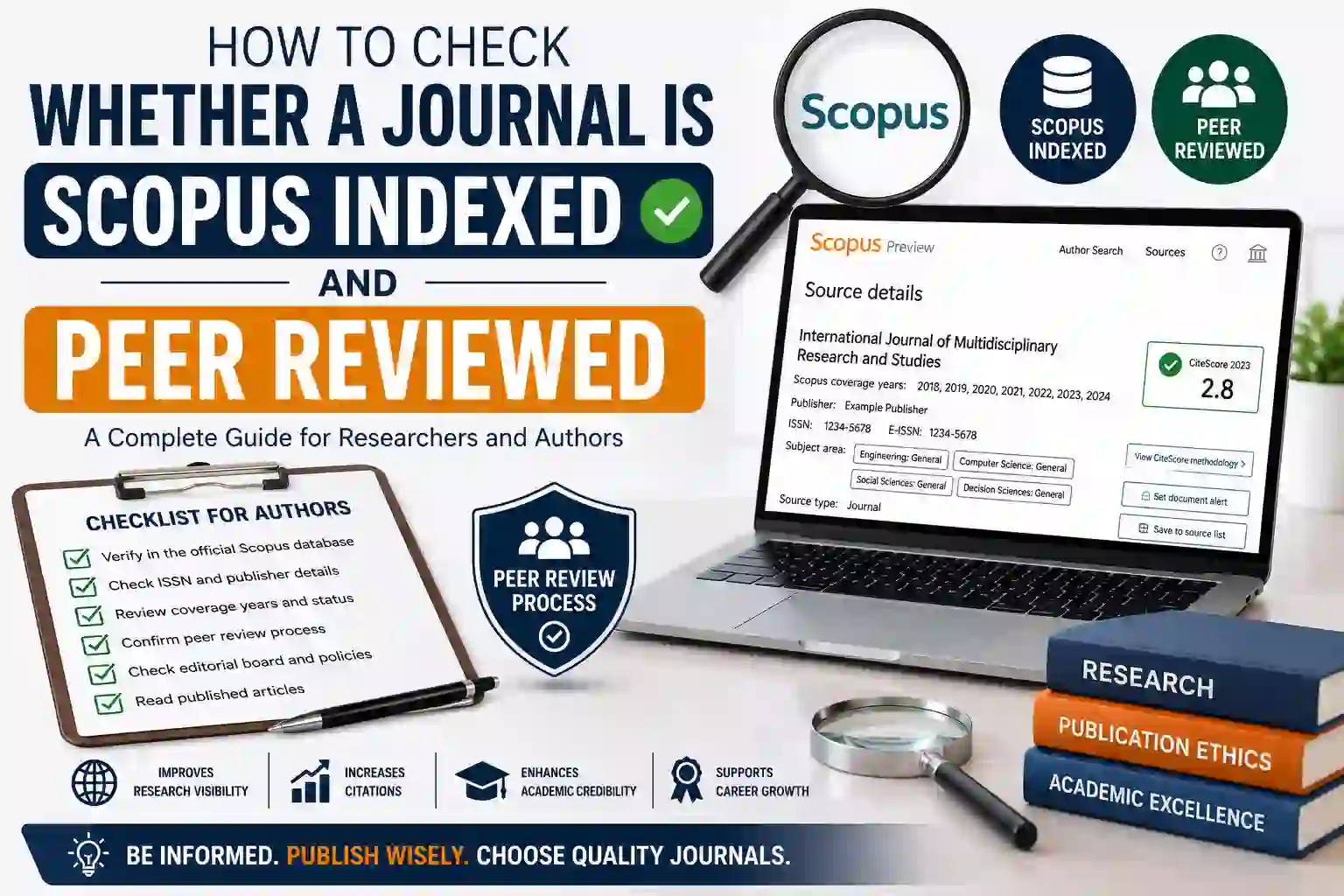
Selecting the right journal is one of the most important steps in academic publishing. Many researchers, PhD scholars, and academicians want to publish their research in Scopus indexed and peer reviewed journals because these journals provide better academic recognition, international visibility, and higher research credibility.
However, many fake or predatory journals falsely claim Scopus indexing and peer review services to attract authors. Because of this, researchers must carefully verify journal authenticity before manuscript submission.
This guide explains how to check whether a journal is genuinely Scopus indexed and peer reviewed, how to avoid fake journals, and how to select trusted publication platforms.
Researchers searching for reliable publication opportunities can also explore the multidisciplinary research journal section for academic publishing information and journal guidelines.
A Scopus indexed journal is a journal included in the Scopus database managed by Elsevier. Scopus is one of the world’s largest abstract and citation databases for peer reviewed research literature.
Scopus indexes:
Researchers often prefer Scopus indexed journals because they provide:
Authors can also read the detailed Scopus indexed journals guide to better understand indexing standards and verification methods.
A peer reviewed journal is a journal in which submitted manuscripts are evaluated by subject experts before publication.
The peer review process helps ensure:
Most trusted academic journals use:
Researchers can review examples of peer reviewed articles in scientific report journals to better understand professional publication standards.
Publishing in fake journals can negatively affect:
Many predatory journals falsely claim:
Researchers should always verify journal details carefully before submission.
The safest method is to search for the journal directly in the official Scopus source database.
Important details to verify:
Always verify the exact ISSN because fake journals sometimes copy names similar to genuine journals.
Some journals may have been discontinued from Scopus indexing. Researchers should confirm whether:
Check whether the publisher information shown on the journal website matches official indexing records.
Trusted journals clearly provide:
A genuine peer reviewed journal should clearly explain:
Review previously published articles to check:
Reliable journals usually have qualified editors and reviewers from recognized academic institutions.
Researchers should verify:
Researchers should avoid journals that:
Authors can also read the detailed guide on how to avoid fake Scopus journals.
| Feature | Scopus Indexed Journals | Peer Reviewed Journals |
|---|---|---|
| Main Purpose | Research indexing and visibility | Research quality evaluation |
| Managed By | Scopus database | Journal editorial system |
| Peer Review Required | Usually yes | Mandatory |
| Citation Tracking | Available | Depends on indexing |
| Research Visibility | High international visibility | Depends on journal indexing |
Researchers interested in this topic can also read the detailed comparison guide on Scopus journals vs peer reviewed journals.
Modern research increasingly combines multiple disciplines such as:
Because of this, many researchers now prefer multidisciplinary peer reviewed journals that support interdisciplinary research and broader academic collaboration.
Researchers can also explore:
Many researchers search for the term “Web of Scopus,” which is actually a common confusion between:
Authors can read the detailed explanation in Web of Scopus Explained: Peer Reviewed Journals vs Scopus and Web of Science.
Publishing in trusted journals improves:
Researchers can also read the guide on why authors should publish in top peer reviewed journals instead of fake Scopus journals.
The IJMRE journal website supports ethical academic publishing through:
Checking whether a journal is genuinely Scopus indexed and peer reviewed is essential for researchers who want reliable academic publication and long-term research credibility.
Researchers should always verify indexing claims, peer review transparency, editorial board authenticity, and publication ethics before manuscript submission.
Careful journal selection helps authors avoid predatory publishing and ensures that research receives proper academic recognition and visibility.
how to check Scopus indexed journals, peer reviewed journals, Scopus indexed journals, multidisciplinary journals, scholarly articles, academic publishing, research journals, peer review process, fake journals, research indexing
The International Journal of Multidisciplinary Research and Explorer (IJMRE) is a non-profit, open-access journal that does not charge any submission, processing, or publication fees. Donations made through this button are entirely voluntary and are used solely to support the maintenance, technical infrastructure, and continued accessibility of open research. Contributions do not influence editorial decisions or the peer review process in any way.