ISSN (Online): 2833-7298
ISSN (Print): 2833-7301
Publication Fees: Free (Free up to 10 pages; USD 5 per additional page)

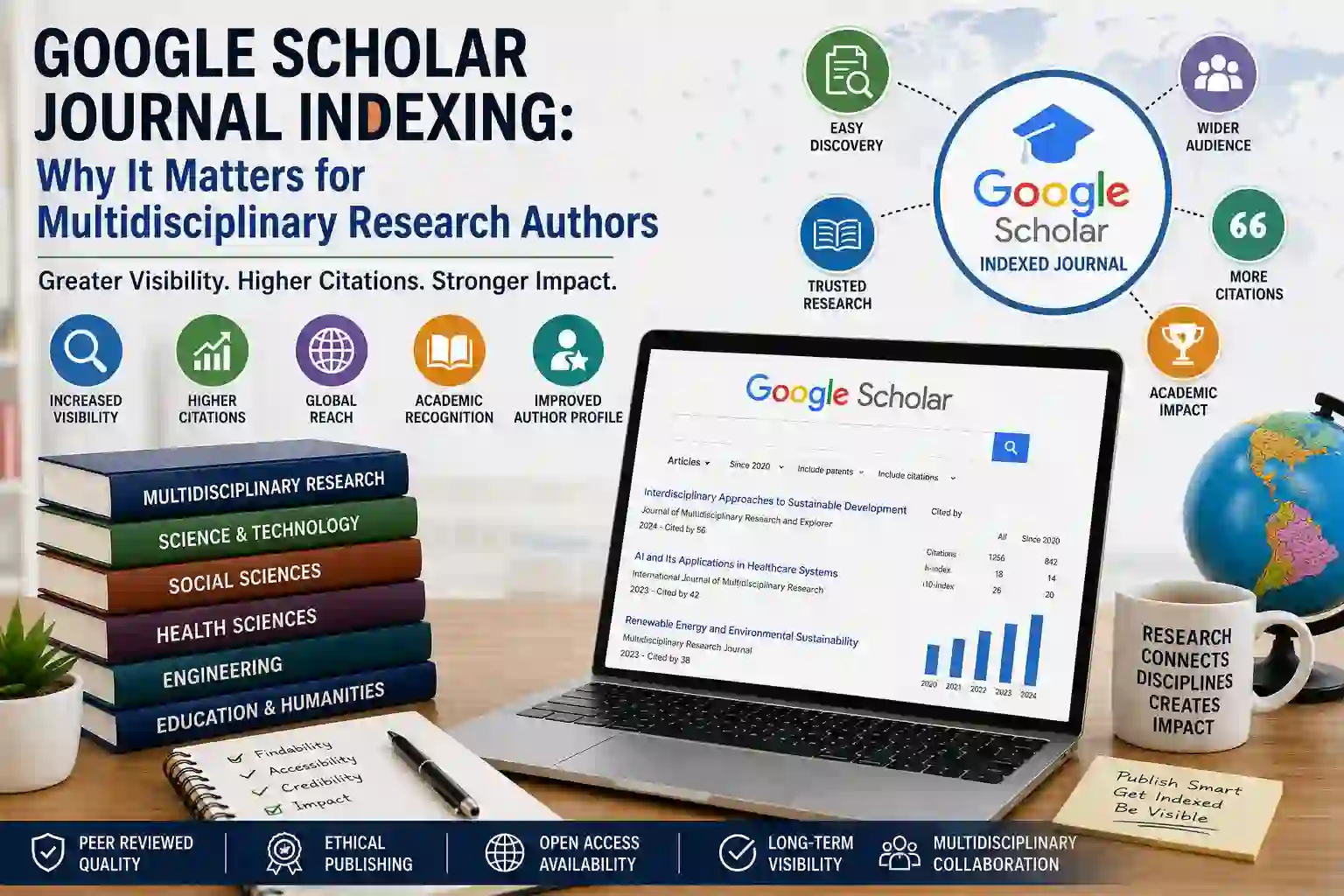
In the digital age of academic publishing, visibility is one of the most important factors influencing the impact of scholarly research. Regardless of how innovative or valuable a research paper may be, its academic contribution remains limited if researchers cannot easily find it. This is where Google Scholar Journal Indexing plays a critical role.
For authors publishing in an International Journal of Multidisciplinary Research, Google Scholar indexing can significantly enhance research visibility, citation opportunities, academic recognition, and global accessibility. Understanding how Google Scholar works and why journal indexing matters can help researchers make better publication decisions.
Google Scholar is a freely accessible academic search engine that indexes scholarly literature from journals, conference proceedings, theses, books, patents, and institutional repositories.
Unlike traditional search engines, Google Scholar focuses specifically on academic content, making it one of the most widely used tools for researchers, students, educators, and professionals worldwide.
When a journal is indexed by Google Scholar, its published articles become searchable and discoverable by millions of researchers across different disciplines.
Google Scholar Journal Indexing refers to the inclusion of a journal's scholarly content within Google's academic search database. Once indexed, individual articles can appear in Google Scholar search results when users search for relevant keywords, topics, authors, or research subjects.
This increased discoverability helps authors reach a broader academic audience and enhances the overall impact of their research publications.
Multidisciplinary research often attracts readers from diverse academic backgrounds. Unlike specialized research that targets a single field, multidisciplinary studies frequently appeal to scholars working across science, technology, social sciences, education, healthcare, engineering, and business.
Because of this broad audience, visibility becomes especially important.
Google Scholar allows researchers worldwide to find published articles quickly. Indexed papers are more likely to appear in search results related to the study's keywords, increasing readership and engagement.
Greater visibility often leads to higher citation opportunities. When researchers can easily locate and access an article, they are more likely to reference it in future studies.
Citations remain one of the most important indicators of research impact and scholarly influence.
Google Scholar provides access to researchers regardless of geographical location. Authors publishing in multidisciplinary journals can reach international audiences without requiring expensive database subscriptions.
Unlike social media promotion or temporary website traffic, Google Scholar indexing provides long-term discoverability. Research papers often remain searchable and accessible for many years after publication.
Researchers can create Google Scholar author profiles that automatically track citations, publications, h-index, and overall research impact.
A multidisciplinary research journal publishes articles from various academic disciplines. Because its readership spans multiple research communities, broad indexing becomes essential.
Google Scholar helps multidisciplinary journals:
Learn more about multidisciplinary publishing:
Why Researchers Prefer Multidisciplinary Journals for Publication
Many researchers mistakenly assume that Google Scholar and Scopus are equivalent. While both improve research visibility, they serve different purposes.
| Feature | Google Scholar | Scopus |
|---|---|---|
| Accessibility | Free | Subscription-Based |
| Coverage | Broad Academic Content | Selected Indexed Sources |
| Citation Tracking | Basic | Advanced Analytics |
| User Access | Anyone | Institutional Access |
For further reading:
Authors should understand that Google Scholar indexing does not automatically guarantee journal quality.
A journal may be indexed by Google Scholar while maintaining varying levels of editorial standards. Therefore, researchers should prioritize journals with a strong peer-review process.
Helpful resources:
Before submitting a manuscript, researchers should verify:
Recommended reading:
Predatory journals often advertise indexing claims to attract submissions. Researchers should carefully evaluate journals before submitting their work.
Read these important guides:
Open-access journals often benefit significantly from Google Scholar indexing because articles become more accessible to readers worldwide.
Researchers interested in open-access publishing should explore:
Modern research challenges increasingly require collaboration across multiple fields. Consequently, multidisciplinary journals have become essential publication platforms.
Further reading:
Many researchers now use AI-powered tools to improve academic writing, generate article summaries, and optimize manuscripts before submission.
Learn more:
Use of Generative AI in Research Paper Publication: Guide for Beginners
No. Google Scholar improves discoverability but does not replace peer review or editorial quality assessment.
Yes. Greater visibility often increases readership and citation opportunities.
Yes. Researchers worldwide can access Google Scholar without subscription fees.
Authors should consider Google Scholar indexing along with peer review, journal reputation, ethics, and editorial standards.
Because multidisciplinary studies target diverse academic communities, Google Scholar helps increase visibility across multiple disciplines and research fields.
Google Scholar Journal Indexing plays a vital role in modern scholarly communication. For multidisciplinary research authors, it enhances discoverability, expands global reach, improves citation potential, and increases academic visibility.
However, indexing should never be the sole factor when selecting a publication venue. Researchers should prioritize reputable peer-reviewed journals that maintain strong editorial standards, ethical publishing practices, and transparent policies.
If you are seeking a trusted platform for multidisciplinary publication, visit the International Journal of Multidisciplinary Research and Explorer (IJMRE) and explore its multidisciplinary research journal publication opportunities.
The International Journal of Multidisciplinary Research and Explorer (IJMRE) is a non-profit, open-access journal that does not charge any submission, processing, or publication fees. Donations made through this button are entirely voluntary and are used solely to support the maintenance, technical infrastructure, and continued accessibility of open research. Contributions do not influence editorial decisions or the peer review process in any way.