ISSN (Online): 2833-7298
ISSN (Print): 2833-7301
Publication Fees: Free (Free up to 10 pages; USD 5 per additional page)

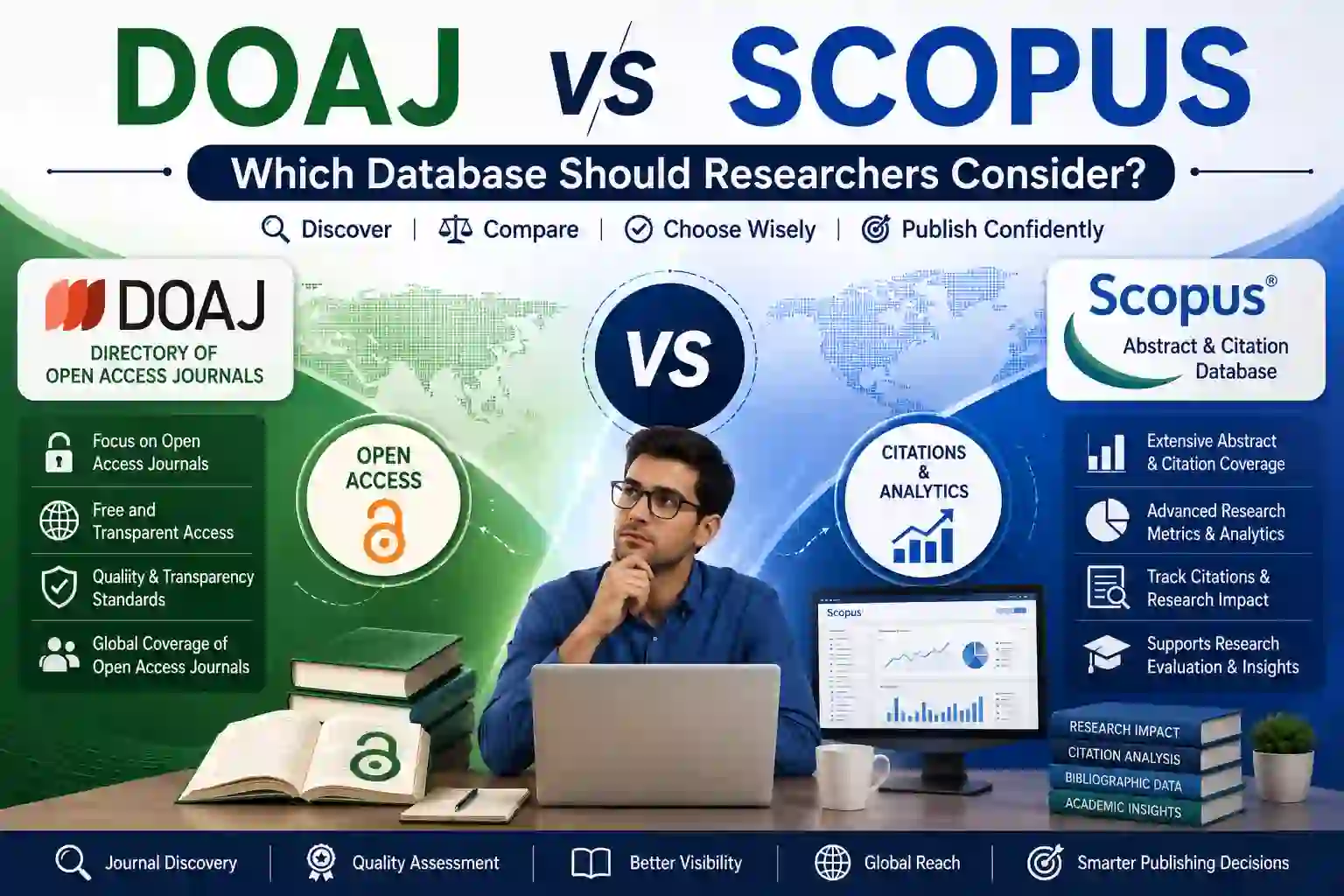
Researchers often encounter multiple journal databases when searching for suitable publication venues. Two of the most frequently discussed platforms are the Directory of Open Access Journals (DOAJ) and Scopus. While both are widely recognized in academic publishing, they serve different purposes and should not be viewed as direct competitors.
Understanding the differences between DOAJ and Scopus can help researchers choose appropriate journals, improve research visibility, and make informed publication decisions.
This guide explains the key differences, benefits, and considerations associated with both databases.
Researchers seeking publication opportunities may explore the International Journal of Multidisciplinary Research and Explorer (IJMRE).
The Directory of Open Access Journals (DOAJ) is a community-curated directory that indexes open access journals meeting specific quality and transparency standards. Its primary objective is to improve the visibility and accessibility of open access scholarly publishing.
DOAJ focuses on journals that provide immediate and unrestricted access to research articles.
To understand DOAJ in detail, read What Is DOAJ? Understanding the Directory of Open Access Journals.
Scopus is one of the world's largest abstract and citation databases for scholarly literature. It indexes journals, conference proceedings, books, and other research outputs across multiple disciplines.
Researchers frequently use Scopus to:
For additional information, see Scopus Indexed Journals Guide.
| Feature | DOAJ | Scopus |
|---|---|---|
| Primary Purpose | Open Access Journal Directory | Citation and Abstract Database |
| Coverage | Open Access Journals Only | Journals, Books, Conferences, and More |
| Citation Tracking | No | Yes |
| Research Analytics | Limited | Extensive |
| Open Access Focus | Primary Focus | Includes Both Open and Subscription Journals |
| Journal Discovery | Yes | Yes |
Yes. Many reputable journals are indexed in both DOAJ and Scopus.
A journal may:
Being included in one database does not automatically guarantee inclusion in the other because each platform has its own evaluation criteria and objectives.
DOAJ is particularly valuable for researchers seeking trustworthy open access journals.
Key advantages include:
Researchers can learn more through How DOAJ Helps Researchers Find Trusted Open Access Journals.
Scopus offers a broader research ecosystem that extends beyond journal discovery.
Advantages include:
Researchers often use Scopus to evaluate research influence and identify established publication venues.
Many researchers ask whether journals listed in DOAJ are peer reviewed. While many DOAJ journals use peer review, authors should always verify the journal's review process independently.
Understanding peer review is essential before publication. Learn more in How Peer Review Works in Academic Journals.
Additional insights are available in Peer Reviewed Articles in Scientific Report Journal.
A common misconception is that "Scopus indexed" and "peer reviewed" mean the same thing. In reality, indexing and peer review are different concepts.
Researchers should understand both concepts when selecting journals.
Read Scopus Journals vs Peer Reviewed Journals for a detailed comparison.
Although indexing is important, researchers should evaluate additional quality indicators before submission:
Authors can use How to Select the Right Peer Reviewed Journal for Publication to make informed decisions.
Before submitting a manuscript, researchers should independently verify any indexing claims made by journals.
Useful resources include:
The answer depends on the researcher's objective.
Rather than selecting one over the other, many successful researchers use both databases together to identify quality journals and assess publication impact.
DOAJ and Scopus play different but complementary roles in academic publishing. DOAJ helps researchers identify trustworthy open access journals, while Scopus provides extensive citation indexing and research analytics.
Researchers should focus on journal quality, peer review standards, editorial transparency, and relevance to their field rather than relying solely on indexing status. Using both DOAJ and Scopus can help authors make more informed publication decisions and maximize the reach of their research.
DOAJ vs Scopus, DOAJ database, Scopus indexed journals, open access journals, peer reviewed journals, research publication, academic publishing, journal indexing, DOAJ journals, Scopus database
The International Journal of Multidisciplinary Research and Explorer (IJMRE) is a non-profit, open-access journal that does not charge any submission, processing, or publication fees. Donations made through this button are entirely voluntary and are used solely to support the maintenance, technical infrastructure, and continued accessibility of open research. Contributions do not influence editorial decisions or the peer review process in any way.