Table of Contents
- Introduction
- Why Publication Matters
- Preparing Your Manuscript
- Selecting the Right Journal
- Understanding Peer Review
- Publication Ethics
- What is DOI?
- Journal Indexing
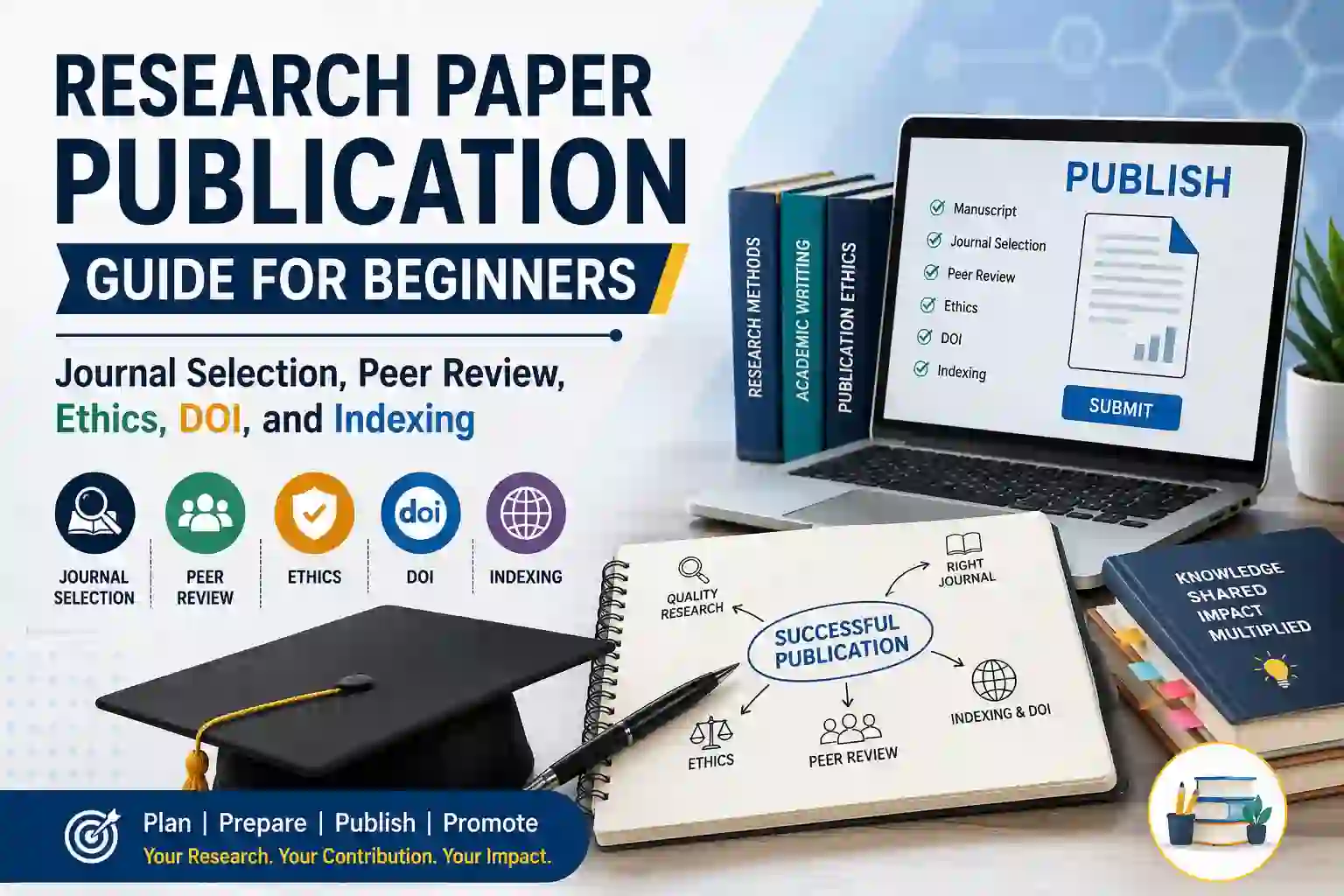
Research Paper Publication Guide for Beginners
Publishing your first research paper is an important milestone in every researcher's academic journey. Whether you are an undergraduate student, postgraduate scholar, PhD candidate, faculty member, or independent researcher, understanding the publication process significantly improves your chances of acceptance.
Many first-time authors believe that publishing is simply about writing a good manuscript. In reality, successful publication depends on selecting an appropriate journal, following ethical guidelines, understanding peer review, choosing reputable publishers, and ensuring that your work reaches the right audience through proper indexing.
This comprehensive guide explains each stage of research paper publication in simple language so beginners can confidently navigate the publication process.
Why Publishing Research is Important
Research publication is more than an academic requirement. It allows researchers to communicate new findings, contribute to scientific knowledge, build professional credibility, and establish collaboration opportunities with scholars around the world.
Publishing also helps:
- Increase academic recognition.
- Improve career opportunities.
- Support funding applications.
- Enhance institutional reputation.
- Create permanent scholarly records.
- Increase research visibility through citations.
Researchers aiming to publish multidisciplinary work should first understand how international journals evaluate submissions. Read our detailed guide:
Step 1 — Prepare a High-Quality Manuscript
Before selecting any journal, ensure your manuscript is complete, accurate, and professionally written.
Your manuscript should include:
- Clear title
- Structured abstract
- Relevant keywords
- Introduction
- Literature review
- Research methodology
- Results
- Discussion
- Conclusion
- References
Many journals reject manuscripts because authors ignore formatting instructions or submit incomplete work. Carefully read the journal’s author guidelines before submission.
Step 2 — Selecting the Right Journal
Journal selection is one of the most important decisions in academic publishing. A strong manuscript submitted to an unsuitable journal often receives immediate rejection.
Consider these factors:
- Scope of the journal
- Peer review policy
- Publication frequency
- Open access policy
- Publication ethics
- Indexing databases
- Acceptance timeline
- Author guidelines
Never select a journal solely because it promises rapid publication. Instead, evaluate the journal’s reputation, editorial standards, and transparency.
Helpful resources:
- How to Select the Right Peer Reviewed Journal for Publication
- Best Peer Reviewed Multidisciplinary Research Journals
- Multidisciplinary vs Specialized Journals
Should Beginners Choose Multidisciplinary Journals?
Multidisciplinary journals often provide broader readership and encourage interdisciplinary collaboration. They are particularly suitable for research that spans multiple domains such as Artificial Intelligence, Computer Science, Healthcare, Management, Environmental Science, and Education.
Learn more:
Why Researchers Prefer Multidisciplinary Journals
Step 3 — Understanding the Peer Review Process
Peer review is the quality assurance system of scholarly publishing. Independent experts evaluate your manuscript before publication.
The process generally includes:
- Editorial screening
- Reviewer assignment
- Technical evaluation
- Scientific evaluation
- Author revision
- Final editorial decision
Possible decisions:
- Accepted
- Minor Revision
- Major Revision
- Rejected
Receiving revision requests is completely normal. Most published papers undergo multiple revisions before acceptance.
Detailed explanation:
How Peer Review Works in Academic Journals
Single Blind vs Double Blind Review
| Feature | Single Blind | Double Blind |
|---|---|---|
| Reviewer knows author | Yes | No |
| Author knows reviewer | No | No |
| Bias Reduction | Moderate | High |
| Common Usage | Very Common | Increasing |
Step 4 — Publication Ethics
Publication ethics protect the integrity of scientific communication. Ethical publishing builds trust among researchers, institutions, journals, and readers.
Authors should avoid:
- Plagiarism
- Data fabrication
- Data falsification
- Duplicate publication
- Improper authorship
- Citation manipulation
- Image manipulation
- Simultaneous journal submission
Good publication ethics also include obtaining necessary approvals, accurately reporting methods and results, properly acknowledging contributors, and disclosing conflicts of interest.
Step 5 — Understanding DOI (Digital Object Identifier)
A Digital Object Identifier (DOI) is a permanent and unique alphanumeric identifier assigned to scholarly content such as research papers, conference proceedings, datasets, and book chapters. Unlike ordinary web links that may change over time, a DOI always points readers to the current location of a published article.
DOIs improve citation accuracy, increase article visibility, simplify referencing, and ensure long-term accessibility. Most reputable journals assign a DOI immediately after publication, allowing researchers worldwide to locate and cite the work reliably.
Benefits of a DOI
- Provides a permanent article link.
- Improves citation tracking.
- Enhances academic credibility.
- Supports indexing services.
- Makes articles easier to locate online.
- Facilitates integration with reference managers.
Before submitting your manuscript, verify whether the journal assigns DOIs to published articles, as this is an indicator of professional scholarly publishing practices.
Step 6 — Understanding Journal Indexing
Many beginners confuse journal indexing with journal quality. While indexing increases the visibility and accessibility of published research, researchers should understand that different databases have different inclusion criteria and purposes.
Common indexing databases include:
- Google Scholar
- DOAJ (Directory of Open Access Journals)
- Scopus
- Web of Science
- Crossref
Indexing helps your research become discoverable by scholars, universities, and institutions around the world. However, authors should avoid choosing journals solely based on claims of indexing without verification.
Useful Resources
- Complete Guide to Scopus Indexed Journals
- How to Check Whether a Journal is Scopus Indexed and Peer Reviewed
- Peer Reviewed Journals vs Scopus and Web of Science
- What is DOAJ?
- How to Search Journals in DOAJ
- How DOAJ Helps Researchers
- DOAJ vs Scopus
Step 7 — Beware of Fake Journals
Predatory or fake journals often promise unrealistically fast publication, guarantee acceptance, and lack transparent peer review. Publishing in such journals can damage your academic reputation and reduce the credibility of your research.
Warning Signs
- Guaranteed acceptance.
- Very short review period.
- No editorial transparency.
- False indexing claims.
- Poor website quality.
- Hidden publication policies.
Recommended Reading:
- How to Avoid Fake Scopus Journals
- Why Authors Should Publish in Top Peer Reviewed Journals Instead of Fake Scopus Journals
Step 8 — Responsible Use of Generative AI
Artificial Intelligence tools can assist researchers with language improvement, grammar correction, literature organization, and idea generation. However, AI should never replace original research, critical thinking, ethical writing, or proper citation practices.
Authors remain fully responsible for the originality, accuracy, and integrity of their manuscripts.
Learn more here:
Use of Generative AI in Research Paper Publication Guide for Beginners
Research Paper Submission Checklist
- ✔ Research fits the journal scope.
- ✔ Manuscript follows author guidelines.
- ✔ References are correctly formatted.
- ✔ Plagiarism has been checked.
- ✔ Figures and tables are properly labeled.
- ✔ Ethics approval obtained (if applicable).
- ✔ All authors approved the submission.
- ✔ Cover letter prepared.
- ✔ Conflict of interest disclosed.
- ✔ Funding information included.
Common Mistakes Beginners Should Avoid
- Submitting to an unsuitable journal.
- Ignoring formatting requirements.
- Using poor-quality references.
- Submitting without proofreading.
- Choosing journals only because they promise quick publication.
- Ignoring reviewer comments.
- Submitting the same manuscript to multiple journals simultaneously.
- Failing to verify journal indexing claims.
Frequently Asked Questions (FAQs)
How do I choose the right journal?
Select a journal whose scope closely matches your research topic, has transparent peer review, follows ethical publishing practices, and is indexed in reputable databases relevant to your field.
Is peer review mandatory?
Most reputable academic journals use peer review to evaluate the quality, originality, and validity of submitted manuscripts before publication.
Does every journal provide a DOI?
Many reputable journals assign DOIs, but not all do. Always check the journal's publication policies before submission.
Is Scopus the only indicator of quality?
No. Journal quality depends on editorial standards, peer review, ethics, relevance, and transparency—not solely on database indexing.
Can I use AI while writing my paper?
Yes, for assistance with language or organization, provided you follow the journal's AI policy and maintain originality, accuracy, and ethical responsibility.
Conclusion
Publishing your first research paper may seem challenging, but understanding each stage of the publication process makes the journey much smoother. By preparing a strong manuscript, selecting a suitable journal, respecting publication ethics, understanding peer review, verifying indexing claims, and avoiding predatory journals, you significantly improve your chances of successful publication.
Academic publishing is not simply about getting accepted—it is about contributing reliable knowledge that benefits the wider research community. Taking the time to understand the publication process will support your long-term academic growth and professional reputation.
Continue Your Publication Journey
Explore more expert resources from IJMRE to strengthen your publishing knowledge:
- IJMRE Home
- Multidisciplinary Research Journal
- Peer Reviewed Articles in Scientific Report Journal
- Scopus Journals vs Peer Reviewed Journals
- Best International Journals for Multidisciplinary Research
Author's Note: Successful publication begins with quality research, ethical practices, and selecting the right journal. Focus on producing valuable research rather than pursuing rapid publication.