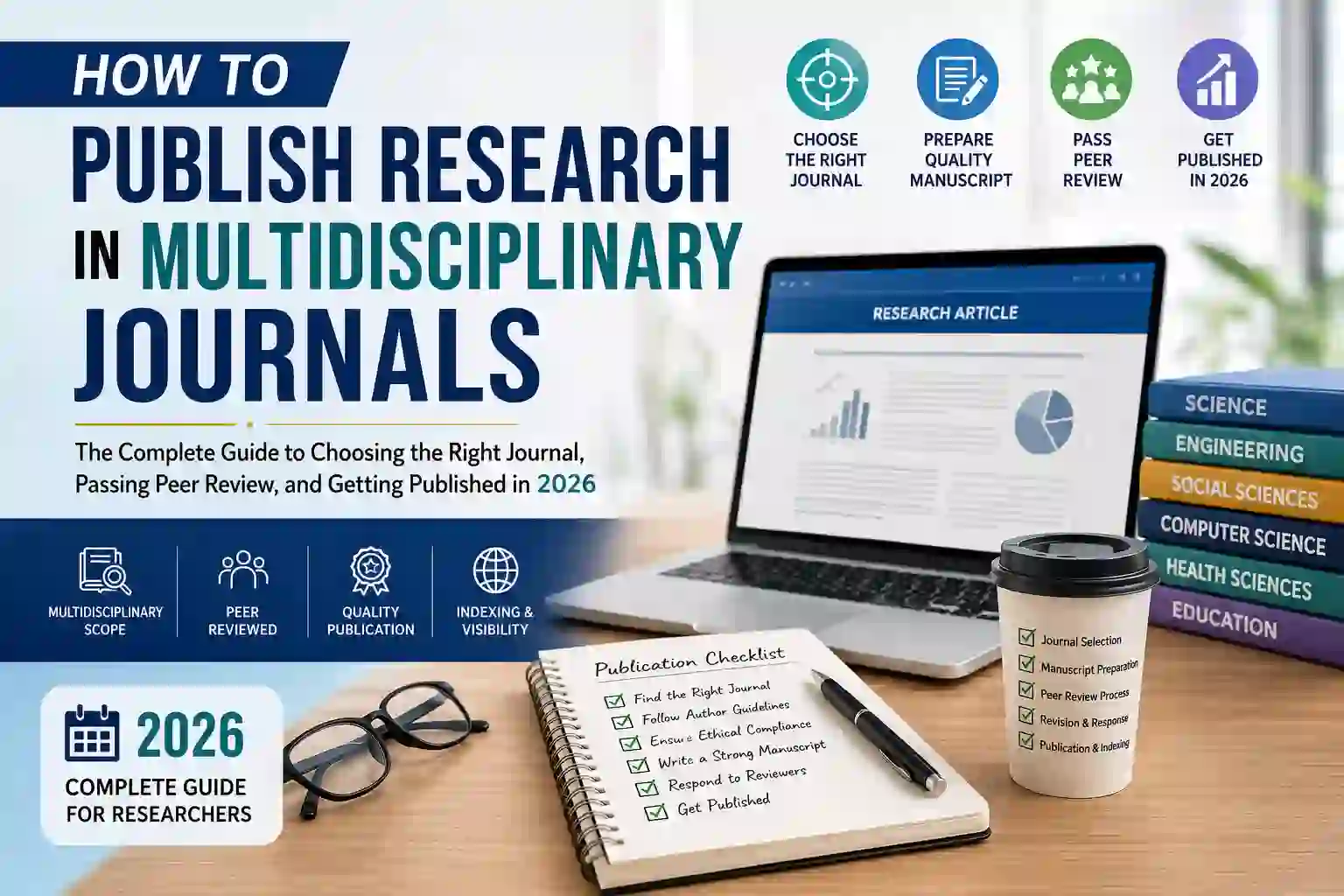
Publishing a research paper is not simply about finding a journal that accepts submissions. Successful publication requires selecting a journal whose scope matches your work, preparing a well-structured manuscript, following publication ethics, responding professionally to reviewers, and understanding how editorial decisions are made.
Many manuscripts are rejected before peer review—not because the research lacks quality, but because authors submit to an unsuitable journal, ignore author guidelines, or fail to explain the significance of their findings. This guide is designed to help researchers make informed decisions at every stage of the publication process.
Whether you are an undergraduate researcher, postgraduate student, PhD scholar, faculty member, or independent researcher, this article provides practical guidance based on accepted publishing practices rather than shortcuts or unrealistic promises.
Why This Guide Focuses on Decision-Making Instead of Shortcuts
Researchers often search for answers to questions such as:
- Which journal should I choose?
- How do I know whether a journal is trustworthy?
- What happens during peer review?
- Why do papers get rejected?
- Can multidisciplinary journals publish my research?
- Should I choose an open-access journal?
- How can I improve my chances of acceptance?
Instead of offering generic advice like "write a good paper" or "follow the guidelines," this guide explains how experienced editors evaluate submissions and provides practical frameworks you can use before submitting your manuscript.
What Are Multidisciplinary Journals?
Multidisciplinary journals publish research from multiple academic disciplines rather than focusing on a single subject area. These journals encourage knowledge sharing across fields and often publish research that combines methods, theories, or applications from different domains.
For example, a study on artificial intelligence applied to healthcare combines computer science, medicine, statistics, and ethics. A multidisciplinary journal is often a better fit than a journal dedicated exclusively to one discipline.
If you are new to multidisciplinary publishing, read our detailed guide:
- Understanding Multidisciplinary Research Journals
- Why Researchers Prefer Multidisciplinary Journals for Publication
- Multidisciplinary vs Specialized Journals: Which Is Better?
When Should You Choose a Multidisciplinary Journal?
| Research Situation | Recommended Choice |
|---|---|
| Your study combines two or more disciplines | Multidisciplinary Journal |
| Your audience includes researchers from different fields | Multidisciplinary Journal |
| Your work solves real-world interdisciplinary problems | Multidisciplinary Journal |
| Your paper focuses on one highly specialized topic | Specialized Journal may be more suitable |
| You want broader visibility across research communities | Multidisciplinary Journal |
Real-World Example
Imagine a research team develops an AI-powered irrigation system for sustainable agriculture.
Their study includes:
- Artificial Intelligence
- Machine Learning
- Internet of Things (IoT)
- Agricultural Engineering
- Environmental Science
- Data Analytics
Submitting this manuscript to a highly specialized agriculture journal may limit its audience, while submitting it to a computer science journal may overlook its agricultural contribution. A reputable multidisciplinary journal allows reviewers with expertise from multiple disciplines to evaluate the work more comprehensively.
Benefits of Publishing in Multidisciplinary Journals
| Benefit | Why It Matters |
|---|---|
| Broader readership | Researchers from different disciplines can discover your work. |
| Greater collaboration opportunities | Cross-disciplinary research often leads to new partnerships. |
| Higher practical impact | Research addressing real-world challenges reaches diverse audiences. |
| Better visibility | Articles can attract citations from multiple academic fields. |
| Support for emerging research areas | Topics like AI, sustainability, healthcare technology, and data science often span multiple disciplines. |
You can also explore our curated resources:
- Best Peer-Reviewed Multidisciplinary Research Journals
- Best International Journals for Multidisciplinary Research
- DOAJ, Google Scholar & Peer-Reviewed Multidisciplinary Journals
Decision Framework: Is Your Paper Ready for a Multidisciplinary Journal?
| Question | If Yes | If No |
|---|---|---|
| Does your research involve multiple disciplines? | Continue | Consider a specialized journal. |
| Does the paper solve a practical research problem? | Continue | Strengthen the contribution section. |
| Can researchers outside your field understand the paper? | Continue | Reduce discipline-specific jargon. |
| Does the journal scope clearly match your topic? | Submit | Find another journal. |
| Does your manuscript follow the author guidelines? | Ready for submission | Revise before submitting. |
Expert Recommendations Before You Submit
- Choose a journal based on scope—not only impact or popularity.
- Read at least five recently published articles from your target journal.
- Compare your manuscript with recently accepted papers.
- Check whether the journal provides transparent peer-review and publication policies.
- Verify indexing claims using official databases instead of relying solely on the journal website.
- Never submit the same manuscript to multiple journals simultaneously.
- Prepare all required documents before submission, including cover letter, declarations, and ethical approvals where applicable.
Common Misconceptions About Journal Publication
| Myth | Reality |
|---|---|
| Fast publication always means poor quality. | Some journals have efficient editorial workflows while maintaining rigorous peer review. |
| Higher publication fees guarantee acceptance. | Legitimate journals make editorial decisions independently of publication fees. |
| Google Scholar indexing alone proves journal quality. | Journal quality should be evaluated using multiple indicators, editorial policies, transparency, and peer-review practices. |
| Scopus indexing automatically means every article is high quality. | Quality depends on the individual manuscript and the journal's editorial standards. |
For a deeper understanding of journal quality indicators, explore these resources:
- Scopus Journals vs Peer-Reviewed Journals
- Scopus, Web of Science, and Peer Review Explained
- DOAJ vs Scopus: Which Database Should Researchers Consider?
What You Will Learn in the Next Sections
The next parts of this guide will provide detailed, step-by-step instructions on:
- Choosing the right journal using objective evaluation criteria.
- Identifying trustworthy journals and avoiding misleading publication claims.
- Preparing a manuscript that meets editorial expectations.
- Understanding how peer review works and how reviewers assess submissions.
- Responding effectively to reviewer comments.
- Improving publication success through ethical research and careful preparation.
Continue to Part 2: Choosing the Right Journal – A Practical Framework for Evaluating Scope, Indexing, Peer Review, Open Access, and Journal Credibility.
Step 1: Choose the Right Journal Before You Write the Final Draft
One of the biggest reasons manuscripts are rejected is journal mismatch. Editors often decline submissions within a few days—not because the research is poor, but because it falls outside the journal's scope or audience.
Experienced researchers frequently identify potential journals before completing the final manuscript. This allows them to structure the paper according to the journal's expectations, formatting requirements, article types, and readership.
Instead of asking "Which journal has the highest acceptance rate?", ask:
- Who needs to read my research?
- Which journal regularly publishes similar studies?
- Will my work contribute something new to that journal's readers?
A Practical Framework for Choosing the Right Journal
Rather than selecting a journal based on a single factor such as indexing or publication speed, evaluate multiple criteria together.
| Evaluation Factor | Questions to Ask | Importance |
|---|---|---|
| Journal Scope | Does my research clearly fit the journal's aims? | ★★★★★ |
| Peer Review | Is the journal transparent about its review process? | ★★★★★ |
| Editorial Board | Are editors experienced researchers? | ★★★★★ |
| Publication Ethics | Does the journal follow ethical publishing practices? | ★★★★★ |
| Indexing | Is the journal indexed where my institution requires? | ★★★★☆ |
| Publication Timeline | Does the review timeline meet my needs? | ★★★★☆ |
| Open Access Policy | Will readers have free access to my research? | ★★★★☆ |
| Publication Charges | Are fees clearly explained? | ★★★★☆ |
Decision Tree: Is This Journal Right for Your Paper?
| Question | If Yes | If No |
|---|---|---|
| Does your topic match the journal scope? | Proceed | Choose another journal. |
| Has the journal published similar papers recently? | Continue | Look for a better match. |
| Are peer-review policies publicly available? | Continue | Investigate further. |
| Are publication fees transparent? | Continue | Contact the editorial office before submitting. |
| Does the journal clearly explain copyright and licensing? | Ready to evaluate further. | Review carefully before submission. |
Evaluate the Journal Scope Carefully
The journal scope is one of the first things editors consider.
Even an excellent manuscript can be rejected immediately if it does not align with the journal's objectives.
Before submitting, ask yourself:
- Does my topic match the journal's published aims?
- Would regular readers find this research useful?
- Has the journal published similar work in the last two years?
- Does my manuscript contribute something new?
A practical resource for evaluating journal scope is available here:
- How to Select the Right Peer-Reviewed Journal for Publication
- Research Paper Publication Guide for Beginners
Read Recently Published Articles Before Submitting
A common mistake is evaluating a journal only by its homepage.
Instead, read several recently published articles and compare them with your own manuscript.
| Compare | Your Manuscript |
|---|---|
| Research Topic | Similar? |
| Research Methodology | Comparable? |
| Article Length | Within range? |
| Reference Style | Consistent? |
| Writing Style | Academic and objective? |
| Figures & Tables | Appropriate quality? |
Should You Choose an Open Access Journal?
Open access journals make research freely available to readers without subscription barriers.
For many researchers, open access improves accessibility, collaboration, and potential readership. However, authors should evaluate journals based on editorial quality—not simply because they are open access.
Helpful resources include:
- Understanding DOAJ
- How DOAJ Helps Researchers Find Trusted Journals
- DOAJ for Beginners
- How to Search Journals in DOAJ
Understanding Journal Indexing
Many authors mistakenly believe indexing alone determines journal quality.
In reality, indexing databases serve different purposes. Researchers should understand what each database represents before choosing a journal.
| Database | Primary Purpose | Should You Check It? |
|---|---|---|
| Google Scholar | Research discovery | Yes |
| DOAJ | Trusted open access journals | Yes |
| Scopus | Citation indexing | If required |
| Web of Science | Citation indexing | If required |
Learn more:
- Why Google Scholar Indexing Matters
- Complete Scopus Indexed Journals Guide
- Peer Review vs Scopus vs Web of Science
How to Verify a Journal's Claims
Never rely solely on statements published on the journal website.
Verify important claims independently using official sources whenever possible.
| Journal Claim | How to Verify |
|---|---|
| Peer Reviewed | Review editorial policies and peer-review process. |
| Open Access | Check licensing and accessibility. |
| Scopus Indexed | Verify through the official Scopus Sources list. |
| DOAJ Indexed | Search the official DOAJ database. |
| Editorial Board | Review editor profiles and affiliations. |
| Publication Ethics | Read ethical publishing policies. |
Related reading:
- How to Check Whether a Journal Is Scopus Indexed and Peer Reviewed
- How to Avoid Fake Scopus Journals
- Why Authors Should Publish in Trusted Peer-Reviewed Journals
Red Flags That Require Extra Caution
- Guaranteed acceptance.
- Guaranteed publication within a few days without review.
- Fake impact factor claims.
- No identifiable editorial board.
- No peer-review policy.
- No publication ethics statement.
- Poor website quality with copied content.
- Hidden publication fees.
- Mass promotional emails promising quick publication.
- Very broad scope with no editorial specialization.
Expert Tip: Create a Shortlist Instead of Choosing Only One Journal
Professional researchers often prepare a ranked list of three to five suitable journals before submission.
| Priority | Reason |
|---|---|
| First Choice | Best scope and readership. |
| Second Choice | Similar audience if the first journal declines. |
| Third Choice | Alternative journal with compatible scope. |
Having alternatives allows you to revise and resubmit efficiently if your manuscript is declined without compromising publication ethics.
Part 2 Action Checklist
Read the journal aims and scope carefully.Read at least five recently published articles.
Verify indexing claims independently.
Review publication ethics and peer-review policies.
Confirm licensing and copyright information.
Understand publication fees before submission.
Prepare a shortlist of suitable journals.
Ensure your manuscript fits the journal's audience.
Continue to Part 3: Preparing Your Manuscript for Submission—Writing, Formatting, Research Ethics, AI Disclosure, Cover Letters, and the Complete Pre-Submission Checklist.
Step 2: Prepare a Manuscript That Meets Editorial Expectations
After selecting a suitable journal, your next priority is preparing a manuscript that is clear, complete, ethically sound, and aligned with the journal's author guidelines. Editors and reviewers evaluate far more than the novelty of your research—they also assess organization, clarity, methodology, reporting quality, and compliance with publication standards.
A well-prepared manuscript improves readability and reduces avoidable delays during editorial screening.
Think Like an Editor Before You Submit
Before assigning reviewers, editors often ask a few practical questions:
- Does this manuscript fit the journal's scope?
- Is the research question clearly defined?
- Is the study original or does it simply repeat existing work?
- Are the methods appropriate and described in enough detail?
- Are the conclusions supported by the results?
- Does the manuscript follow the journal's formatting requirements?
- Are ethical declarations complete?
If the answer to several of these questions is "No," the paper may be rejected before external peer review.
The Standard Structure of a Research Article
| Section | Purpose |
|---|---|
| Title | Describe the research accurately and concisely. |
| Abstract | Summarize the problem, methods, results, and conclusions. |
| Keywords | Help readers and databases discover your article. |
| Introduction | Explain the research problem and objectives. |
| Literature Review | Provide context and identify knowledge gaps. |
| Methodology | Describe how the study was conducted. |
| Results | Present findings objectively. |
| Discussion | Interpret findings and compare with previous research. |
| Conclusion | Summarize contributions and future directions. |
| References | Cite all sources accurately. |
Writing a Strong Research Title
Your title is often the first element seen by editors, reviewers, indexing services, and potential readers. It should accurately reflect the content without exaggeration or unnecessary complexity.
Less Effective:
A Study on Artificial Intelligence
More Informative:
Machine Learning-Based Crop Disease Detection Using Deep Convolutional Neural Networks
Avoid vague phrases such as "A Study of," "Some Observations," or "An Analysis of" unless they genuinely add meaning.
Writing an Effective Abstract
Many editors decide whether to continue reading based on the abstract. A strong abstract briefly answers five questions:
| Question | Include |
|---|---|
| What problem did you study? | Research objective |
| Why is it important? | Background |
| How was it studied? | Methodology |
| What was discovered? | Key findings |
| Why do the results matter? | Practical implications |
Present Your Research Question Clearly
A manuscript without a clearly defined research question often appears unfocused.
Good research questions are:
- Specific
- Researchable
- Relevant
- Supported by evidence
- Clearly connected to the conclusions
Demonstrate the Novelty of Your Research
Editors are interested in understanding what your study contributes to existing knowledge.
Novelty does not necessarily require discovering an entirely new theory. It may involve:
- Applying an existing method in a new context.
- Improving an existing model.
- Comparing different techniques.
- Using a new dataset.
- Addressing an unanswered research question.
- Combining multiple disciplines to solve a practical problem.
Real-World Example
"We applied an existing machine learning algorithm."
Stronger Contribution"We compared five machine learning algorithms on an agricultural dataset collected under real farming conditions and identified the model that consistently achieved higher prediction accuracy with lower computational cost."
Follow the Journal's Author Guidelines Carefully
Every journal publishes detailed instructions for authors. Ignoring these guidelines creates unnecessary work for editors and may delay the review process.
| Requirement | Check Before Submission |
|---|---|
| Reference Style | APA, IEEE, Vancouver, etc. |
| Article Length | Within journal limits. |
| Figures | High resolution. |
| Tables | Clearly formatted. |
| Keywords | Within required number. |
| Abstract Length | Matches journal requirements. |
| Author Information | Complete and accurate. |
Research Ethics Are Not Optional
Ethical publishing protects the integrity of scholarly communication. Journals increasingly verify ethical compliance before sending manuscripts for review.
Authors should ensure:
- Original work is submitted.
- All contributors meet authorship criteria.
- Data are reported honestly.
- Conflicts of interest are disclosed.
- Required ethical approvals are obtained.
- Sources are cited appropriately.
- No duplicate or simultaneous submissions are made.
Using Generative AI Responsibly
Many researchers now use generative AI tools to improve grammar, summarize literature, or refine writing. However, authors remain fully responsible for the accuracy, originality, citations, and integrity of their work.
Before using AI tools:
- Review the journal's AI policy.
- Disclose AI assistance if required.
- Verify every factual statement.
- Never fabricate references or data.
- Do not list AI as an author.
Related resources:
Prepare a Professional Cover Letter
A concise cover letter helps editors quickly understand why your manuscript is appropriate for their journal.
A typical cover letter includes:
- Article title.
- Brief description of the research.
- Reason the manuscript fits the journal.
- Statement confirming originality.
- Confirmation that the manuscript is not under consideration elsewhere.
- Conflict of interest declaration (if applicable).
Avoid copying the abstract into your cover letter. Instead, explain why the journal's readers will benefit from your research.
Common Mistakes That Delay Review
| Mistake | Possible Consequence |
|---|---|
| Ignoring author guidelines | Editorial delays or desk rejection. |
| Poor English or unclear writing | Difficult peer review. |
| Incomplete references | Revision requests. |
| Low-quality figures | Formatting revisions. |
| Missing ethical statements | Submission returned to authors. |
| Unsupported conclusions | Reviewer criticism. |
Pre-Submission Checklist
Recommended Reading Before Submission
- How Peer Review Works in Academic Journals
- Understanding Peer-Reviewed Articles
- Complete Research Paper Publication Guide
- International Platforms for Publishing Multidisciplinary Research
Key Takeaways from Part 3
- Write for clarity before complexity.
- Follow every instruction in the journal's author guidelines.
- Demonstrate your study's originality and significance.
- Ensure all ethical and authorship requirements are met.
- Use AI responsibly and according to journal policies.
- Complete a thorough pre-submission review to minimize avoidable revisions.
Continue to Part 4: Understanding Peer Review—How Editors Select Reviewers, Why Papers Are Rejected, How to Respond to Reviewer Comments, and Strategies for Improving Your Chances of Acceptance.
Step 2: Prepare a Manuscript That Meets Editorial Expectations
After selecting a suitable journal, your next priority is preparing a manuscript that is clear, complete, ethically sound, and aligned with the journal's author guidelines. Editors and reviewers evaluate far more than the novelty of your research—they also assess organization, clarity, methodology, reporting quality, and compliance with publication standards.
A well-prepared manuscript improves readability and reduces avoidable delays during editorial screening.
Think Like an Editor Before You Submit
Before assigning reviewers, editors often ask a few practical questions:
- Does this manuscript fit the journal's scope?
- Is the research question clearly defined?
- Is the study original or does it simply repeat existing work?
- Are the methods appropriate and described in enough detail?
- Are the conclusions supported by the results?
- Does the manuscript follow the journal's formatting requirements?
- Are ethical declarations complete?
If the answer to several of these questions is "No," the paper may be rejected before external peer review.
The Standard Structure of a Research Article
| Section | Purpose |
|---|---|
| Title | Describe the research accurately and concisely. |
| Abstract | Summarize the problem, methods, results, and conclusions. |
| Keywords | Help readers and databases discover your article. |
| Introduction | Explain the research problem and objectives. |
| Literature Review | Provide context and identify knowledge gaps. |
| Methodology | Describe how the study was conducted. |
| Results | Present findings objectively. |
| Discussion | Interpret findings and compare with previous research. |
| Conclusion | Summarize contributions and future directions. |
| References | Cite all sources accurately. |
Writing a Strong Research Title
Your title is often the first element seen by editors, reviewers, indexing services, and potential readers. It should accurately reflect the content without exaggeration or unnecessary complexity.
Less Effective:
A Study on Artificial Intelligence
More Informative:
Machine Learning-Based Crop Disease Detection Using Deep Convolutional Neural Networks
Avoid vague phrases such as "A Study of," "Some Observations," or "An Analysis of" unless they genuinely add meaning.
Writing an Effective Abstract
Many editors decide whether to continue reading based on the abstract. A strong abstract briefly answers five questions:
| Question | Include |
|---|---|
| What problem did you study? | Research objective |
| Why is it important? | Background |
| How was it studied? | Methodology |
| What was discovered? | Key findings |
| Why do the results matter? | Practical implications |
Present Your Research Question Clearly
A manuscript without a clearly defined research question often appears unfocused.
Good research questions are:
- Specific
- Researchable
- Relevant
- Supported by evidence
- Clearly connected to the conclusions
Demonstrate the Novelty of Your Research
Editors are interested in understanding what your study contributes to existing knowledge.
Novelty does not necessarily require discovering an entirely new theory. It may involve:
- Applying an existing method in a new context.
- Improving an existing model.
- Comparing different techniques.
- Using a new dataset.
- Addressing an unanswered research question.
- Combining multiple disciplines to solve a practical problem.
Real-World Example
"We applied an existing machine learning algorithm."
Stronger Contribution"We compared five machine learning algorithms on an agricultural dataset collected under real farming conditions and identified the model that consistently achieved higher prediction accuracy with lower computational cost."
Follow the Journal's Author Guidelines Carefully
Every journal publishes detailed instructions for authors. Ignoring these guidelines creates unnecessary work for editors and may delay the review process.
| Requirement | Check Before Submission |
|---|---|
| Reference Style | APA, IEEE, Vancouver, etc. |
| Article Length | Within journal limits. |
| Figures | High resolution. |
| Tables | Clearly formatted. |
| Keywords | Within required number. |
| Abstract Length | Matches journal requirements. |
| Author Information | Complete and accurate. |
Research Ethics Are Not Optional
Ethical publishing protects the integrity of scholarly communication. Journals increasingly verify ethical compliance before sending manuscripts for review.
Authors should ensure:
- Original work is submitted.
- All contributors meet authorship criteria.
- Data are reported honestly.
- Conflicts of interest are disclosed.
- Required ethical approvals are obtained.
- Sources are cited appropriately.
- No duplicate or simultaneous submissions are made.
Using Generative AI Responsibly
Many researchers now use generative AI tools to improve grammar, summarize literature, or refine writing. However, authors remain fully responsible for the accuracy, originality, citations, and integrity of their work.
Before using AI tools:
- Review the journal's AI policy.
- Disclose AI assistance if required.
- Verify every factual statement.
- Never fabricate references or data.
- Do not list AI as an author.
Related resources:
Prepare a Professional Cover Letter
A concise cover letter helps editors quickly understand why your manuscript is appropriate for their journal.
A typical cover letter includes:
- Article title.
- Brief description of the research.
- Reason the manuscript fits the journal.
- Statement confirming originality.
- Confirmation that the manuscript is not under consideration elsewhere.
- Conflict of interest declaration (if applicable).
Avoid copying the abstract into your cover letter. Instead, explain why the journal's readers will benefit from your research.
Common Mistakes That Delay Review
| Mistake | Possible Consequence |
|---|---|
| Ignoring author guidelines | Editorial delays or desk rejection. |
| Poor English or unclear writing | Difficult peer review. |
| Incomplete references | Revision requests. |
| Low-quality figures | Formatting revisions. |
| Missing ethical statements | Submission returned to authors. |
| Unsupported conclusions | Reviewer criticism. |
Pre-Submission Checklist
Recommended Reading Before Submission
- How Peer Review Works in Academic Journals
- Understanding Peer-Reviewed Articles
- Complete Research Paper Publication Guide
- International Platforms for Publishing Multidisciplinary Research
Key Takeaways from Part 3
- Write for clarity before complexity.
- Follow every instruction in the journal's author guidelines.
- Demonstrate your study's originality and significance.
- Ensure all ethical and authorship requirements are met.
- Use AI responsibly and according to journal policies.
- Complete a thorough pre-submission review to minimize avoidable revisions.
Continue to Part 4: Understanding Peer Review—How Editors Select Reviewers, Why Papers Are Rejected, How to Respond to Reviewer Comments, and Strategies for Improving Your Chances of Acceptance.
Step 3: Understanding Peer Review and How to Improve Your Chances of Acceptance
After your manuscript passes the initial editorial screening, it typically enters the peer review stage. Peer review is a quality assurance process in which independent experts evaluate the scientific quality, originality, methodology, clarity, and overall contribution of your research before publication.
Many authors think peer review is designed to find mistakes. In reality, its primary purpose is to improve research quality while helping editors make informed publication decisions.
How the Peer Review Process Usually Works
| Stage | What Happens |
|---|---|
| 1. Initial Editorial Screening | The editor checks scope, formatting, originality, ethics, and overall suitability. |
| 2. Reviewer Selection | Experts with relevant subject knowledge are invited to review the manuscript. |
| 3. Independent Review | Reviewers evaluate the study and provide constructive feedback. |
| 4. Editorial Decision | The editor considers reviewer recommendations before making a decision. |
| 5. Author Revision | Authors revise the manuscript and prepare a detailed response. |
| 6. Final Decision | The manuscript is accepted, requires further revision, or is rejected. |
To learn more about the review process, read:
What Editors Evaluate Before Sending Your Paper to Reviewers
Editors act as the first quality filter. Before investing reviewers' time, they determine whether your manuscript meets the journal's minimum requirements.
| Editorial Check | Why It Matters |
|---|---|
| Journal Scope | Ensures the manuscript is relevant to readers. |
| Originality | Confirms the work contributes new knowledge. |
| Writing Quality | Allows reviewers to evaluate the research efficiently. |
| Research Ethics | Protects the integrity of scholarly publishing. |
| Formatting | Reduces unnecessary editorial corrections. |
| Completeness | Ensures all required sections are included. |
A strong manuscript is not judged solely by interesting results. Editors also consider whether the research is presented clearly, ethically, and according to the journal's submission requirements.
Different Types of Peer Review
| Review Type | Characteristics |
|---|---|
| Single-Blind Review | Reviewers know the authors' identities, but authors do not know the reviewers. |
| Double-Blind Review | Neither authors nor reviewers know each other's identities. |
| Open Peer Review | Reviewer identities may be disclosed, promoting transparency. |
Each review model has advantages and limitations. Authors should understand the journal's review policy before submission.
What Reviewers Usually Evaluate
| Evaluation Area | Typical Questions |
|---|---|
| Originality | Does the study add meaningful knowledge? |
| Research Design | Are the methods appropriate? |
| Data Analysis | Are results supported by evidence? |
| Discussion | Are findings interpreted appropriately? |
| References | Are relevant studies cited accurately? |
| Writing | Is the manuscript clear and well organized? |
| Contribution | Will readers benefit from this research? |
Possible Editorial Decisions
| Decision | Meaning | Recommended Action |
|---|---|---|
| Accept | No further revisions required. | Proceed with publication. |
| Minor Revision | Small improvements are needed. | Revise carefully and respond to every comment. |
| Major Revision | Substantial changes are required. | Address all reviewer concerns thoroughly. |
| Reject with Resubmission Encouraged | The study has potential but requires extensive revision. | Revise comprehensively before submitting again. |
| Reject | The manuscript is not suitable or does not meet publication standards. | Review feedback objectively and identify a more suitable journal if appropriate. |
How to Respond to Reviewer Comments Professionally
Receiving revision requests is a normal part of academic publishing. Even experienced researchers regularly revise manuscripts before acceptance.
When preparing your response:
- Read every reviewer comment carefully.
- Wait before responding if feedback feels discouraging.
- Separate editorial comments from reviewer comments.
- Respond respectfully, even when you disagree.
- Support disagreements with evidence rather than opinion.
- Clearly identify every change made in the revised manuscript.
Example Response to Reviewer Comments
| Reviewer Comment | Professional Response |
|---|---|
| Please explain why this dataset was selected. | Thank you for the helpful suggestion. We have expanded the methodology section (Page 6, Paragraph 2) to explain the dataset selection criteria and its relevance to the research objectives. |
| Add recent references. | We appreciate this recommendation. Eight recent publications have been incorporated into the literature review to strengthen the discussion. |
| The conclusion is too brief. | The conclusion has been expanded to include practical implications, study limitations, and recommendations for future research. |
Common Reasons Manuscripts Are Rejected
| Reason | Can It Be Prevented? |
|---|---|
| Journal scope mismatch | Yes |
| Weak methodology | Often |
| Poor English or organization | Yes |
| Insufficient originality | Sometimes |
| Unsupported conclusions | Yes |
| Incomplete references | Yes |
| Ethical concerns | Yes |
| Ignoring reviewer comments | Yes |
Real-World Scenario
A research team submitted an interdisciplinary study on artificial intelligence for medical diagnosis.
The reviewers requested:
- More explanation of the clinical dataset.
- Additional comparison with previous studies.
- Improved discussion of ethical considerations.
Rather than arguing with the reviewers, the authors revised the manuscript, strengthened the methodology section, cited recent literature, expanded the discussion, and submitted a detailed response letter.
The revised manuscript was accepted after the second review.
Best Practices During Revision
- Respond to every reviewer comment individually.
- Use polite and professional language.
- Indicate where changes were made.
- Highlight revised text if requested.
- Maintain consistency throughout the manuscript.
- Review the entire paper after making revisions.
What Not to Do
- Do not ignore reviewer comments.
- Do not respond emotionally.
- Do not criticize reviewers personally.
- Do not submit incomplete revisions.
- Do not introduce unrelated changes without explanation.
- Do not fabricate data to satisfy reviewer requests.
Peer Review Success Checklist
Additional Resources
- How Peer Review Works in Academic Journals
- How to Select the Right Peer-Reviewed Journal
- Research Paper Publication Guide
- Best Peer-Reviewed Multidisciplinary Research Journals
Key Takeaways from Part 4
- Peer review is intended to improve research quality, not simply identify mistakes.
- Editors evaluate scope, ethics, originality, clarity, and completeness before peer review begins.
- Revision requests are common and should be viewed as opportunities to strengthen your manuscript.
- A detailed, respectful response to reviewer comments significantly improves the review process.
- Professional communication with editors and reviewers contributes to successful publication.
Continue to Part 5: After Acceptance—Publication Workflow, DOI Assignment, Copyright, Licensing, Indexing, Increasing Research Visibility, Frequently Asked Questions, and Final Action Checklists.
Step 4: What Happens After Your Manuscript Is Accepted?
Receiving an acceptance email is an important milestone, but it is not the final step in the publication process. After acceptance, journals typically complete several editorial and production tasks before your article becomes officially published.
Understanding this workflow helps authors know what to expect and avoid unnecessary concerns about publication timelines.
Typical Publication Workflow After Acceptance
| Stage | Purpose | Author Action |
|---|---|---|
| Acceptance Letter | Confirms editorial acceptance. | Review acceptance details carefully. |
| Copyright / License | Defines publishing rights. | Complete required forms. |
| Copyediting | Improves grammar, consistency, and formatting. | Answer editor queries if needed. |
| Proofreading | Final quality check before publication. | Review proofs carefully. |
| DOI Assignment | Provides a permanent identifier. | No action unless requested. |
| Online Publication | Article becomes publicly available. | Share responsibly. |
| Indexing | Metadata distributed to databases. | Monitor visibility over time. |
Why Proofreading Matters Even After Acceptance
Acceptance does not mean the article is completely finished. During proof correction, authors should carefully check:
- Author names and affiliations
- Email addresses
- Figures and tables
- Equations
- Reference formatting
- Typographical errors
- DOI links in references
- Acknowledgements
Only correct genuine errors during proofreading. Avoid rewriting large sections unless the journal specifically permits substantial post-acceptance revisions.
Understanding DOI (Digital Object Identifier)
A Digital Object Identifier (DOI) provides a permanent, persistent link to a published article. Unlike ordinary URLs, a DOI remains stable even if the journal's website structure changes.
| Benefit | Why It Matters |
|---|---|
| Permanent Identification | Ensures long-term accessibility. |
| Reliable Citation | Allows accurate referencing. |
| Better Discoverability | Helps indexing services identify articles. |
| Cross-linking | Improves scholarly connectivity. |
Understanding Copyright and Licensing
Authors should always understand the publishing agreement before signing it.
| Question | Why It Is Important |
|---|---|
| Who owns copyright? | Defines legal ownership of the work. |
| Which Creative Commons license applies? | Explains how others may reuse the article. |
| Can authors share their article? | Determines repository and website sharing rights. |
| Can figures be reused? | Depends on the publication license. |
How Journal Indexing Works
Publication and indexing are different processes.
Once an article is published, its metadata may gradually appear in academic databases depending on each database's update schedule and indexing policies.
| Database | Purpose | Visibility Benefit |
|---|---|---|
| Google Scholar | Academic discovery | Improves search visibility. |
| DOAJ | Open-access discovery | Increases trust for eligible journals. |
| Scopus | Citation database | Institutional recognition. |
| Web of Science | Citation indexing | Research assessment. |
Learn more through these detailed guides:
- Why Google Scholar Journal Indexing Matters
- Complete Guide to Scopus Indexed Journals
- DOAJ vs Scopus
- Understanding DOAJ
How to Increase the Visibility of Your Published Research
Publication is only the beginning. Increasing the visibility of your research helps other scholars discover, read, and build upon your work.
| Action | Benefit |
|---|---|
| Share the DOI | Provides a permanent article link. |
| Update ORCID profile | Improves researcher visibility. |
| Update institutional profile | Supports academic reporting. |
| Share on professional networks | Reaches researchers in related fields. |
| Present at conferences | Expands academic discussion. |
| Cite your previous work appropriately | Builds a coherent research portfolio. |
Common Mistakes After Publication
- Ignoring proof corrections.
- Sharing incorrect manuscript versions.
- Using unofficial citation information.
- Assuming indexing happens immediately.
- Failing to update researcher profiles.
- Not promoting research through appropriate academic channels.
Real-World Example
A multidisciplinary engineering paper was published in an open-access journal.
Instead of waiting for readers to discover the article, the authors:
- Updated their ORCID records.
- Added the publication to their university profiles.
- Shared the DOI during conference presentations.
- Referenced the article in subsequent related publications where appropriate.
These activities improved the article's visibility and helped other researchers find the work more easily through academic search platforms.
Publication Success Checklist
Complete Research Publication Roadmap
| Step | Status |
|---|---|
| Choose the right journal | ✓ |
| Prepare the manuscript | ✓ |
| Follow publication ethics | ✓ |
| Submit according to guidelines | ✓ |
| Complete peer review | ✓ |
| Respond to reviewers | ✓ |
| Receive acceptance | ✓ |
| Review proofs | ✓ |
| Publish article | ✓ |
| Increase research visibility | ✓ |
Recommended Resources for Researchers
- International Journal of Multidisciplinary Research and Explorer (IJMRE)
- Best Peer-Reviewed Multidisciplinary Research Journals
- Best International Journals for Multidisciplinary Research
- Best Peer-Reviewed Multidisciplinary Journals for Researchers
- How to Select the Right Peer-Reviewed Journal
- Complete Research Paper Publication Guide
Key Takeaways from Part 5
- Acceptance marks the beginning of the publication production process, not the end.
- Review publication proofs carefully to identify any remaining errors before final publication.
- Understand your copyright agreement and the journal's licensing terms.
- Use the DOI when sharing your work to ensure readers access the official published version.
- Improve the visibility of your research by maintaining researcher profiles and sharing your work responsibly.
- Successful publication combines rigorous research, ethical conduct, thoughtful journal selection, and active dissemination after publication.
Next: Part 6 includes 25+ Frequently Asked Questions (FAQs), a comprehensive publication checklist, SEO-friendly FAQ schema-ready HTML, and a practical action plan for researchers preparing their next manuscript.
Frequently Asked Questions (FAQs)
1. What is a multidisciplinary journal?
A multidisciplinary journal publishes research from multiple academic disciplines rather than focusing on a single subject area. These journals are particularly suitable for studies that combine knowledge from different fields, such as artificial intelligence in healthcare, environmental engineering, educational technology, or data science applications.
2. How do I know whether a multidisciplinary journal is suitable for my research?
Compare your manuscript with the journal's aims, scope, and recently published articles. If your research addresses topics commonly published by the journal and provides value to its readers, it may be an appropriate choice.
3. Is a peer-reviewed journal better than a non-peer-reviewed journal?
Peer review provides independent expert evaluation before publication. While no review system is perfect, peer-reviewed journals generally offer greater confidence that manuscripts have undergone scholarly assessment.
Related guide: How Peer Review Works in Academic Journals
4. What is the difference between Scopus, Web of Science, Google Scholar, and DOAJ?
These services have different purposes:
- Google Scholar helps researchers discover scholarly literature.
- DOAJ indexes eligible open-access journals.
- Scopus is a citation database used by many institutions.
- Web of Science is another major citation indexing platform.
Each database has its own inclusion criteria and should not be considered a direct substitute for peer review.
5. Does indexing guarantee journal quality?
No. Indexing is one indicator among many. Authors should also evaluate editorial policies, peer review, ethics, transparency, licensing, and relevance to their research.
6. How long does peer review usually take?
Review times vary considerably between journals and disciplines. Factors such as reviewer availability, manuscript complexity, revision cycles, and editorial workload can all influence the timeline.
7. What is a desk rejection?
A desk rejection occurs when the editor declines a manuscript before external peer review. Common reasons include poor journal fit, incomplete submissions, formatting issues, or insufficient originality.
8. Can I submit the same manuscript to multiple journals simultaneously?
No. Simultaneous submission is generally considered unethical unless explicitly permitted by the journals involved.
9. Can I use generative AI while preparing my manuscript?
Many journals permit limited use of AI tools for language improvement or drafting assistance, provided authors remain responsible for the content and comply with the journal's AI policy.
Read more: Use of Generative AI in Research Paper Publication
10. What should I do if reviewers disagree with each other?
This is common. Editors evaluate all reviewer comments and make the final decision. Address each comment carefully and explain your reasoning whenever you respectfully disagree.
11. Does paying an Article Processing Charge (APC) guarantee publication?
No. Reputable journals make editorial decisions independently of publication fees. Acceptance should be based on the quality and suitability of the research.
12. How can I avoid predatory journals?
Verify editorial policies, peer-review procedures, publication ethics, editorial board information, licensing, and indexing claims before submitting.
Helpful resources:
13. What should I do if my manuscript is rejected?
Read reviewer comments carefully, identify opportunities for improvement, revise the manuscript where appropriate, and consider submitting it to another suitable journal after ensuring it matches the new journal's scope.
14. How important is the cover letter?
A concise, professional cover letter helps editors understand why your manuscript fits the journal and confirms that ethical publication requirements have been met.
15. How can I improve the visibility of my published article?
Share the DOI, maintain your ORCID profile, update institutional repositories where permitted, present your work at conferences, and engage responsibly with the academic community.
Complete Research Publication Checklist
Decision-Making Framework for Journal Selection
| If Your Goal Is... | Focus On... |
|---|---|
| Publishing interdisciplinary research | Multidisciplinary journals with a matching scope. |
| Meeting institutional indexing requirements | Verify indexing using official databases. |
| Increasing research visibility | Transparent peer review, quality publishing practices, and appropriate dissemination. |
| Publishing open-access research | Review licensing, accessibility, and journal policies. |
| Avoiding unreliable journals | Evaluate ethics, editorial transparency, and publication practices. |
Key Lessons from This Guide
- Choose journals based on relevance to your research—not just reputation or publication speed.
- Read recent articles published by your target journal before submitting.
- Follow every instruction in the journal's author guidelines.
- Ensure your manuscript demonstrates originality, methodological rigor, and ethical compliance.
- Treat reviewer feedback as an opportunity to improve your work.
- Understand copyright, licensing, DOI assignment, and indexing after acceptance.
- Increase your research visibility by sharing the published article responsibly and maintaining your researcher profiles.
Recommended Reading for Researchers
- International Journal of Multidisciplinary Research and Explorer (IJMRE)
- Research Paper Publication Guide for Beginners
- How to Select the Right Peer-Reviewed Journal
- How Peer Review Works in Academic Journals
- Best Peer-Reviewed Multidisciplinary Research Journals
- Best Peer-Reviewed Multidisciplinary Journals for Researchers
- Best International Journals for Multidisciplinary Research
- Why Google Scholar Journal Indexing Matters
- Understanding DOAJ
- Complete Scopus Indexed Journals Guide
Final Takeaway
Successful research publication is rarely the result of a single factor. It is the outcome of selecting an appropriate journal, conducting rigorous and ethical research, preparing a well-structured manuscript, engaging constructively with peer review, and actively increasing the visibility of your published work. By approaching publication as a structured process rather than a one-time submission, researchers can improve both the quality of their manuscripts and their long-term academic impact.