ISSN (Online): 2833-7298
ISSN (Print): 2833-7301
Publication Fees: Free (Free up to 10 pages; USD 5 per additional page)

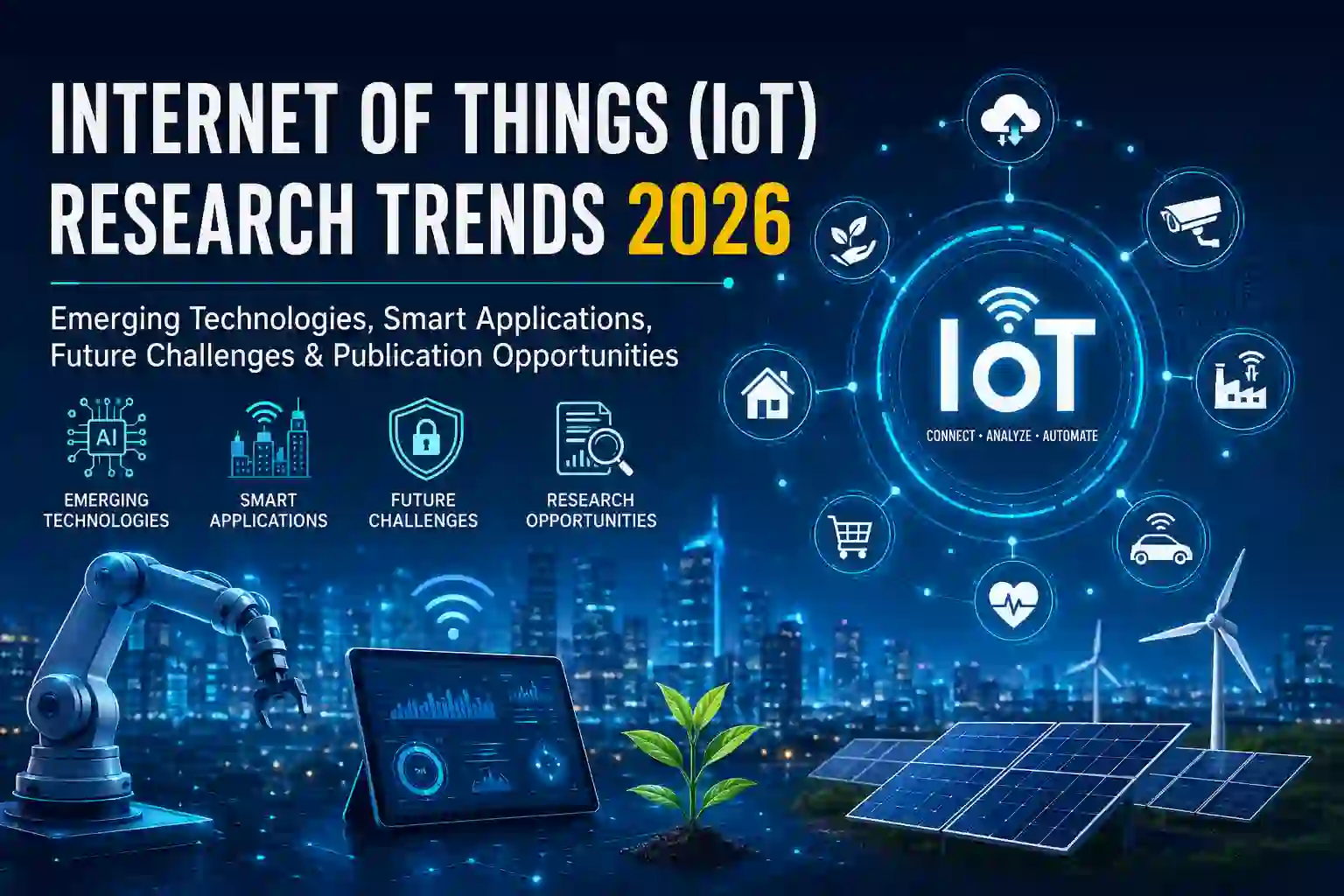
Discover the latest Internet of Things (IoT) research trends shaping 2026. Explore AI-powered IoT, Edge Computing, Digital Twins, TinyML, Industrial IoT, smart cities, healthcare innovations, cybersecurity challenges, sustainable IoT, publication opportunities, and practical guidance for researchers seeking to publish in reputable peer-reviewed journals.
AI, Edge AI, TinyML, Digital Twins, Blockchain, 5G & 6G Integration
Healthcare, Smart Cities, Agriculture, Manufacturing, Transportation, Education
Research methodology, journal selection, peer review, publication ethics, and editorial advice.
35–45 Minutes
Researchers, Students, Faculty, Engineers, and Industry Professionals
Comprehensive Research Guide
Research Trends, Case Studies, Publication Tips, Ethics, and Future Directions
The Internet of Things has evolved into one of the most dynamic multidisciplinary research domains. Successful IoT research now combines embedded systems, Artificial Intelligence, cloud computing, cybersecurity, networking, and data analytics to solve real-world challenges. This guide has been developed to help students, early-career researchers, and experienced academics understand emerging research directions, identify meaningful publication opportunities, and conduct ethical, impactful research in the rapidly evolving IoT ecosystem.
If you are planning to publish your work, you may also find these resources helpful:
The Internet of Things (IoT) has emerged as one of the most transformative technologies of the twenty-first century, fundamentally changing how people, devices, businesses, and governments interact with the digital world. What began as a concept of connecting everyday objects to the internet has evolved into a sophisticated ecosystem where billions of intelligent devices continuously collect, exchange, and analyze data to improve decision-making and automate complex processes. In 2026, IoT is no longer limited to smart homes or wearable devices—it has become a driving force behind Industry 4.0 and the transition toward more intelligent, sustainable, and connected societies.
The rapid advancement of technologies such as Artificial Intelligence (AI), Edge Computing, 5G and emerging 6G networks, Digital Twins, TinyML, cloud computing, and blockchain has significantly expanded the capabilities of IoT systems. Modern IoT platforms can process vast amounts of sensor-generated data in real time, enabling predictive maintenance, autonomous decision-making, remote monitoring, intelligent healthcare, smart agriculture, connected transportation, and energy-efficient infrastructure. These innovations are opening new research opportunities across engineering, computer science, healthcare, environmental science, agriculture, business, and public policy.
For researchers, IoT represents one of the most dynamic multidisciplinary fields of study. A single IoT research project often integrates embedded systems, wireless communication, cybersecurity, machine learning, big data analytics, cloud computing, and software engineering. This interdisciplinary nature makes IoT research particularly valuable for publication in international peer-reviewed journals, where innovative solutions addressing real-world challenges are highly encouraged. Researchers seeking suitable publication venues can explore our guide on Best Peer-Reviewed Journals for AI, Computer Science and IoT Research, which discusses quality journals for emerging technology research.
As IoT technologies continue to mature, researchers face increasingly complex challenges beyond simply connecting devices. Security vulnerabilities, data privacy, interoperability among heterogeneous systems, scalability, energy efficiency, ethical use of artificial intelligence, and regulatory compliance have become central themes in contemporary IoT research. Addressing these issues requires not only technical expertise but also an understanding of responsible innovation, transparent research methodologies, and publication ethics. Authors who are preparing their first manuscript may benefit from reading our Research Paper Publication Guide for Beginners, which explains journal selection, peer review, DOI assignment, and ethical publishing practices.
Another important trend shaping IoT research in 2026 is the growing collaboration between academia and industry. Universities are increasingly partnering with healthcare organizations, manufacturing companies, agricultural enterprises, smart city initiatives, and technology providers to develop practical IoT solutions capable of addressing real societal challenges. These collaborations generate valuable datasets, realistic case studies, and innovative applications that improve both scientific knowledge and commercial adoption. As a result, journals increasingly favor research that demonstrates measurable impact, reproducible methodologies, and practical significance rather than purely theoretical contributions.
This comprehensive guide has been written for undergraduate students, postgraduate researchers, doctoral scholars, faculty members, engineers, and industry professionals who wish to understand the latest Internet of Things research trends in 2026. Throughout this article, you will explore emerging technologies, smart applications, real-world case studies, publication opportunities, research methodologies, editorial expectations, ethical considerations, and practical recommendations for producing high-quality research. If you are planning to submit your work to an international journal, you may also find our article on How to Publish Research in Multidisciplinary Journals: Complete Guide 2026 helpful for selecting an appropriate journal and preparing a strong manuscript for peer review.
Every successful Internet of Things (IoT) application relies on a well-designed architecture that enables devices to communicate, process information, and deliver meaningful services. Whether developing a smart healthcare monitoring platform, an intelligent transportation system, or an Industry 4.0 manufacturing solution, researchers must understand how IoT components interact throughout the data lifecycle.
An IoT architecture is a structured framework describing how physical devices, communication networks, computing resources, and applications work together to collect, transmit, analyze, and utilize data. Although implementations vary depending on the application, most modern IoT systems follow a layered architecture that improves scalability, security, interoperability, and maintainability.
Understanding IoT architecture is particularly important for researchers because reviewers of peer-reviewed journals expect manuscripts to clearly describe system design, communication workflows, hardware components, software frameworks, and data processing methodologies. If you are preparing your first research article, our guide on How Peer Review Works in Academic Journals explains how editors evaluate the technical quality and reproducibility of engineering research.
Although researchers may encounter three-layer, five-layer, or cloud-native IoT architectures, the following four-layer model is widely accepted because it clearly separates responsibilities across different components of an IoT ecosystem.
| Layer | Primary Function | Example Technologies |
|---|---|---|
| Perception Layer | Collects data from physical environments using sensors and embedded devices. | Temperature sensors, RFID, cameras, GPS, accelerometers, humidity sensors. |
| Network Layer | Transfers collected information securely between devices and computing platforms. | Wi-Fi, Bluetooth LE, Zigbee, LoRaWAN, NB-IoT, 5G, Ethernet. |
| Processing Layer | Stores, processes, analyzes, and secures incoming data. | Cloud Computing, Edge Computing, AI platforms, databases. |
| Application Layer | Provides intelligent services and user interfaces. | Smart healthcare dashboards, industrial monitoring, smart city platforms. |
The perception layer forms the physical foundation of every IoT ecosystem. It consists of sensors, actuators, RFID tags, cameras, wearable devices, drones, industrial controllers, and embedded systems capable of collecting environmental information.
Depending on the research domain, sensors may measure:
Researchers continually develop new sensing technologies that improve measurement accuracy while reducing energy consumption and manufacturing costs. Sensor innovation remains one of the fastest-growing IoT research areas in 2026.
In precision agriculture, wireless soil sensors continuously monitor moisture, temperature, and nutrient availability. Farmers receive real-time recommendations that optimize irrigation schedules, reducing water consumption while improving crop yield.
After data are collected, they must be transmitted securely and efficiently. The network layer is responsible for communication between devices, gateways, cloud servers, and edge computing platforms.
Choosing an appropriate communication technology depends on factors such as transmission distance, bandwidth, power consumption, latency, and deployment cost.
| Technology | Typical Application |
|---|---|
| Wi-Fi | Smart homes and offices |
| Bluetooth Low Energy | Wearable healthcare devices |
| Zigbee | Home automation |
| LoRaWAN | Smart agriculture and environmental monitoring |
| NB-IoT | Utility metering and smart cities |
| 5G | Autonomous vehicles and industrial automation |
Current research increasingly investigates hybrid communication models capable of switching automatically between multiple protocols depending on environmental conditions and network congestion.
The processing layer transforms raw sensor readings into actionable information. This layer integrates cloud computing, edge computing, artificial intelligence, machine learning, databases, and cybersecurity mechanisms to analyze data and support intelligent decision-making.
Instead of sending every sensor reading directly to cloud servers, many modern IoT systems process information at the network edge. Edge computing reduces communication delays, decreases bandwidth requirements, and improves privacy by processing sensitive information locally.
Researchers working on intelligent IoT systems frequently combine AI algorithms with edge computing to create autonomous systems capable of making real-time decisions without relying entirely on centralized cloud infrastructure.
For researchers interested in AI-integrated connected systems, our article Best Peer-Reviewed AI Journals for Publishing Artificial Intelligence Research in 2026 discusses publication opportunities for interdisciplinary research.
The application layer represents the services delivered to users. Here, processed information becomes valuable through dashboards, mobile applications, intelligent alerts, predictive analytics, and automated control systems.
Examples include:
Research contributions at this layer often emphasize usability, decision support, automation, and measurable societal impact.
Although IoT applications differ significantly across domains, nearly every connected system contains several fundamental components that enable end-to-end functionality.
| Component | Purpose |
|---|---|
| Sensors | Collect physical data. |
| Actuators | Perform automated physical actions. |
| Microcontrollers | Control embedded hardware. |
| Communication Modules | Transmit information between devices. |
| Gateways | Connect local devices with cloud platforms. |
| Cloud Servers | Store and analyze large datasets. |
| Edge Devices | Perform local AI processing. |
| User Applications | Present information and enable interaction. |
Rather than studying each component independently, modern IoT research focuses on optimizing the complete ecosystem. Researchers investigate how sensors, communication protocols, artificial intelligence, cybersecurity, and cloud infrastructure can work together to create scalable, resilient, and energy-efficient intelligent systems. This systems-level perspective is increasingly expected in high-impact journals because it demonstrates practical applicability beyond laboratory environments.
When selecting a journal for IoT research, authors should ensure that the journal's aims and scope align with interdisciplinary topics spanning computer science, electronics, networking, and artificial intelligence. Our guides on How to Select the Right Peer-Reviewed Journal for Publication and Best Peer-Reviewed Multidisciplinary Research Journals can help identify suitable publication venues.
One of the most common reasons IoT manuscripts are rejected is an incomplete description of the system architecture. Editors and reviewers expect clear architecture diagrams, communication workflows, hardware specifications, software frameworks, datasets, evaluation metrics, and experimental procedures. A well-documented architecture significantly improves the reproducibility and credibility of your research.
In the next section, we will examine the emerging technologies driving IoT innovation in 2026, including Artificial Intelligence, Edge Computing, TinyML, Digital Twins, Blockchain, Cloud Computing, and next-generation 5G/6G communication networks.
The Internet of Things has evolved far beyond connecting physical devices to the internet. In 2026, modern IoT ecosystems combine Artificial Intelligence (AI), Edge Computing, Tiny Machine Learning (TinyML), cloud platforms, advanced wireless communication, and intelligent automation to deliver real-time insights and autonomous decision-making. These technologies are transforming how researchers design smart systems for healthcare, manufacturing, agriculture, transportation, environmental monitoring, and smart cities.
Understanding these enabling technologies is essential for researchers because high-quality journals increasingly expect manuscripts to demonstrate technical innovation, measurable performance improvements, and practical applicability. Rather than focusing on a single technology, today's IoT research often integrates multiple disciplines to solve complex real-world problems. Researchers interested in publishing interdisciplinary work may find our guide on Best Peer-Reviewed Journals for AI, Computer Science and IoT Research helpful when identifying appropriate publication venues.
Artificial Intelligence has become one of the most influential technologies driving IoT innovation. Traditional IoT systems primarily collected and transmitted sensor data for human interpretation. Modern AI-powered IoT systems, however, can analyze large volumes of real-time data, recognize patterns, predict future events, and make autonomous decisions with minimal human intervention.
Machine learning, deep learning, reinforcement learning, computer vision, and natural language processing are increasingly integrated into IoT platforms to improve automation, operational efficiency, and predictive capabilities.
A manufacturing company installs thousands of vibration and temperature sensors on production equipment. Instead of waiting for machinery to fail, AI algorithms continuously analyze sensor data and predict component failures several days in advance. Maintenance teams receive automated alerts, reducing equipment downtime and significantly lowering operational costs.
Researchers exploring AI-assisted scientific research should also read our article on Use of Generative AI in Research Paper Publication: Guide for Beginners, which discusses responsible AI usage, transparency, and ethical disclosure in academic publishing.
As billions of IoT devices generate enormous amounts of data every second, transmitting every sensor reading directly to cloud servers has become increasingly inefficient. High communication latency, bandwidth limitations, privacy concerns, and network congestion have accelerated the adoption of Edge Computing.
Edge Computing processes data closer to where it is generated rather than relying exclusively on centralized cloud infrastructure. Instead of sending raw sensor data across the internet, intelligent edge devices perform local computation and transmit only relevant information to cloud platforms.
Consider an autonomous vehicle navigating through busy urban traffic. Waiting for cloud servers to analyze camera images could introduce dangerous delays. Instead, edge processors inside the vehicle analyze images locally within milliseconds, enabling immediate braking, obstacle avoidance, and navigation decisions.
TinyML is an emerging research area focused on deploying machine learning models directly onto extremely small, low-power embedded devices such as microcontrollers, wearable sensors, drones, environmental monitoring stations, and smart agricultural sensors.
Unlike conventional AI systems requiring powerful GPUs or cloud infrastructure, TinyML enables intelligent decision-making directly on resource-constrained devices. This significantly reduces communication costs, improves privacy, lowers power consumption, and enables offline operation.
| Application | TinyML Function |
|---|---|
| Healthcare Wearables | Heart rate anomaly detection. |
| Wildlife Monitoring | Animal sound classification. |
| Industrial Sensors | Machine fault prediction. |
| Agriculture | Crop disease detection. |
| Environmental Monitoring | Air quality analysis. |
| Smart Homes | Voice command recognition. |
TinyML has become particularly attractive for researchers because it addresses multiple contemporary challenges simultaneously, including energy efficiency, sustainability, intelligent automation, and scalable deployment of AI-powered IoT systems.
| Technology | Main Objective | Typical Hardware | Primary Benefit |
|---|---|---|---|
| Artificial Intelligence | Intelligent data analysis and prediction. | Cloud servers, GPUs, AI accelerators. | Advanced decision-making. |
| Edge Computing | Local data processing. | Edge gateways, edge servers. | Low latency and privacy. |
| TinyML | Machine learning on microcontrollers. | Embedded devices, sensors. | Ultra-low power intelligent systems. |
One common weakness in IoT manuscripts is describing emerging technologies without demonstrating their practical contribution. Rather than simply stating that an IoT system uses AI or Edge Computing, authors should clearly explain why these technologies were selected, how they improve performance, and how they compare with existing approaches. Quantitative evaluation using metrics such as latency, accuracy, energy consumption, bandwidth utilization, and computational efficiency significantly strengthens a research paper.
When preparing your manuscript, ensure that your methodology, datasets, experimental setup, and evaluation metrics are described transparently. Researchers who are unfamiliar with selecting appropriate journals should consult our guides on How to Select the Right Peer-Reviewed Journal for Publication, Best Peer-Reviewed Multidisciplinary Research Journals, and Google Scholar Journal Indexing: Why It Matters for Multidisciplinary Research Authors.
In the next section, we will explore additional breakthrough technologies shaping IoT research in 2026, including Digital Twins, Blockchain, Cloud Computing, and next-generation 5G/6G communication networks, and examine how these innovations are creating new opportunities for impactful interdisciplinary research.
One of the fastest-growing research trends in the Internet of Things (IoT) is the adoption of Digital Twin technology. A Digital Twin is a virtual representation of a physical object, process, machine, or entire system that continuously receives real-time data from IoT sensors. By synchronizing physical assets with their digital counterparts, researchers and organizations can monitor system performance, simulate future scenarios, detect anomalies, and optimize operations without interrupting real-world activities.
Unlike traditional simulation models that often rely on historical or static datasets, Digital Twins operate using live data streams collected from connected IoT devices. This enables engineers and researchers to understand how systems behave under changing environmental conditions and to evaluate the impact of design modifications before implementing them physically.
| Industry | Digital Twin Application |
|---|---|
| Manufacturing | Predictive maintenance and production optimization. |
| Healthcare | Patient-specific treatment simulation and medical device monitoring. |
| Smart Cities | Traffic management, infrastructure planning, and energy optimization. |
| Agriculture | Crop growth simulation and irrigation optimization. |
| Energy | Power plant monitoring and smart grid management. |
| Transportation | Fleet management and autonomous vehicle testing. |
Imagine a smart manufacturing facility equipped with thousands of IoT sensors monitoring production equipment. A Digital Twin continuously mirrors every machine's operating condition, allowing engineers to simulate maintenance schedules before equipment failures occur. Instead of reacting to unexpected breakdowns, the factory predicts failures weeks in advance, reducing maintenance costs while improving productivity.
Researchers interested in publishing multidisciplinary engineering research should also explore our guide on International Journal of Multidisciplinary Research: Best Platforms for Publishing Multidisciplinary Research, which discusses suitable publication opportunities for interdisciplinary technological innovations.
As IoT networks continue expanding to billions of connected devices, ensuring data integrity, authentication, and trust has become increasingly challenging. Traditional centralized architectures may introduce single points of failure, making IoT systems vulnerable to cyberattacks, unauthorized access, and data manipulation. Blockchain technology addresses many of these concerns by providing decentralized, transparent, and tamper-resistant record keeping.
Blockchain stores transactions across distributed nodes rather than relying on a central server. Each transaction is cryptographically secured, making unauthorized modification extremely difficult. When integrated with IoT, blockchain enhances device authentication, secure data sharing, and trusted communication among connected devices.
| Sector | Blockchain + IoT Solution |
|---|---|
| Healthcare | Secure patient record management. |
| Supply Chain | Product traceability and anti-counterfeiting. |
| Agriculture | Food quality monitoring throughout distribution. |
| Smart Grid | Secure peer-to-peer energy trading. |
| Manufacturing | Trusted industrial device authentication. |
| Transportation | Vehicle identity and maintenance verification. |
A pharmaceutical company deploys IoT sensors throughout its cold-chain logistics network to monitor vaccine temperature during transportation. Blockchain records every sensor reading and shipment event, creating an immutable audit trail that verifies product quality from manufacturing to final delivery. This approach improves regulatory compliance and reduces the risk of counterfeit products entering the supply chain.
| Technology | Primary Purpose | Key Benefits | Typical Applications |
|---|---|---|---|
| Digital Twins | Virtual simulation of physical systems. | Prediction, optimization, monitoring, simulation. | Manufacturing, healthcare, smart cities, energy. |
| Blockchain | Secure decentralized data management. | Trust, transparency, authentication, cybersecurity. | Supply chain, healthcare, Industrial IoT, logistics. |
Many manuscripts mention Digital Twins or Blockchain simply because they are trending technologies. Editors increasingly expect authors to justify why these technologies are necessary for the proposed solution. Clearly explain the research problem, describe the implementation architecture, compare your approach with existing methods, and present measurable improvements using quantitative evaluation metrics such as latency, throughput, energy consumption, prediction accuracy, security performance, or operational efficiency. Demonstrating practical impact is often more valuable than merely adopting a fashionable technology.
Researchers planning to publish IoT research should also understand how reputable journals evaluate innovation, originality, and peer-review quality. Our resources on How to Select the Right Peer-Reviewed Journal for Publication, Scopus Journals vs. Peer-Reviewed Journals, and How to Avoid Fake Scopus Journals provide practical guidance for identifying trustworthy publication venues.
In the next section, we will examine how Cloud Computing, 5G, and emerging 6G communication networks are accelerating IoT innovation, enabling scalable intelligent systems, and creating exciting new research opportunities across academia and industry.
While sensors, communication networks, and intelligent edge devices form the foundation of the Internet of Things (IoT), Cloud Computing provides the computational power, storage capacity, and scalability required to transform massive volumes of sensor-generated data into meaningful information. In 2026, cloud computing continues to play a central role in IoT research by enabling organizations to process billions of data points, deploy Artificial Intelligence (AI) models, manage connected devices remotely, and build intelligent applications capable of serving millions of users simultaneously.
Modern IoT deployments generate enormous quantities of structured and unstructured data every second. Environmental sensors monitor air quality, wearable devices collect health information, industrial machines record operational parameters, and smart cities continuously capture traffic and energy consumption data. Without cloud infrastructure, storing, processing, and analyzing this information would be technically challenging and economically impractical.
Cloud computing provides researchers with flexible access to virtual servers, distributed databases, machine learning platforms, big data analytics, application programming interfaces (APIs), and scalable storage systems without requiring significant investments in physical infrastructure. Consequently, cloud-native IoT architectures have become the preferred approach for both academic research and industrial innovation.
A typical cloud-enabled IoT architecture follows a structured workflow:
This centralized yet highly scalable architecture enables organizations to monitor thousands or even millions of connected devices across multiple geographical locations while maintaining consistent system performance.
| Benefit | Description |
|---|---|
| Scalability | Supports millions of connected devices without major infrastructure upgrades. |
| Massive Storage | Stores large volumes of structured and unstructured IoT data. |
| AI Integration | Enables machine learning, predictive analytics, and intelligent automation. |
| Remote Accessibility | Researchers and organizations can access systems from anywhere. |
| Cost Efficiency | Reduces capital expenditure through pay-as-you-use services. |
| Automatic Backup | Improves data availability and disaster recovery capabilities. |
| Device Management | Supports remote monitoring, software updates, and configuration. |
Consider a hospital that deploys wearable IoT devices to monitor patients' heart rate, oxygen saturation, blood pressure, and body temperature. Thousands of sensor readings are transmitted every minute to a secure cloud platform. Artificial Intelligence algorithms analyze these data streams in real time, identifying abnormal physiological patterns and notifying healthcare professionals before medical emergencies occur. Physicians can securely access patient dashboards from different hospital departments or remote clinics, improving treatment efficiency while reducing response times.
This example demonstrates how IoT, cloud computing, and AI work together to improve healthcare outcomes while enabling continuous monitoring and evidence-based clinical decision-making.
| Service Model | Purpose in IoT |
|---|---|
| Infrastructure as a Service (IaaS) | Provides virtual servers, storage, and networking resources for IoT applications. |
| Platform as a Service (PaaS) | Offers development environments for building IoT software and APIs. |
| Software as a Service (SaaS) | Delivers cloud-hosted dashboards, analytics tools, and IoT management platforms. |
Cloud computing remains an active area of IoT research. Current investigations focus on improving performance, security, sustainability, and interoperability while reducing operational costs.
Researchers should avoid treating cloud computing as merely a storage solution. High-quality IoT studies explain why a cloud architecture was selected, describe data processing workflows, justify platform choices, discuss latency and scalability considerations, and evaluate performance using measurable metrics such as throughput, response time, resource utilization, availability, security, and operational cost. Including architectural diagrams and reproducible experimental configurations significantly strengthens a manuscript during peer review.
Editors increasingly favor manuscripts that evaluate complete IoT ecosystems rather than isolated cloud components. When presenting a cloud-enabled IoT solution, clearly explain how sensors, communication protocols, cloud infrastructure, Artificial Intelligence, and user applications interact. Comparative evaluations against existing architectures greatly improve the scientific contribution and demonstrate the practical value of your research.
Researchers preparing manuscripts for international publication should also understand journal quality indicators, indexing databases, and ethical publishing practices. The following resources provide valuable guidance:
In the following section, we will explore how 5G and emerging 6G communication technologies are enabling ultra-low latency, massive machine-type communication, intelligent automation, and next-generation Internet of Things applications across healthcare, autonomous transportation, smart manufacturing, and connected cities.
Communication networks are the foundation of every Internet of Things (IoT) ecosystem. Regardless of how intelligent sensors, Artificial Intelligence (AI), or cloud platforms become, IoT devices cannot deliver reliable services without fast, secure, and efficient communication technologies. In 2026, the global deployment of 5G networks and ongoing research into 6G communication systems are revolutionizing IoT by enabling ultra-fast connectivity, massive device communication, ultra-low latency, and highly reliable wireless services.
Earlier generations of mobile communication, such as 3G and 4G, primarily focused on improving internet access for smartphones and personal devices. Modern IoT applications, however, require communication infrastructures capable of supporting millions of connected sensors, autonomous vehicles, industrial robots, wearable medical devices, drones, and intelligent city infrastructure simultaneously. This demand has made 5G one of the most significant technological enablers of next-generation IoT research.
Fifth-generation (5G) wireless communication introduces several capabilities specifically designed for connected intelligent systems rather than traditional mobile internet usage. Compared with previous generations, 5G offers dramatically improved speed, reduced latency, enhanced reliability, and support for a much larger number of connected devices.
| Feature | 4G LTE | 5G |
|---|---|---|
| Maximum Speed | Up to 1 Gbps | Up to 20 Gbps |
| Latency | 30–50 ms | Less than 1–10 ms |
| Connected Devices | Thousands | Millions per square kilometer |
| Energy Efficiency | Moderate | Significantly Improved |
| Primary Focus | Mobile Internet | IoT, AI, Autonomous Systems, Industry 4.0 |
Modern IoT applications frequently require real-time communication between thousands of intelligent devices. Even a delay of a few milliseconds may significantly affect system performance in applications such as autonomous driving, robotic surgery, industrial automation, and emergency response systems.
By providing ultra-low latency and highly reliable communication, 5G enables researchers to design IoT systems capable of making autonomous decisions almost instantly. This capability has accelerated research into Edge AI, Digital Twins, collaborative robotics, smart manufacturing, and intelligent transportation systems.
| Application Area | Role of 5G |
|---|---|
| Autonomous Vehicles | Real-time vehicle communication and collision avoidance. |
| Smart Healthcare | Remote surgery, patient monitoring, emergency diagnostics. |
| Industrial IoT | Real-time robotic automation and predictive maintenance. |
| Smart Agriculture | Connected drones, autonomous irrigation, precision farming. |
| Smart Cities | Traffic optimization, intelligent surveillance, energy management. |
| Environmental Monitoring | Large-scale sensor deployments with continuous data collection. |
Imagine a metropolitan smart city where thousands of traffic cameras, connected vehicles, road sensors, and emergency response systems continuously exchange information using 5G networks. Artificial Intelligence analyzes traffic conditions in real time, dynamically adjusts traffic signals, prioritizes emergency vehicles, predicts congestion, and recommends alternative routes for commuters. The combination of IoT, AI, Edge Computing, and 5G significantly reduces travel time, fuel consumption, and environmental pollution while improving road safety.
Although 5G deployment continues worldwide, researchers have already begun exploring 6G communication technologies. Expected to become commercially available during the next decade, 6G aims to support intelligent communication ecosystems that integrate Artificial Intelligence directly into network infrastructure while enabling unprecedented communication speed, reliability, and automation.
Unlike previous communication generations, 6G is expected to combine wireless communication, sensing, Artificial Intelligence, satellite connectivity, holographic communication, and digital intelligence into a unified global infrastructure supporting billions of interconnected devices.
When discussing 5G or 6G in a research paper, avoid describing these technologies only from a theoretical perspective. Editors expect authors to explain how advanced communication networks improve the proposed IoT solution. Clearly report measurable improvements such as latency reduction, communication reliability, throughput, scalability, energy efficiency, or Quality of Service (QoS). Quantitative comparisons with previous communication technologies substantially strengthen the scientific contribution of your manuscript.
Researchers interested in intelligent communication systems should also review our publication resources, including Web of Science vs. Scopus Explained, Best International Journals for Multidisciplinary Research, Multidisciplinary vs. Specialized Journals, and Common Mistakes Researchers Make While Selecting DOAJ Journals to identify appropriate publication venues and avoid common submission mistakes.
As Internet of Things (IoT) technologies continue to mature, researchers are shifting their focus from simply connecting devices toward building intelligent, autonomous, secure, and sustainable digital ecosystems. The convergence of Artificial Intelligence (AI), Edge Computing, Digital Twins, Blockchain, Cloud Computing, and next-generation communication networks has created unprecedented opportunities for innovation across academia and industry. Consequently, IoT remains one of the fastest-growing multidisciplinary research domains, attracting significant funding from governments, universities, research organizations, and technology companies worldwide.
For graduate students and early-career researchers, understanding emerging research directions is essential for selecting novel dissertation topics, securing research grants, collaborating with industry, and publishing in high-impact peer-reviewed journals. Rather than reproducing existing studies, researchers should identify unresolved challenges that demonstrate originality, practical significance, and measurable societal impact.
The following research topics are expected to remain highly relevant throughout 2026 and the coming years.
| Research Area | Emerging Opportunities |
|---|---|
| AI-Powered IoT | Explainable AI, Federated Learning, autonomous decision-making, intelligent automation. |
| Edge Intelligence | Distributed AI, collaborative edge-cloud systems, low-latency analytics. |
| Healthcare IoT | Remote diagnostics, wearable medical devices, personalized healthcare. |
| Industrial IoT (IIoT) | Predictive maintenance, Industry 5.0, intelligent robotics, smart factories. |
| Smart Agriculture | Precision farming, autonomous irrigation, crop disease prediction. |
| Smart Cities | Traffic optimization, energy management, public safety, environmental monitoring. |
| Green IoT | Energy-efficient communication, carbon-aware computing, sustainable sensor networks. |
| Cybersecurity | Zero-trust architectures, lightweight encryption, post-quantum security. |
One of the greatest strengths of IoT research is its multidisciplinary nature. Successful projects increasingly combine knowledge from computer science, electronics, communication engineering, data science, healthcare, environmental science, business analytics, mechanical engineering, and public policy. Researchers who integrate expertise from multiple disciplines often produce more innovative solutions and attract broader interest from international journals.
Authors interested in publishing interdisciplinary studies may benefit from reading Best International Journals for Multidisciplinary Research (DOAJ, Google Scholar & Peer Reviewed) and Why Researchers Prefer Multidisciplinary Journals for Publication, which explain how multidisciplinary journals evaluate innovative research across diverse subject areas.
The rapid expansion of IoT research has created numerous publication opportunities in reputable international journals covering Artificial Intelligence, Computer Science, Electronics, Information Technology, Cybersecurity, Embedded Systems, Networking, Healthcare Engineering, Environmental Monitoring, and Industrial Automation. Before submitting a manuscript, researchers should carefully evaluate whether a journal's aims and scope align with the objectives of their research.
A strong publication strategy involves selecting journals with transparent editorial policies, rigorous peer review, recognized indexing, and clear publication ethics. Authors should also verify journal quality using trusted indexing databases and avoid submitting to predatory or misleading publishers.
Selecting a trending topic alone is not sufficient for publication success. Editors look for originality, rigorous methodology, reproducible experiments, transparent reporting, ethical compliance, and clear practical contributions. Before beginning your project, conduct a comprehensive literature review to identify genuine research gaps rather than simply repeating existing work with different datasets.
In the next section, we will discuss editorial expectations, publication best practices, common reasons IoT manuscripts are rejected, and practical recommendations for increasing the likelihood of acceptance in reputable peer-reviewed journals.
The International Journal of Multidisciplinary Research and Explorer (IJMRE) is a non-profit, open-access journal that does not charge any submission, processing, or publication fees. Donations made through this button are entirely voluntary and are used solely to support the maintenance, technical infrastructure, and continued accessibility of open research. Contributions do not influence editorial decisions or the peer review process in any way.