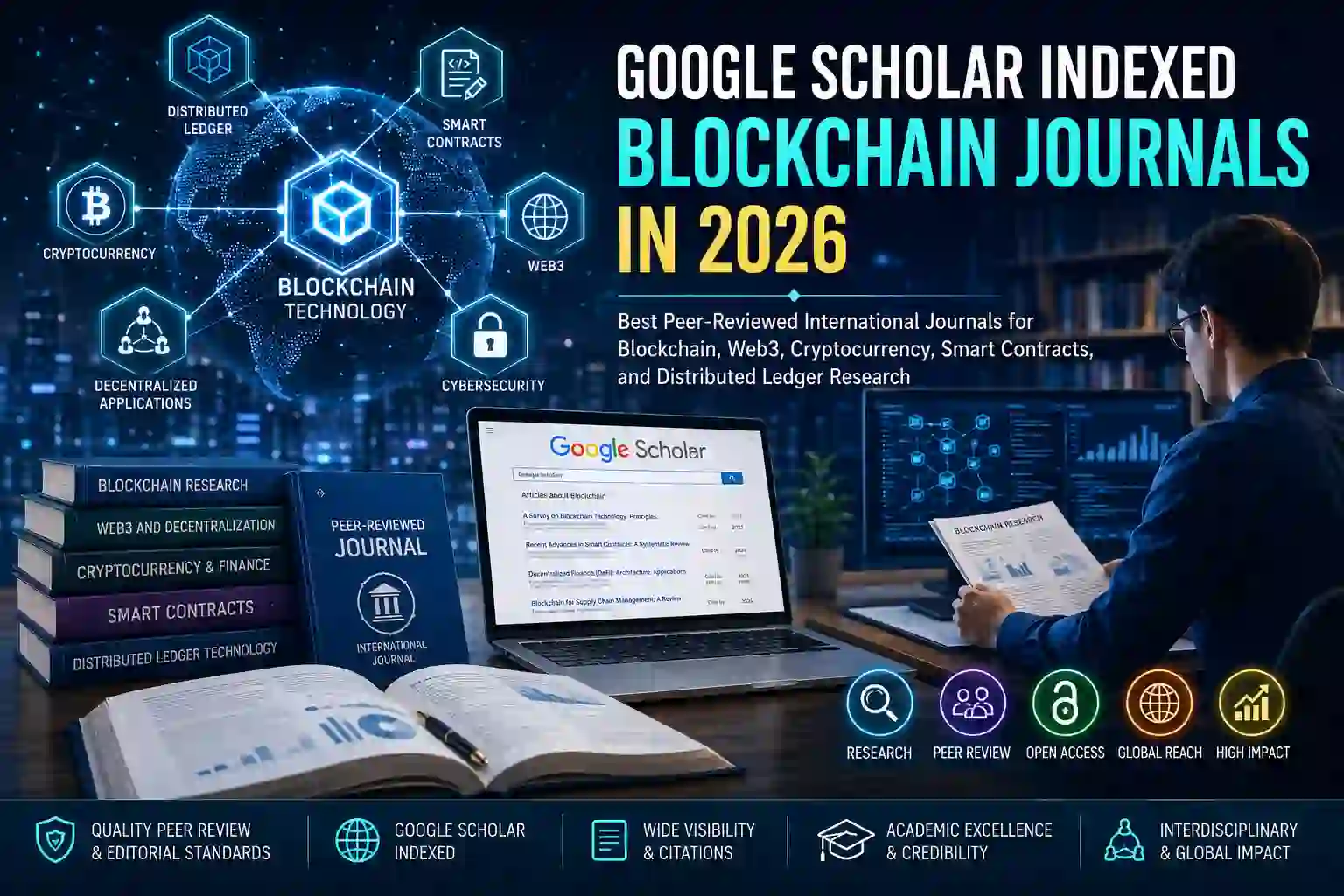
Updated for 2026 | Beginner Friendly | Research Publication Guide
A Conversation Every New Researcher Eventually Has
During a postgraduate research seminar, a student named Rahul proudly shared his first blockchain research paper. He had spent nearly eight months designing a secure blockchain-based healthcare record system using smart contracts. His experimental results were promising, and his supervisor believed the work could make a meaningful contribution.
When it came time to publish, Rahul searched online for "best blockchain journals." Within minutes, he found hundreds of websites claiming to offer rapid publication, international recognition, and guaranteed acceptance.
Confused, he asked his professor a simple question:
"How do I know which blockchain journals are trustworthy and which ones are worth submitting to?"
The professor smiled because nearly every first-time researcher asks the same question.
Instead of recommending a single journal, the professor explained something far more valuable:
- Understand how scholarly publishing works.
- Learn what peer review actually means.
- Know why Google Scholar indexing matters.
- Choose journals based on quality rather than advertisements.
- Publish where your research can genuinely contribute to the academic community.
This guide follows the same teaching approach. Rather than simply listing journals, it explains how researchers can identify reputable Google Scholar indexed blockchain journals, understand the publication process, and make informed decisions throughout their academic careers.
Why Blockchain Research Continues to Grow in 2026
Blockchain has evolved far beyond cryptocurrency. Today, researchers investigate blockchain applications across healthcare, finance, supply chain management, cybersecurity, education, digital identity, agriculture, government services, smart cities, and the Internet of Things.
Modern blockchain research often combines multiple disciplines, including Artificial Intelligence, Machine Learning, Cloud Computing, Big Data Analytics, Cybersecurity, and Software Engineering. As a result, researchers frequently publish their work in both specialized blockchain journals and multidisciplinary peer-reviewed journals.
For researchers interested in interdisciplinary publication opportunities, the following resources may be useful:
- International Journal of Multidisciplinary Research and Explorer (IJMRE)
- Understanding Multidisciplinary Research Journals
- Why Researchers Prefer Multidisciplinary Journals
What Is Blockchain?
Blockchain is a distributed digital ledger that records transactions across multiple computers in a secure and tamper-resistant manner. Instead of relying on one central authority, every participating node maintains a synchronized copy of the ledger.
Once information is verified and added to the blockchain, altering previous records becomes extremely difficult because every new block is cryptographically linked to earlier blocks.
Simple Example
Imagine a shared notebook owned by hundreds of people. Whenever someone writes a new page, everyone receives an identical copy. If one person attempts to erase an earlier page, every other copy immediately reveals the discrepancy. Blockchain works on a similar principle using cryptography rather than paper.
What Is Web3?
Web3 represents the next stage of internet technologies that emphasize decentralization, blockchain infrastructure, digital ownership, and user-controlled applications.
| Generation | Main Characteristic |
|---|---|
| Web 1.0 | Read-only websites |
| Web 2.0 | Interactive platforms and social media |
| Web3 | Decentralized applications powered by blockchain |
Researchers now study Web3 topics including decentralized finance (DeFi), decentralized autonomous organizations (DAOs), decentralized identity systems, blockchain governance, and tokenized digital ecosystems.
What Is Cryptocurrency?
Cryptocurrency is a digital asset that uses cryptographic techniques and blockchain technology to facilitate secure electronic transactions.
Although cryptocurrencies receive significant media attention, academic blockchain research extends well beyond digital currencies.
Researchers investigate:
- Consensus mechanisms
- Energy-efficient blockchain protocols
- Scalability solutions
- Cross-chain interoperability
- Privacy-preserving transactions
- Financial technologies
- Regulatory frameworks
What Are Smart Contracts?
Smart contracts are computer programs stored on blockchain networks that automatically execute predefined conditions without requiring manual intervention.
Real-World Example
A logistics company can design a smart contract that automatically releases payment when shipment sensors confirm successful delivery. No intermediary is required because the blockchain verifies the agreed conditions.
Research on smart contracts often addresses:
- Security vulnerabilities
- Formal verification
- Automated auditing
- Programming languages
- Gas optimization
- Performance analysis
What Is Distributed Ledger Technology (DLT)?
Distributed Ledger Technology (DLT) is the broader technological framework that allows multiple participants to maintain synchronized records without relying on a centralized database.
Blockchain is one implementation of DLT, but not every distributed ledger uses a blockchain structure.
| Blockchain | Distributed Ledger Technology |
|---|---|
| Data stored in blocks | May use different data structures |
| Sequential chain of blocks | Various ledger architectures |
| Most popular DLT implementation | Broader technology category |
What Is Google Scholar?
Google Scholar is a freely accessible academic search engine that indexes scholarly literature from journals, conference proceedings, theses, books, institutional repositories, and other academic sources.
Researchers use Google Scholar to:
- Search scientific literature.
- Track citations.
- Identify influential publications.
- Review previous research.
- Monitor academic impact.
Unlike commercial citation databases, Google Scholar aggregates scholarly content from a wide variety of publishers and repositories, making it one of the most widely used academic discovery tools.
What Does "Google Scholar Indexed Journal" Mean?
A Google Scholar indexed journal is one whose scholarly articles can be discovered and indexed by Google Scholar, allowing researchers around the world to search for and access published work through the platform.
It is important to understand that Google Scholar indexing alone does not determine journal quality. Researchers should also evaluate:
- Peer-review process
- Editorial board
- Publication ethics
- Journal scope
- Transparency
- Research relevance
For a deeper understanding of journal indexing, you may also find these guides helpful:
- Google Scholar Journal Indexing: Why It Matters for Researchers
- Scopus Journals vs Peer-Reviewed Journals
- Scopus vs Web of Science vs Peer-Reviewed Journals
Learning Objectives for This Guide
By the end of this article, you will be able to:
- Understand Google Scholar indexing.
- Identify trustworthy blockchain journals.
- Evaluate peer-review quality.
- Select suitable publication venues.
- Avoid common publishing mistakes.
- Understand publication ethics.
- Prepare blockchain research for successful journal submission.
Coming Up in Part 2
The next section explains how Google Scholar indexing works, why peer review matters, common misconceptions about indexed journals, the differences between Google Scholar, Scopus, Web of Science, and DOAJ, and how researchers can evaluate blockchain journals before submission.
How Does Google Scholar Index Academic Journals?
One of the biggest misconceptions among new researchers is that publishers "apply" to Google Scholar in the same way they apply to indexing databases. In reality, Google Scholar primarily uses automated systems to discover scholarly content that is publicly accessible and technically structured for indexing.
When a journal follows good publishing practices—such as providing structured metadata, accessible article pages, complete bibliographic information, and crawlable content—its articles are more likely to be indexed and discoverable through Google Scholar.
However, discoverability should never be confused with scientific quality. A journal's reputation depends on much more than whether its articles appear in search results.
Why Google Scholar Matters for Blockchain Researchers
Blockchain research is highly interdisciplinary. A single paper may attract readers from computer science, finance, cybersecurity, healthcare, supply chain management, economics, or law.
Because researchers from different disciplines frequently use Google Scholar to locate relevant literature, publication in journals whose articles are discoverable through Google Scholar can improve the visibility of your research.
Benefits for Authors
- Greater visibility among international researchers.
- Easier discovery through keyword searches.
- Improved citation opportunities.
- Broader interdisciplinary readership.
- Long-term accessibility for future researchers.
Google Scholar vs. Other Academic Databases
Researchers often encounter several indexing databases during journal selection. Each serves a different purpose.
| Platform | Main Purpose | Suitable For |
|---|---|---|
| Google Scholar | Academic search engine | Finding scholarly literature |
| Scopus | Citation indexing database | Research evaluation and analytics |
| Web of Science | Citation indexing platform | Impact assessment and research metrics |
| DOAJ | Directory of open access journals | Finding trusted open-access journals |
Each platform has its own inclusion criteria and objectives. Responsible researchers evaluate journals holistically rather than relying on a single indexing database.
Related reading:
- DOAJ vs Scopus: Which Database Should Researchers Consider?
- Scopus Indexed Journals Guide
- Understanding the Directory of Open Access Journals (DOAJ)
What Does Peer Review Mean?
Peer review is the evaluation of a research manuscript by independent experts with relevant academic knowledge before publication.
Its purpose is to assess:
- Originality
- Scientific validity
- Methodological quality
- Technical accuracy
- Clarity of presentation
- Contribution to existing knowledge
Peer review does not guarantee that a paper is perfect, but it helps improve research quality by providing constructive academic feedback before publication.
Common Peer Review Models
| Review Type | Description |
|---|---|
| Single-Blind | Reviewers know the authors' identities, but authors do not know the reviewers. |
| Double-Blind | Neither authors nor reviewers know each other's identities. |
| Open Peer Review | Reviewer identities may be disclosed depending on journal policy. |
Each model has strengths and limitations. The quality of the review process depends more on editorial standards and reviewer expertise than on the review model itself.
Learn more:
Real-World Case Study
A doctoral student develops a blockchain-based voting system and submits the manuscript to the first journal found through an online search. The journal promises publication within one week and claims to be "internationally indexed."
Before submitting, the student's supervisor recommends checking:
- Whether the journal clearly explains its peer-review process.
- Its editorial board and publication ethics.
- Recently published blockchain articles.
- Whether the journal's scope matches the manuscript.
- The transparency of its editorial policies.
After reviewing these factors, the student discovers that another journal is a much better fit for the research. Although the publication process takes longer, the manuscript receives detailed reviewer feedback that strengthens the final published article.
Common Misconceptions About Google Scholar Indexed Journals
| Misconception | Reality |
|---|---|
| Google Scholar indexing guarantees journal quality. | Indexing improves discoverability but does not guarantee editorial quality. |
| Every indexed journal has the same reputation. | Editorial standards vary among journals. |
| Fast publication means better journals. | Rigorous peer review requires adequate evaluation time. |
| High citation counts always indicate better research. | Citations should be interpreted alongside research quality and context. |
| Blockchain journals only publish cryptocurrency research. | Blockchain research spans many disciplines beyond cryptocurrency. |
Blockchain Research Areas Published in Academic Journals
Modern blockchain journals publish research across a broad range of topics.
| Research Area | Example Topics |
|---|---|
| Blockchain Security | Consensus security, attacks, privacy |
| Web3 | Decentralized applications, DAOs |
| Cryptocurrency | Digital assets, stablecoins, regulation |
| Smart Contracts | Verification, auditing, optimization |
| Distributed Ledger Technology | Consensus mechanisms, scalability |
| Supply Chain | Traceability and logistics |
| Healthcare | Medical records and secure data sharing |
| Artificial Intelligence | AI-powered blockchain systems |
| Cybersecurity | Identity management and secure authentication |
Editorial Advice from Experienced Researchers
New researchers often spend weeks searching for "the best journal." Experienced researchers usually begin with a different question:
"Which journal serves the audience that will benefit most from my research?"
A carefully selected journal improves the likelihood that reviewers understand the research problem, provide meaningful feedback, and connect the work with the appropriate academic community.
How to Start Evaluating a Blockchain Journal
Before preparing your submission, review the following checklist:
- Does the journal regularly publish blockchain research?
- Is the peer-review process clearly described?
- Are publication ethics publicly available?
- Does the editorial board include blockchain researchers?
- Are recently published articles relevant to your work?
- Are author guidelines complete and transparent?
If the answer to most of these questions is "yes," the journal is likely worth evaluating further.
Helpful IJMRE Resources
- How to Check Whether a Journal Is Scopus Indexed and Peer Reviewed
- How to Select the Right Peer-Reviewed Journal for Publication
- Best Peer-Reviewed Multidisciplinary Research Journals
- Why Google Scholar Journal Indexing Matters
In the next section, we will examine the characteristics of high-quality peer-reviewed international blockchain journals, discuss the types of research they publish, compare multidisciplinary and specialized journals, and provide practical guidance for selecting the right publication venue for Blockchain, Web3, Cryptocurrency, Smart Contracts, and Distributed Ledger Technology research.
Characteristics of High-Quality Blockchain Journals
Many researchers search online for a list of the "best blockchain journals." While journal rankings and indexing databases can be useful starting points, experienced researchers evaluate journals using several quality indicators rather than relying on a single metric.
A high-quality blockchain journal typically demonstrates:
- Clearly defined aims and scope.
- A transparent peer-review process.
- An experienced editorial board.
- Publication ethics aligned with international standards.
- Regular publication schedules.
- High-quality published articles.
- Detailed author guidelines.
- Long-term accessibility of published research.
These characteristics often matter more than promotional claims about rapid publication or indexing alone.
What Types of Blockchain Research Do Leading Journals Publish?
Blockchain journals publish far more than cryptocurrency research. As blockchain technology matures, journals increasingly welcome interdisciplinary research that combines distributed ledger technology with artificial intelligence, cybersecurity, cloud computing, healthcare, finance, and software engineering.
| Research Area | Typical Topics |
|---|---|
| Blockchain Architecture | Consensus protocols, scalability, interoperability |
| Web3 | Decentralized applications (DApps), DAOs, token economies |
| Cryptocurrency | Digital assets, stablecoins, decentralized finance (DeFi) |
| Smart Contracts | Security, formal verification, auditing, optimization |
| Distributed Ledger Technology | Alternative ledger architectures and enterprise solutions |
| Cybersecurity | Identity management, secure authentication, blockchain security |
| Healthcare | Electronic health records, secure medical data sharing |
| Supply Chain | Product traceability, logistics transparency |
| Artificial Intelligence | AI-integrated blockchain applications |
Specialized Blockchain Journals vs. Multidisciplinary Journals
Choosing between a specialized blockchain journal and a multidisciplinary journal depends on your research objectives, audience, and the breadth of your study.
| Specialized Blockchain Journals | Multidisciplinary Journals |
|---|---|
| Focus exclusively on blockchain technologies. | Publish research from multiple scientific disciplines. |
| Readers are blockchain experts. | Readers come from diverse academic backgrounds. |
| Highly technical articles. | Interdisciplinary applications receive broader attention. |
| Ideal for protocol-level research. | Ideal for applied blockchain solutions. |
For example, a paper proposing a new blockchain consensus algorithm may fit a specialized blockchain journal, while research combining blockchain, AI, and healthcare may be more suitable for a multidisciplinary journal.
Related reading:
- Multidisciplinary vs. Specialized Journals: Which Is Better?
- Best International Journals for Multidisciplinary Research
Real-World Case Scenario
Consider two researchers working on blockchain technology:
Researcher A develops a mathematical consensus algorithm that improves Byzantine Fault Tolerance. The work is highly theoretical and primarily interests blockchain protocol researchers.
Researcher B designs a blockchain-enabled medical record system integrated with artificial intelligence for hospitals. This work spans blockchain, healthcare, cybersecurity, and machine learning.
Although both studies involve blockchain, they target different audiences and may be better suited to different types of journals.
Successful publication depends on selecting the journal whose readership aligns with the research contribution.
Emerging Blockchain Research Topics in 2026
Editors increasingly seek manuscripts addressing practical challenges and future technologies. Some rapidly growing research areas include:
- Blockchain for Artificial Intelligence.
- Blockchain-powered Internet of Things (IoT).
- Quantum-resistant blockchain security.
- Zero-knowledge proofs.
- Cross-chain interoperability.
- Central Bank Digital Currencies (CBDCs).
- Green and energy-efficient blockchain.
- Blockchain for digital identity.
- Blockchain in healthcare.
- Blockchain in supply chain management.
- Tokenization of real-world assets.
- Privacy-preserving distributed systems.
Decision Framework for Selecting a Blockchain Journal
Before submitting your manuscript, answer the following questions:
| Question | Why It Matters |
|---|---|
| Does the journal publish blockchain research regularly? | Ensures alignment with journal scope. |
| Will the readers benefit from my work? | Improves visibility and citations. |
| Does the journal explain its peer-review process? | Indicates editorial transparency. |
| Are ethical publishing policies available? | Reflects responsible scholarly publishing. |
| Does the journal publish similar studies? | Demonstrates relevance. |
Editorial Advice for First-Time Authors
Editors appreciate manuscripts that clearly explain:
- The research problem.
- Why the problem matters.
- The novelty of the proposed solution.
- The methodology.
- The experimental evaluation.
- The practical significance of the findings.
Many submissions are rejected not because the research lacks value but because the manuscript fails to communicate its contribution effectively.
Best Practices for Blockchain Researchers
- Conduct a comprehensive literature review.
- Compare your approach with existing methods.
- Use reproducible experimental procedures.
- Include appropriate datasets and evaluation metrics.
- Discuss limitations honestly.
- Follow reporting standards and ethical guidelines.
- Select journals based on scope rather than publication speed.
Useful IJMRE Resources
- Research Paper Publication Guide for Beginners
- Best Peer-Reviewed Journals for AI, Computer Science, and IoT Research
- Use of Generative AI in Research Paper Publication
- Best Peer-Reviewed AI Journals for Publishing Artificial Intelligence Research
Key Takeaways from Part 3
- High-quality blockchain journals emphasize rigorous peer review and editorial transparency.
- Blockchain research now spans numerous interdisciplinary domains beyond cryptocurrency.
- Choosing the right journal depends on audience, scope, and research contribution.
- Specialized and multidisciplinary journals both offer valuable publication opportunities.
- Editors prioritize originality, methodological rigor, and practical significance.
The next section explains how to identify trustworthy blockchain journals, avoid predatory publishers, evaluate publication ethics, understand editorial expectations, and prepare your manuscript for successful peer review.
How to Identify a Trustworthy Blockchain Journal
One of the most important skills every researcher should develop is the ability to evaluate journals critically before submission. High-quality journals are transparent about their editorial policies, peer-review process, publication ethics, and author guidelines. Rather than relying on marketing claims, assess whether the journal consistently demonstrates scholarly standards.
Before submitting your blockchain research, review the journal's website carefully and verify that it provides clear information about:
- Aims and scope.
- Editorial board members.
- Peer-review process.
- Publication ethics policy.
- Author guidelines.
- Publication frequency.
- Previously published articles.
- Contact information.
Quality Indicators of a Good Blockchain Journal
| Indicator | Why It Matters |
|---|---|
| Transparent editorial policies | Demonstrates accountability and professionalism. |
| Clearly described peer review | Ensures independent academic evaluation. |
| Experienced editorial board | Provides subject expertise and quality oversight. |
| Detailed author guidelines | Helps authors prepare manuscripts correctly. |
| Publication ethics statement | Shows commitment to responsible publishing. |
| Consistent publication schedule | Reflects editorial stability. |
| Relevant published articles | Confirms alignment with your research topic. |
Case Scenario: Choosing Between Two Blockchain Journals
A researcher has completed a study on blockchain-based supply chain traceability. Two journals appear suitable.
Journal A
- Clearly defines its scope.
- Explains the peer-review process.
- Publishes recent blockchain research.
- Provides detailed author guidelines.
Journal B
- Promises publication within three days.
- Provides almost no editorial information.
- Lists no peer-review policy.
- Contains very few published research articles.
Although rapid publication may seem attractive, Journal A is generally the stronger choice because it demonstrates transparency and established editorial practices.
Publication Ethics Every Blockchain Researcher Should Understand
Responsible research publishing depends on maintaining high ethical standards throughout the research and publication process. Ethical publishing protects both scientific integrity and public trust.
Authors are generally expected to:
- Submit original research.
- Avoid plagiarism.
- Report data honestly.
- Disclose conflicts of interest when applicable.
- Obtain required ethical approvals.
- Properly acknowledge previous research.
- Avoid duplicate publication.
Common Ethical Issues in Blockchain Research
| Issue | Good Research Practice |
|---|---|
| Plagiarism | Write original content and cite all sources. |
| Data manipulation | Report findings accurately without alteration. |
| Duplicate submission | Submit to only one journal at a time. |
| Improper authorship | Include only genuine contributors. |
| Citation manipulation | Use references based on relevance, not quantity. |
| Undisclosed conflicts | Provide complete transparency where required. |
Common Misconceptions About Journal Quality
Beginning researchers often rely on assumptions that can lead to poor publication decisions.
| Misconception | Reality |
|---|---|
| Fast publication means better service. | Rigorous peer review requires time. |
| Every international journal has identical standards. | Editorial quality varies considerably. |
| Higher publication fees guarantee quality. | Fees and quality are independent factors. |
| Google Scholar indexing alone proves journal quality. | Editorial transparency and peer review remain essential. |
| Acceptance is the primary goal. | Publishing meaningful, reproducible research is the true objective. |
Editorial Advice from Journal Editors
Editors frequently report that many manuscripts are rejected before peer review because they do not fit the journal's scope or fail to follow author instructions.
Before submission:
- Read the journal's aims and scope carefully.
- Study several recently published articles.
- Follow formatting requirements.
- Prepare a concise cover letter.
- Ensure references are complete and consistent.
How to Avoid Predatory Journals
Predatory journals often imitate legitimate scholarly journals while providing little or no meaningful peer review. Publishing in such journals may reduce the visibility and credibility of your research.
Warning signs may include:
- Unrealistic publication promises.
- Aggressive email solicitations.
- Missing editorial information.
- Unclear peer-review procedures.
- Poor website quality.
- False or unverifiable indexing claims.
Helpful resources:
- How to Avoid Fake Scopus Journals
- Why Authors Should Publish in Top Peer-Reviewed Journals Instead of Fake Scopus Journals
Journal Evaluation Checklist
| Question | Yes / No |
|---|---|
| Does the journal publish blockchain research regularly? | ☐ |
| Is the peer-review process explained? | ☐ |
| Are publication ethics publicly available? | ☐ |
| Are editorial board members listed? | ☐ |
| Do published articles match your research topic? | ☐ |
| Are submission guidelines complete? | ☐ |
| Are indexing claims verifiable? | ☐ |
| Does the journal align with your target audience? | ☐ |
Practical Recommendations for New Researchers
- Select journals based on research fit rather than marketing claims.
- Read several published articles before submitting.
- Verify editorial transparency.
- Follow publication ethics carefully.
- Maintain complete research records for reproducibility.
- Ask supervisors or experienced researchers for journal recommendations when uncertain.
Useful IJMRE Resources
- How to Select the Right Peer-Reviewed Journal for Publication
- How Peer Review Works in Academic Journals
- Common Mistakes Researchers Make While Selecting Journals
- Research Paper Publication Guide for Beginners
The next section focuses on manuscript preparation for blockchain research, common reasons papers are rejected, reviewer expectations, writing strategies, real editorial examples, and practical advice to improve your chances of successful publication.
Preparing a High-Quality Blockchain Research Manuscript
Publishing in a reputable peer-reviewed blockchain journal begins long before submitting your manuscript. Editors and reviewers evaluate not only the novelty of your research but also how clearly and systematically it is presented. A well-organized manuscript allows reviewers to understand your contribution and evaluate its scientific merit.
Successful authors typically invest considerable time in planning, writing, revising, and proofreading before submission.
Recommended Structure of a Blockchain Research Paper
| Section | Purpose |
|---|---|
| Title | Clearly identifies the research topic. |
| Abstract | Summarizes objectives, methods, results, and conclusions. |
| Keywords | Improve discoverability in academic databases. |
| Introduction | Explains the research problem and objectives. |
| Literature Review | Discusses previous studies and identifies research gaps. |
| Methodology | Describes research methods in sufficient detail for reproducibility. |
| Results | Presents findings objectively. |
| Discussion | Interprets results and compares them with existing literature. |
| Conclusion | Summarizes contributions and suggests future research. |
| References | Accurately cite all sources used. |
Writing an Effective Research Title
The title is often the first element editors, reviewers, and readers encounter. An effective title should accurately reflect the research without being unnecessarily long or overly broad.
Example
Less Effective:
Blockchain Applications
More Effective:
A Privacy-Preserving Blockchain Framework for Secure Healthcare Data Sharing Using Smart Contracts
Specific titles improve discoverability and immediately communicate the manuscript's contribution.
How to Write a Strong Abstract
A good abstract answers five essential questions:
- What problem does the research address?
- Why is the problem important?
- How was the study conducted?
- What were the primary findings?
- Why are the findings significant?
Keep the abstract concise, factual, and free from unnecessary technical detail.
Developing a Convincing Introduction
The introduction should guide readers logically from the broader research context to the specific problem addressed by the study.
An effective introduction usually includes:
- Background information.
- Current challenges.
- Research gap.
- Study objectives.
- Summary of contributions.
Avoid extensive literature review within the introduction. Instead, clearly explain why the research is needed.
Presenting a Reproducible Methodology
One hallmark of strong scientific research is reproducibility. Other researchers should be able to understand and repeat your methodology using the information provided.
Include:
- Research design.
- Datasets.
- Blockchain platform or framework.
- Programming languages and development tools.
- Experimental setup.
- Evaluation metrics.
- Statistical methods where appropriate.
Reporting Results Clearly
Present results objectively before discussing their implications. Use tables, charts, and figures where appropriate to improve clarity.
Good reporting practices include:
- Comparing results with benchmark methods.
- Explaining unexpected outcomes.
- Reporting limitations honestly.
- Using appropriate statistical evidence.
What Reviewers Commonly Evaluate
| Evaluation Area | Typical Reviewer Questions |
|---|---|
| Originality | Does the study provide new knowledge? |
| Methodology | Are the methods scientifically sound? |
| Technical Accuracy | Are conclusions supported by the data? |
| Literature Review | Does the paper acknowledge relevant previous work? |
| Writing Quality | Is the manuscript well organized and understandable? |
| Contribution | Will the research benefit the intended audience? |
Real Editorial Example
A manuscript proposed a blockchain-based digital identity system but failed to compare its approach with existing authentication methods. Reviewers agreed that the idea was interesting but requested major revisions because the novelty of the contribution was unclear.
After the authors expanded the literature review, added comparative experiments, and clarified the advantages of their approach, the revised manuscript was accepted.
This example illustrates that careful revision often strengthens research rather than delaying publication unnecessarily.
Common Reasons Blockchain Papers Are Rejected
| Reason | How to Avoid It |
|---|---|
| Poor journal fit | Select journals whose scope matches your research. |
| Weak literature review | Include current and relevant scholarly references. |
| Insufficient novelty | Clearly explain the research contribution. |
| Incomplete methodology | Provide reproducible experimental details. |
| Poor organization | Follow the journal's manuscript structure. |
| Formatting errors | Follow author guidelines carefully. |
Editorial Advice for First-Time Authors
- Read the journal's author guidelines before writing.
- Study several recently published articles in the target journal.
- Write clearly and avoid unnecessary jargon.
- Support claims with appropriate evidence.
- Revise the manuscript multiple times before submission.
- Request feedback from supervisors or colleagues.
Best Practices for Blockchain Researchers
- Choose meaningful research questions.
- Conduct systematic literature reviews.
- Use reproducible experimental methods.
- Report both strengths and limitations.
- Maintain research integrity throughout the publication process.
- Treat reviewer comments as opportunities to improve the manuscript.
Helpful IJMRE Resources
- Research Paper Publication Guide for Beginners
- How Peer Review Works in Academic Journals
- How to Select the Right Peer-Reviewed Journal for Publication
- Best Peer-Reviewed Multidisciplinary Journals for Researchers
Frequently Asked Questions (FAQs)
1. What is a Google Scholar indexed blockchain journal?
A Google Scholar indexed blockchain journal is a scholarly journal whose published articles can be discovered through Google Scholar. Google Scholar improves the visibility and accessibility of research, but indexing alone should not be considered a guarantee of journal quality. Researchers should also evaluate peer review, editorial standards, publication ethics, and the journal's relevance to their research.
2. Is a Google Scholar indexed journal always peer reviewed?
No. While many Google Scholar indexed journals use rigorous peer review, Google Scholar indexes scholarly content from a variety of sources. Always verify the journal's peer-review process before submitting your manuscript.
3. Should I publish blockchain research in a multidisciplinary journal?
It depends on the nature of your research. If your study combines blockchain with artificial intelligence, cybersecurity, healthcare, finance, IoT, or software engineering, a multidisciplinary journal may help you reach a broader academic audience.
Helpful resource:
4. How do I verify whether a blockchain journal is trustworthy?
Review the journal's aims and scope, editorial board, peer-review process, publication ethics, author guidelines, and recently published articles. Avoid making decisions based solely on marketing claims or indexing statements.
5. Is blockchain research limited to cryptocurrency?
No. Modern blockchain research includes distributed ledger technology, decentralized applications, Web3, digital identity, supply chain management, healthcare, smart contracts, cybersecurity, governance, and many other interdisciplinary applications.
6. What is the most common mistake made by first-time researchers?
Many new researchers choose journals based only on publication speed or indexing. A better approach is to evaluate journal scope, editorial transparency, peer-review quality, and relevance to the intended audience.
7. Can Generative AI be used while preparing a blockchain research paper?
Many journals allow responsible use of Generative AI for language improvement or coding assistance. However, authors remain fully responsible for the originality, accuracy, citations, and scientific integrity of their work. Always follow the AI policy of your chosen journal.
Related guide:
Checklist for Beginners Before Submitting a Blockchain Research Paper
| Checklist Item | Status |
|---|---|
| Selected a journal that matches the research topic. | ☐ |
| Read the journal's author guidelines. | ☐ |
| Verified the peer-review process. | ☐ |
| Checked publication ethics requirements. | ☐ |
| Prepared a complete manuscript. | ☐ |
| Verified all references. | ☐ |
| Proofread the manuscript carefully. | ☐ |
| Prepared a cover letter. | ☐ |
| Confirmed originality before submission. | ☐ |
Actionable Takeaways
- Choose journals that align closely with your research objectives.
- Evaluate editorial transparency before submitting.
- Understand the peer-review process and publication ethics.
- Prepare a clear, reproducible, and well-structured manuscript.
- Respond constructively to reviewer feedback.
- Continue improving your research through ongoing learning and collaboration.
Related IJMRE Resources
- International Journal of Multidisciplinary Research and Explorer (IJMRE)
- Best International Journals for Multidisciplinary Research
- How to Search Journals in the DOAJ Database
- How DOAJ Helps Researchers Find Trusted Open Access Journals
- Google Scholar Journal Indexing: Why It Matters
Final Thoughts
Publishing blockchain research successfully requires more than selecting a journal with broad visibility. The most impactful publications are those submitted to journals whose editorial scope, peer-review process, and academic standards align with the research being presented.
Whether your work focuses on blockchain architecture, Web3, cryptocurrency, smart contracts, distributed ledger technology, decentralized finance, healthcare applications, or blockchain-enabled cybersecurity, investing time in journal selection and manuscript preparation will improve both publication quality and long-term research impact.