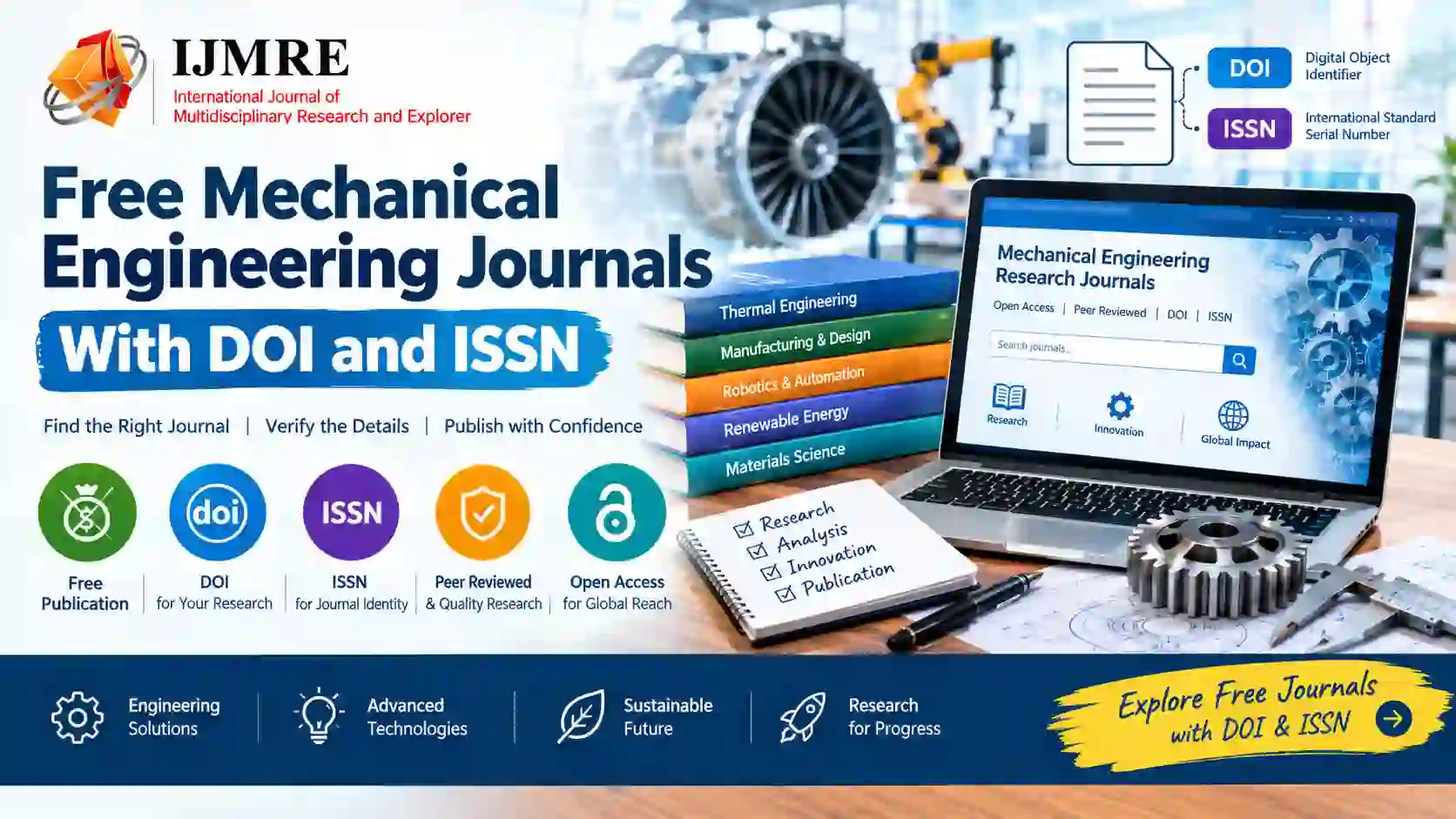
Publishing a mechanical engineering research paper is an important step in sharing technical findings, documenting innovation, and contributing to engineering knowledge. However, researchers—particularly students, early-career academics, and authors with limited research funding—often face a practical challenge: finding a suitable journal that provides DOI and ISSN identifiers without imposing high publication charges.
Whether your research focuses on thermal engineering, manufacturing, robotics, renewable energy, fluid mechanics, materials science, or computational modeling, journal selection requires more than searching for the words “free,” “DOI,” or “ISSN.” Authors should also examine the journal’s scope, peer-review process, publication policies, editorial transparency, and the accessibility of published articles.
This guide explains how to identify free mechanical engineering research journals with DOI and ISSN, how to verify their credentials, and what to consider before submitting a manuscript. It also discusses the publication options offered by the International Journal of Multidisciplinary Research and Explorer (IJMRE) for mechanical engineering studies that fit its multidisciplinary scope.
What Are Free Mechanical Engineering Research Journals?
Free mechanical engineering research journals are journals that allow authors to publish eligible manuscripts without paying a publication fee. Depending on the journal, “free” may mean no submission fee, no article processing charge (APC), or no charge for publication under specified conditions.
These terms are not interchangeable. A journal may offer free submission but charge an APC after acceptance. Another journal may publish articles without author fees but require a subscription for readers. Some open-access journals provide free access to readers while charging authors to support publication services.
Before submitting, check the journal’s official fee policy rather than relying only on search-result descriptions or third-party lists.
Understanding DOI and ISSN
Two identifiers frequently mentioned in academic publishing are the Digital Object Identifier (DOI) and the International Standard Serial Number (ISSN). They serve different purposes.
| Feature | DOI | ISSN |
|---|---|---|
| Full form | Digital Object Identifier | International Standard Serial Number |
| Purpose | Provides a persistent identifier for a digital object, such as a research article | Identifies a continuing publication, such as a journal |
| Typical use | Article identification and citation | Journal identification in print or online form |
| Format | Often appears as a DOI prefix and suffix, such as 10.xxxx/xxxxx | Eight digits, commonly displayed with a hyphen |
| What it does not prove | It does not by itself establish peer-review quality or indexing | It does not by itself establish quality, indexing, or a journal’s legitimacy |
A DOI can help readers locate and cite an article consistently. An ISSN helps identify a journal as a serial publication. Neither identifier guarantees that a journal is reputable, peer-reviewed, indexed in a particular database, or free to publish in.
Mechanical Engineering Research Areas to Consider
Mechanical engineering includes a wide range of research topics. When evaluating a journal, compare your manuscript’s specific subject and methods with the journal’s stated scope and recently published papers.
| Research area | Example topics | Potentially related disciplines |
|---|---|---|
| Thermal engineering | Heat transfer, thermal systems, refrigeration, energy efficiency | Energy engineering, materials science |
| Manufacturing and production | Advanced machining, additive manufacturing, process optimization | Industrial engineering, materials science |
| Robotics and automation | Robotic control, automation systems, intelligent manufacturing | Electrical engineering, computer science |
| Renewable energy | Solar thermal systems, wind energy, energy storage | Environmental science, electrical engineering |
| Fluid mechanics | Computational fluid dynamics, turbulence, flow optimization | Applied mathematics, aerospace engineering |
| Materials and design | Composite materials, fatigue analysis, structural optimization | Materials science, civil engineering |
| Automotive and transportation | Vehicle efficiency, electric mobility, engine performance | Automotive engineering, control systems |
How to Find Free Mechanical Engineering Journals With DOI and ISSN
1. Search by Your Specific Research Topic
Begin with the central contribution of your paper rather than a broad phrase such as “mechanical engineering journal.” A study on heat exchanger performance may fit a thermal engineering journal, while a paper on AI-assisted predictive maintenance may be relevant to mechanical engineering, industrial automation, or an interdisciplinary technology journal.
Use precise search terms such as:
- Mechanical engineering journals with no APC
- Free open-access mechanical engineering journals
- Peer-reviewed journals for manufacturing research
- Thermal engineering journals with DOI
- Mechanical engineering journals with online ISSN
- Interdisciplinary engineering journals for robotics research
Search results are a starting point, not proof that a journal is free or suitable. Confirm the details on the journal’s official website.
2. Check the Journal’s Official Fee Policy
Look for a dedicated publication-fee, APC, or author-charges page. Confirm whether the journal charges at submission, after acceptance, for extra pages, for optional services, or for any other publication-related process.
Record the exact conditions. For example, a journal may waive charges for a limited number of pages but apply a per-page fee beyond that limit. This is different from a journal that has no publication charges under any circumstances.
3. Verify the ISSN
Check the journal’s online or print ISSN on its official website and compare it with the relevant ISSN record. Make sure the title and publication details correspond to the journal you intend to submit to.
Remember that print and online editions can have separate ISSNs. An ISSN is an identification number, not a quality certification.
4. Verify the DOI of Published Articles
Open several recent articles from the journal and check whether their DOI links resolve to the correct article record. Compare the title, authors, journal name, publication date, and other metadata.
Do not assume that a journal assigns a DOI to every article simply because a DOI appears on its website. Check the policy and inspect actual published articles.
5. Examine Peer Review and Editorial Transparency
A credible journal should explain how manuscripts are evaluated. Look for information about editorial screening, reviewer selection, review models, conflicts of interest, revisions, and editorial decisions.
Peer review can take different forms, including single-blind, double-blind, and open review. The journal should describe the process it actually follows. A claim of peer review is more meaningful when the policy is specific and publicly available.
For more guidance, read How Peer Review Works in Academic Journals.
6. Check Indexing Claims Separately
Some authors require a journal to be included in a particular database for institutional, funding, or career-related reasons. Verify those requirements before submission.
Search the database itself and confirm that the journal’s title and ISSN match the record. A DOI, ISSN, Google Scholar visibility, or statement on a journal’s website should not be treated as proof of inclusion in Scopus, Web of Science, or another specific index.
See the guide to Scopus-indexed journals and how to check whether a journal is Scopus indexed and peer-reviewed for additional verification guidance.
Free Publication, Open Access, and Paid Publication: What Is the Difference?
Authors often use “free journal” and “open-access journal” as if they mean the same thing. In practice, they describe different aspects of publishing.
| Publishing model | What it generally means | What authors should verify |
|---|---|---|
| No-APC journal | Authors are not charged an article processing fee under the stated policy | Whether any other publication charges apply |
| Open-access journal | Readers can access published articles without a subscription | License terms, reuse permissions, and author charges |
| Subscription journal | Readers or institutions may need a subscription to access content | Whether an open-access option is available and whether it has a fee |
| Hybrid journal | A subscription journal may offer open access for selected articles | Optional open-access charges and the standard publication model |
| Conditional or page-based fee model | Some publication conditions are free, while specified services or page limits may incur charges | Exact thresholds, amounts, and when payment is required |
For a broader explanation, see What Is an Open Access Journal and Why Does It Matter? and Are Paid Journals Worth the Publication Fee?.
IJMRE as an Option for Relevant Mechanical Engineering Research
The International Journal of Multidisciplinary Research and Explorer (IJMRE) publishes peer-reviewed, open-access research across multiple subject areas, including science, engineering, technology, management, social sciences, education, and interdisciplinary studies.
Mechanical engineering authors may consider IJMRE when their manuscript fits its current scope. Potentially relevant areas can include:
- Mechanical design and engineering analysis
- Thermal and energy systems
- Manufacturing and production technologies
- Robotics and automation
- Renewable energy applications
- Mechanical systems integrated with AI, IoT, or data analytics
- Interdisciplinary engineering and technology studies
IJMRE’s regular publication information states that publication is free for articles up to 10 pages, with a charge of USD 5 per additional page. Authors should confirm the latest fee details and manuscript requirements on the official website before submitting.
IJMRE provides DOI information for its published articles. Authors should inspect recent article records and the journal’s current policies to confirm the details relevant to their submission.
Useful official resources:
- IJMRE official website
- Author Guidelines
- Peer-Review Policy
- Licensing Terms
- Current Issue
- Journal Archives
For more engineering-specific reading, see Free Open Access Mechanical Engineering Journals and Mechanical Engineering Research Journals: Peer-Reviewed International Options.
Warning Signs to Watch for When Choosing a Journal
Low publication fees can be helpful, but cost alone should not determine journal selection. Be cautious if you encounter any of the following:
- Guaranteed acceptance or publication without meaningful evaluation
- Unrealistic promises of peer review or publication within a very short period
- Unclear or hidden publication charges
- Unverifiable editorial-board members or affiliations
- Vague peer-review and research-ethics policies
- False or misleading claims of indexing
- Journal titles or websites that closely imitate established publications
- Pressure to pay before receiving clear information about the editorial process
These signs do not replace a full assessment, but they indicate that authors should investigate further. A transparent journal should make its policies, fees, scope, and editorial information reasonably easy to verify.
Checklist Before Submitting Your Mechanical Engineering Paper
- Is the manuscript within the journal’s stated scope?
- Have you read recent papers from the journal?
- Is the peer-review process clearly described?
- Are the publication fees and any page limits clear?
- Does the journal provide a valid ISSN record?
- Do the DOI links for recent articles resolve correctly?
- Are the journal’s indexing claims independently verified?
- Are the licensing and copyright terms suitable for your needs?
- Have you followed the manuscript template and author guidelines?
- Are all required ethics statements, permissions, and author declarations included?
Frequently Asked Questions
Can I publish a mechanical engineering paper for free and still receive a DOI?
Some journals provide DOI-bearing articles without charging authors, while others apply fees under specific conditions. Check the journal’s current fee policy and inspect published articles to confirm DOI assignment.
Does an ISSN mean that a mechanical engineering journal is reputable?
No. An ISSN identifies a continuing publication. It does not certify peer-review quality, editorial standards, indexing, or academic reputation.
Are all open-access mechanical engineering journals free for authors?
No. Open access describes reader access to published content. Some open-access journals charge APCs, while others use funding or alternative models that do not require author payment.
How can I check whether a journal’s DOI is valid?
Open the DOI link and confirm that it resolves to the correct article. Compare the article title, author details, journal name, and publication information with the journal’s official record.
Can I submit mechanical engineering research to a multidisciplinary journal?
Yes, if the manuscript fits the journal’s scope and its contribution is relevant to the journal’s readership. Research connecting mechanical engineering with materials science, energy, AI, IoT, manufacturing, or other fields may be suitable for some multidisciplinary journals.
What should I prioritize: free publication, DOI, ISSN, or indexing?
These features serve different purposes. Start with the journal’s fit for your research and its editorial and ethical standards. Then verify the identifiers, access model, fees, and any indexing requirements that matter for your institution or career goals.
Conclusion
Finding free mechanical engineering research journals with DOI and ISSN requires careful verification. A journal’s fee policy, DOI assignment, ISSN record, peer-review process, scope, licensing, and indexing status should be checked independently rather than inferred from a single claim.
For authors with limited publication budgets, no-APC and low-cost options can make scholarly communication more accessible. However, the goal should be to find a journal that is both financially suitable and academically appropriate for the research.
Mechanical engineering researchers whose work fits a multidisciplinary engineering and technology scope may consider IJMRE’s open-access research publishing platform. Reviewing its current author guidelines, peer-review policy, publication fees, and recent articles can help authors decide whether it meets their manuscript requirements.
Related IJMRE Resources
- Free Open Access Mechanical Engineering Journals
- Free vs Paid Mechanical Engineering Journals
- Paid Journals for Engineering Research
- Budget-Friendly Research Publication Options
- How to Publish Research Papers Without High APC Charges
- How to Select the Right Peer-Reviewed Journal
Keywords
free mechanical engineering research journals, mechanical engineering journals with DOI, mechanical engineering journals with ISSN, free engineering journals, no APC mechanical engineering journals, free open access engineering journals, peer-reviewed mechanical engineering journals, mechanical engineering research publication, affordable engineering journals, mechanical engineering journal selection, DOI and ISSN journals, multidisciplinary engineering journal, IJMRE