ISSN (Online): 2833-7298
ISSN (Print): 2833-7301
Publication Fees: Free (Free up to 10 pages; USD 5 per additional page)

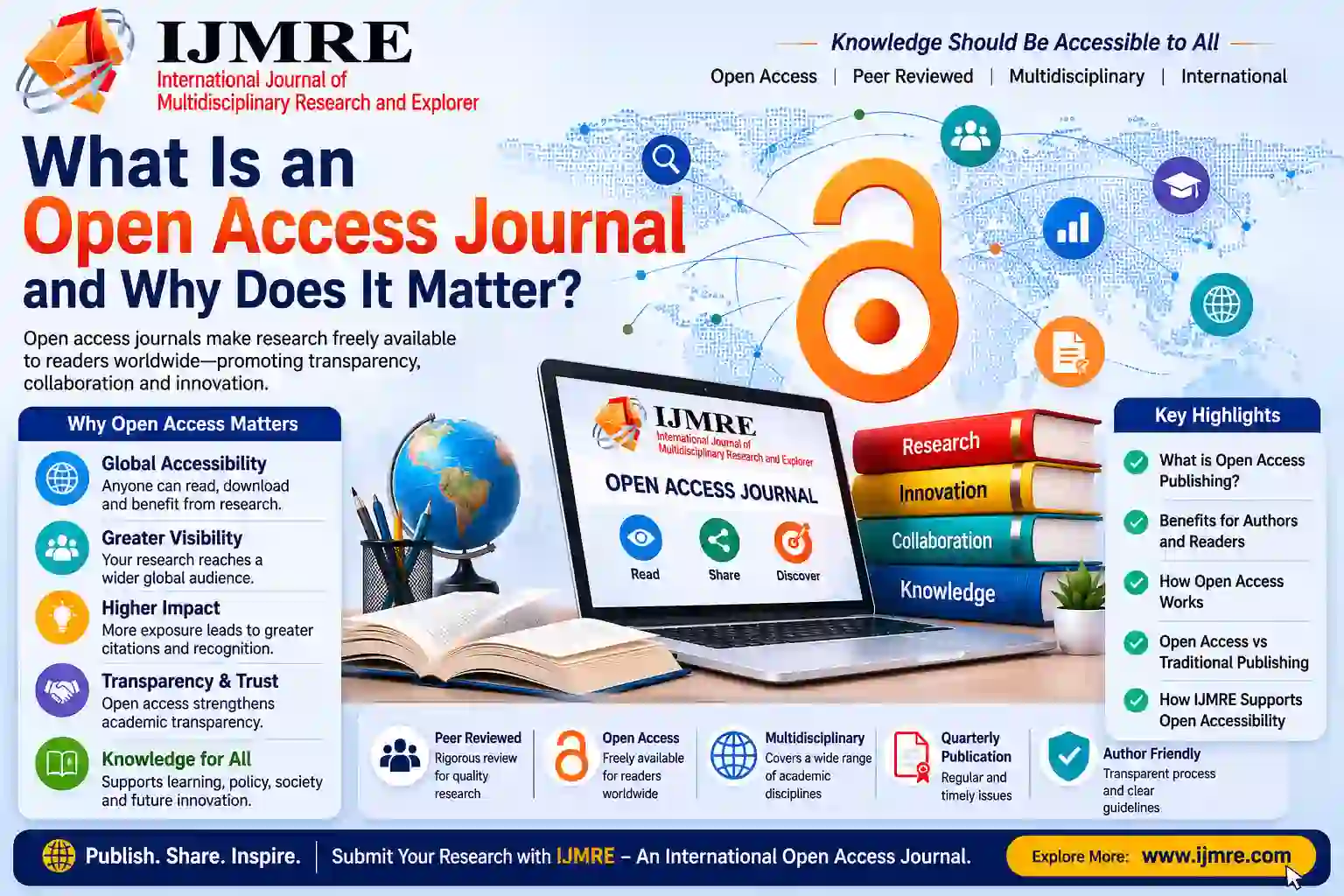
For many researchers, publishing a research paper is only the beginning. After months of collecting data, conducting experiments, analyzing results, and preparing a manuscript, authors want their work to reach as many relevant readers as possible. This is one reason open access publishing has become an important part of modern scholarly communication.
But what exactly is an open access journal? Does open access mean that publication is free? Does it mean that every open access journal is high quality? How does open access differ from traditional subscription publishing?
These are important questions for students, PhD scholars, faculty members, independent researchers, and professionals preparing their next research paper.
In this guide, we explain what an open access journal is, how the model works, why it matters to researchers and readers, what authors should check before submitting, and how the International Journal of Multidisciplinary Research and Explorer (IJMRE) approaches open-access scholarly publishing.
An open access journal is a scholarly journal that makes its published research available to readers online without requiring a traditional subscription or payment to access individual articles.
In a conventional subscription model, readers or institutions may need to pay for access to journal content. In an open access model, published articles are made available to readers without that traditional access barrier.
This means that a researcher in a university, a student, an independent scholar, or a professional outside academia may be able to read an open access research paper directly online.
However, it is important to understand that open access refers primarily to reader access, not automatically to publication cost.
No. This is one of the most common misunderstandings about open access publishing.
An article can be freely available to readers while the journal charges authors an Article Processing Charge (APC). Conversely, some journals may provide open access without charging authors a standard APC.
Therefore, when searching for a free research journal, researchers should check two separate questions:
These are separate aspects of the publishing model.
The general process is similar to other forms of scholarly publishing.
The important point is that open access does not eliminate the need for editorial evaluation or peer review. Researchers should still evaluate the quality and transparency of a journal before submitting.
Research has value only when it can be discovered, read, understood, and used by other people. Open access can reduce one important barrier: access to the published article.
For example, consider a researcher who discovers an interesting paper while searching online. If the article is behind a subscription barrier, the researcher may not be able to read the full paper without institutional or personal access.
With open access publishing, the article can be available directly to readers.
This can be particularly relevant to:
Academic research is increasingly international. A research paper may be written by authors from one country, address a global problem, and be useful to readers on another continent.
Open access can make this type of knowledge exchange easier because readers do not necessarily need access to the same institutional subscriptions as the authors.
For an international research journal, accessibility can therefore be an important part of communicating research to a broader academic audience.
The International Journal of Multidisciplinary Research and Explorer (IJMRE) describes itself as a peer-reviewed, open-access academic journal published quarterly. Its stated purpose is to provide a platform for researchers, academicians, and professionals to disseminate scholarly work across selected areas of multidisciplinary research.
Its multidisciplinary approach is particularly relevant to research that does not fit neatly into one academic discipline.
For example, modern research may combine:
Such research can benefit from a publication environment that recognizes connections between different areas of knowledge.
IJMRE combines open accessibility with a multidisciplinary research focus. According to its current journal information, it publishes research articles, review papers, and case studies across selected multidisciplinary areas.
Authors considering IJMRE should still evaluate whether their particular manuscript fits the journal's aims and scope before submitting.
Researchers looking for an open access journal for research papers can use the following checklist when evaluating IJMRE or any other journal:
| Factor | What Researchers Should Check |
|---|---|
| Scope | Does the journal publish research related to your topic? |
| Peer Review | Is the review process clearly explained? |
| Open Access | Are published articles freely accessible? |
| Fees | Are APCs and other charges clearly stated? |
| Licensing | Can readers understand how published content may be reused? |
| Ethics | Are publication ethics and research integrity policies available? |
| Author Guidelines | Are manuscript requirements clearly provided? |
| Recent Articles | Does the journal publish research relevant to your field? |
Open access and publication fees should be considered separately.
IJMRE currently states that there is no publication fee for articles up to 10 pages. Its current journal information also states that articles exceeding 10 pages are subject to a charge of USD 5 per additional page.
Authors should always check the latest official fee policy before submission because journal policies and charges can change over time.
This fee structure can be relevant to researchers searching for an affordable open access journal, particularly those working with limited publication budgets.
| Feature | Open Access Publishing | Traditional Subscription Publishing |
|---|---|---|
| Reader access | Generally available without a subscription | May require subscription or payment |
| Author fees | May be free or may involve APCs | Depends on the publisher and journal |
| Discoverability | Readers can directly access published content | Access may depend on institutional subscriptions |
| Licensing | Often clearly defined through an open license | May have more restrictive reuse conditions |
| Research sharing | Generally easier to share with readers | May be subject to access restrictions |
IJMRE currently publishes its articles under the Creative Commons Attribution 4.0 International (CC BY 4.0) license.
Under this license, readers can copy, distribute, display, and adapt published material, including for commercial purposes, provided that appropriate credit is given to the original authors and source, the license is linked, and changes are indicated.
IJMRE's licensing policy also states that authors retain copyright and grant the journal a non-exclusive right of first publication.
For researchers, understanding licensing is important because open access is not only about being able to read an article. It also concerns how published research can legally be reused and shared.
Readers can access published research without the traditional subscription barrier.
Authors can direct colleagues, students, collaborators, and other interested readers to the publicly accessible article.
Open access can make research easier to access across institutions and geographical boundaries.
Researchers outside the author's primary discipline can discover and read relevant work.
Openly accessible research can be useful to students and teachers who need scholarly literature for learning and academic work.
An explicit open license can help readers understand how an article may be reused, shared, or adapted.
No.
Open access can improve accessibility, but it does not guarantee citations, academic recognition, indexing, or research impact.
Citations can depend on many factors, including:
Therefore, researchers should avoid choosing a journal solely because it promises higher citations or greater visibility.
No.
Open access describes the accessibility of published research. Peer review describes the process used to evaluate manuscripts.
A journal can therefore be both open access and peer reviewed.
IJMRE identifies itself as a peer-reviewed, open-access journal. Its submission information explains that manuscripts are first assessed by an editor, and suitable submissions are sent for peer review before an acceptance or rejection decision.
Researchers should always read the current peer-review policy of the journal they are considering rather than assuming that every open access journal uses the same process.
The growth of open access publishing has also created more choices for researchers. This makes careful journal selection especially important.
A legitimate journal should clearly explain what subjects and types of research it publishes.
Look at recent articles rather than judging a journal only by its homepage.
Look for a clear explanation of editorial assessment and peer review.
Do not assume that open access means free publication. Read the complete fee policy.
Find out whether the journal clearly states how published articles can be reused.
Look for policies related to plagiarism, authorship, conflicts of interest, corrections, retractions, and research integrity.
If indexing is important to your academic requirements, verify the journal's inclusion directly through the relevant indexing service.
Clear author instructions are an important part of a transparent publishing process.
Some research questions cannot be answered from a single academic discipline.
Consider a study on smart cities. It might involve:
Similarly, research on an AI-powered manufacturing system could involve mechanical engineering, computer science, artificial intelligence, industrial automation, and data science.
This is where a multidisciplinary research journal can provide a useful publication option when the manuscript genuinely fits its scope.
Researchers can explore IJMRE when looking for an international multidisciplinary platform for interdisciplinary research.
| Term | Meaning |
|---|---|
| Open Access | Published research is freely accessible to readers. |
| Free Publication | The author does not pay a publication fee under the applicable policy. |
| APC | Article Processing Charge paid by an author or funding organization. |
| Peer Review | Scholarly evaluation of a manuscript before publication. |
| CC BY | A Creative Commons license allowing broad reuse with appropriate attribution. |
Understanding these terms can prevent researchers from confusing publication cost with reader access.
One of the most practical mistakes authors make is assuming that an open access journal is automatically free to publish in.
Before submitting a manuscript, check:
For IJMRE, the current official journal information states that there is no publication fee up to 10 pages, with USD 5 per additional page.
Open access can be particularly useful for:
However, the suitability of a journal should always be determined by research quality and journal fit rather than by accessibility alone.
If you are considering IJMRE, ask yourself the following questions:
If the answer to these questions is yes, you can make a more informed submission decision.
Authors can review the journal's current information and submission requirements through the official IJMRE website.
An open access journal makes its published scholarly articles freely accessible to readers online without requiring a traditional subscription to access the individual article.
Not necessarily. Some open access journals charge authors an APC, while others may operate with no publication fee or another funding model.
APC stands for Article Processing Charge. It is a fee that some journals charge authors or their institutions to support publication services.
Yes. IJMRE currently describes itself as a peer-reviewed, open-access academic journal.
IJMRE currently states that there is no publication fee for articles up to 10 pages. Articles exceeding 10 pages are subject to the stated additional-page charge. Authors should check the latest official policy before submitting.
IJMRE currently publishes its articles under the Creative Commons Attribution 4.0 International (CC BY 4.0) license.
No. Open access describes article accessibility. Manuscript acceptance depends on the journal's editorial and peer-review process and the quality and suitability of the research.
No. Open access can improve accessibility, but citations depend on many factors, including research quality, relevance, discoverability, and scholarly use.
No. A multidisciplinary journal is most appropriate when the manuscript fits its stated scope and genuinely relates to the areas the journal publishes.
Researchers searching for information about open access publishing may use several related search terms. Important keywords for this topic include:
Open access is an important development in scholarly communication, but it should not be treated as a shortcut to publication.
Before choosing a journal, researchers should evaluate:
A journal that is free to read but unclear about its editorial policies may not necessarily be the best choice. Similarly, a journal with an APC is not automatically superior.
Open access matters because research becomes more accessible to the people who need to read it.
For students, researchers, academics, professionals, and interdisciplinary teams, removing subscription barriers can make it easier to discover and use scholarly literature.
At the same time, researchers should understand that open access, free publication, peer review, indexing, DOI registration, and journal quality are different concepts. Each should be evaluated separately.
IJMRE provides an open-access, peer-reviewed multidisciplinary publishing platform for researchers working across selected academic fields. Its current licensing policy uses CC BY 4.0, and its current publication information states that articles up to 10 pages have no publication fee.
If you are preparing a research paper and looking for an open access journal, the most important step is to evaluate whether the journal's scope, policies, peer-review process, licensing, and publication model match your research needs.
For researchers whose work crosses academic disciplines, you can learn more about the International Journal of Multidisciplinary Research and Explorer (IJMRE) and review its current author requirements before considering a submission.
Open access is not simply about removing a paywall—it is about making scholarly knowledge more accessible while maintaining responsible and transparent academic publishing practices.
The International Journal of Multidisciplinary Research and Explorer (IJMRE) is a non-profit, open-access journal that does not charge any submission, processing, or publication fees. Donations made through this button are entirely voluntary and are used solely to support the maintenance, technical infrastructure, and continued accessibility of open research. Contributions do not influence editorial decisions or the peer review process in any way.