For many mechanical engineering researchers, completing a research paper is only the first step. The next challenge is finding a suitable journal that matches the research topic, publication requirements, budget, peer-review expectations, and desired publication model.
Consider a mechanical engineering researcher who has completed a study on thermal engineering, manufacturing, robotics, renewable energy, computational mechanics, materials, fluid mechanics, or mechanical design. While searching for a journal, the researcher may discover both journals that publish without an article processing charge (APC) and journals that require a publication fee.
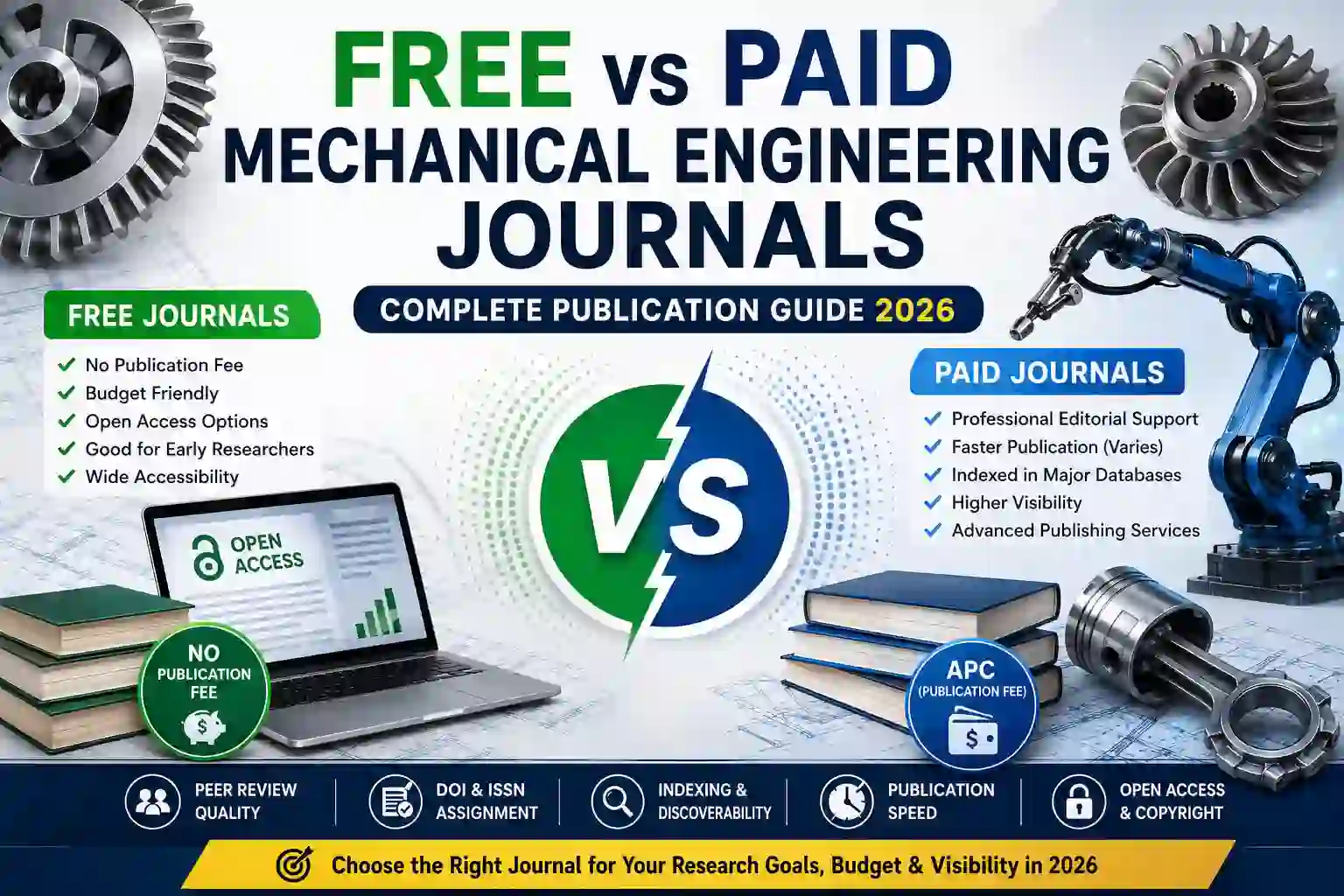
This naturally leads to an important question: Should you choose a free mechanical engineering journal or a paid journal in 2026?
The answer depends on more than the publication fee. Researchers should consider journal scope, peer review, editorial standards, indexing, open-access policies, DOI, ISSN, publication speed, copyright, and overall suitability for the manuscript.
This guide explains the differences between free and paid mechanical engineering journals and provides a practical framework for choosing an appropriate publication venue.
Researchers looking for an international research journal can also explore multidisciplinary publication opportunities when their mechanical engineering research overlaps with areas such as computer science, artificial intelligence, IoT, materials science, environmental science, or management.
What Is a Free Mechanical Engineering Journal?
A free mechanical engineering journal generally refers to a journal that does not charge authors an article processing charge or publication fee for an accepted manuscript.
However, researchers should understand that "free" can refer specifically to the author publication cost. A journal may be free for authors but operate under a subscription model for readers. Other journals may provide both free publication and open access.
Therefore, always check the journal's official author-fee and access policies before submission.
Typical Features of Free Journals
- No APC or publication fee may be charged to authors.
- Peer review may be provided without an author fee.
- The journal may be supported by a university, institution, society, foundation, or publisher.
- Some journals may provide open access without charging authors.
- Publication schedules can vary significantly between journals.
What Is a Paid Mechanical Engineering Journal?
A paid mechanical engineering journal charges an author fee for publishing an accepted article under its applicable publishing model. The fee is commonly called an Article Processing Charge (APC).
APCs can help publishers cover expenses associated with editorial management, peer-review administration, article production, hosting, digital infrastructure, archiving, and open-access distribution.
However, the presence of an APC does not automatically indicate higher journal quality. Researchers should evaluate the journal independently before submission.
Common Features of Paid Journals
- An APC or publication fee may apply.
- Open-access publication may be available.
- Publication services can vary between publishers.
- Some journals may provide optional expedited processing services.
- Waivers or discounts may be available depending on the journal.
- Additional charges may apply in some publishing models.
Free vs Paid Mechanical Engineering Journals: Key Differences
| Factor | Free Journal | Paid Journal |
|---|---|---|
| Author publication fee | Usually no APC | APC or publication fee may apply |
| Peer review | Depends on the journal | Depends on the journal |
| Open access | May or may not be available | Often available under open-access models |
| DOI | May be provided | May be provided |
| ISSN | May be available | May be available |
| Indexing | Depends on the journal | Depends on the journal |
| Publication speed | Varies | Varies |
| Research accessibility | Depends on publishing model | Often supports open access |
| Budget requirement | Low or zero publication cost | Requires funding if an APC applies |
| Journal quality | Must be evaluated individually | Must be evaluated individually |
Is a Paid Mechanical Engineering Journal Better Than a Free Journal?
Not necessarily.
A publication fee is not a guarantee of journal quality, peer-review standards, indexing, or academic reputation. Likewise, a journal that does not charge an APC is not automatically superior.
Researchers should evaluate the complete journal profile rather than making a decision based solely on cost.
Important factors include:
- Journal scope
- Peer-review process
- Editorial board
- Publication ethics
- Indexing and discoverability
- Publication history
- DOI and ISSN information
- Open-access policy
- Copyright and licensing
- Publication fees
- Expected publication timeline
Mechanical Engineering Research Areas Covered by Journals
Mechanical engineering is a broad discipline, and different journals specialize in different areas. Before submitting, researchers should ensure that their manuscript falls within the journal's stated scope.
Common mechanical engineering research areas include:
- Thermal engineering
- Heat transfer
- Fluid mechanics
- Manufacturing engineering
- Mechanical design
- Machine design
- Robotics and automation
- Computational mechanics
- Finite element analysis
- Materials and manufacturing
- Automotive engineering
- Renewable energy systems
- Energy efficiency
- Mechatronics
- Industrial engineering
- CAD and computer-aided engineering
- Tribology
- Vibration and control
- Advanced materials
- Additive manufacturing
How to Choose a Mechanical Engineering Journal
1. Check the Journal Scope
The first step is to determine whether the journal regularly publishes research similar to your manuscript.
For example, a paper about computational fluid dynamics may be better suited to a journal that specifically publishes fluid mechanics or computational engineering research than a journal with an unrelated scope.
Similarly, research involving mechanical systems and IoT may be suitable for a multidisciplinary or interdisciplinary journal.
2. Examine the Peer-Review Process
A transparent peer-review process is one of the most important factors when evaluating a journal.
Check whether the journal clearly explains:
- Peer-review type
- Reviewer evaluation
- Editorial decision process
- Revision procedures
- Research ethics requirements
- Conflict-of-interest policy
Researchers can also read our detailed guide on how peer review works in academic journals.
3. Check Publication Fees Before Submission
If the journal is paid, determine exactly what the stated APC covers.
Check whether additional charges exist for:
- Additional pages
- Figures or special formatting
- Language editing
- Fast-track processing
- Special publication services
- Withdrawal after acceptance
A transparent journal should provide clear information about publication charges before authors submit their manuscripts.
4. Verify DOI Information
A Digital Object Identifier (DOI) provides a persistent identifier for a digital article. It can make a published research paper easier to identify and cite.
However, researchers should remember that the presence of a DOI does not by itself prove that a journal is reputable or indexed in a particular database.
DOI information should therefore be considered alongside peer review, editorial policies, indexing, publication history, and ethics.
5. Check the ISSN
An International Standard Serial Number (ISSN) identifies a serial publication. A journal may have separate ISSNs for different publication formats, such as online and print.
As with DOI, an ISSN is an identification mechanism and should not be treated as a quality certification.
6. Verify Indexing Claims
If indexing is important for your academic requirements, verify the journal's current status directly through the relevant indexing database.
Do not rely solely on logos, screenshots, promotional claims, or third-party lists displayed on a journal website.
For guidance, read How to Check Whether a Journal Is Scopus Indexed and Peer Reviewed.
Advantages of Free Mechanical Engineering Journals
1. Lower Publication Cost
The most obvious advantage is that authors can publish without paying an APC when the journal genuinely has a no-fee publication model.
2. Useful for Researchers With Limited Funding
Students, independent researchers, early-career academics, and researchers without institutional publication funding may benefit from journals that do not charge publication fees.
3. Reduced Research Dissemination Cost
When publication is free, researchers can allocate limited research funding to equipment, experiments, data collection, conferences, or other research activities.
Potential Limitations of Free Journals
- Publication schedules can vary.
- Some journals may not provide immediate open access.
- Editorial services may differ between publishers.
- Some journals may have limited digital publishing resources.
- Researchers must still evaluate peer review and journal quality.
Advantages of Paid Mechanical Engineering Journals
1. Open-Access Opportunities
Some paid journals publish articles under open-access models, allowing readers to access research without a subscription.
2. Publishing Infrastructure
APCs may support editorial management, digital hosting, article production, archiving, and other publishing infrastructure.
3. Additional Publishing Services
Depending on the journal, paid publishing models may include additional production or article-processing services.
Potential Limitations of Paid Journals
- Publication fees can create financial pressure.
- APCs can vary significantly between journals.
- Additional charges may apply.
- A fee does not guarantee manuscript acceptance.
- Researchers need to distinguish legitimate journals from deceptive publishing operations.
What Is a Low-APC Mechanical Engineering Journal?
A low-APC mechanical engineering journal is a journal that charges a relatively affordable article processing fee compared with higher-cost publishing options.
Low APC can be attractive to researchers who want open-access publication while working within a limited budget.
However, affordability should never replace quality assessment. A low-cost journal should still have a clear scope, transparent peer review, publication ethics, editorial information, fee policy, and appropriate publication standards.
Researchers interested in affordable open-access publishing can also read our guide to low-APC open-access journals.
Free vs Low-APC vs High-APC Journals
| Publication Model | Author Cost | Potential Benefit | What to Check |
|---|---|---|---|
| Free / No APC | No publication fee | Affordable publishing | Quality, peer review, access and indexing |
| Low APC | Affordable publication fee | Potential open access at lower cost | Fee transparency and journal quality |
| Higher APC | Higher publication fee | May provide open-access publishing and publishing infrastructure | Services, quality, transparency and value |
When Should You Choose a Free Mechanical Engineering Journal?
A free journal may be appropriate when your primary concern is minimizing publication costs and the journal meets your academic requirements.
Consider a free journal when:
- You have a limited publication budget.
- Your university does not provide APC funding.
- You are an independent researcher.
- The journal's scope matches your research.
- The peer-review process is clearly explained.
- The publication timeline is acceptable.
- The journal satisfies your institution's requirements.
When Should You Choose a Paid Mechanical Engineering Journal?
A paid journal may be suitable when the journal's publishing model provides benefits that matter to your research dissemination strategy.
Consider a paid journal when:
- You have legitimate research or institutional funding.
- Open-access availability is important.
- The APC is transparent and affordable within your budget.
- The journal has appropriate peer-review policies.
- The journal's scope closely matches your manuscript.
- The publication model satisfies your academic requirements.
How to Avoid Predatory Mechanical Engineering Journals
Researchers should be careful when evaluating both free and paid journals. Predatory publishing is not defined simply by whether a journal charges an APC.
Be cautious if a journal:
- Guarantees acceptance.
- Promises publication without meaningful peer review.
- Claims unrealistic publication times.
- Uses questionable indexing claims.
- Provides little information about its publisher.
- Has an unclear editorial board.
- Does not disclose publication fees clearly.
- Uses aggressive email invitations.
- Publishes articles unrelated to its stated scope.
For additional guidance, see How to Avoid Fake Scopus Journals.
Free vs Paid Journals for Mechanical Engineering: Decision Table
| Your Situation | Potential Choice | Reason |
|---|---|---|
| Limited publication budget | Free / No APC | Reduces author cost |
| Need open-access publication | Free OA or Paid OA | Depends on the journal's publishing model |
| University provides APC funding | Free or Paid | Compare quality and academic suitability |
| Independent researcher | Free or Low APC | Helps control publication expenses |
| Need specific indexing | Either | Verify the current indexing status independently |
| Interdisciplinary research | Multidisciplinary journal | May better match cross-disciplinary research |
Why Mechanical Engineering Researchers May Choose Multidisciplinary Journals
Modern mechanical engineering increasingly overlaps with other disciplines. Research involving robotics, artificial intelligence, IoT, smart manufacturing, renewable energy, computational modeling, materials science, and automation can involve methods from several academic fields.
For interdisciplinary research, a multidisciplinary research journal may provide a suitable publication environment when the manuscript falls within its stated scope.
Researchers can learn more about multidisciplinary publishing in Why Researchers Prefer Multidisciplinary Journals for Publication.
How to Select the Right Mechanical Engineering Journal in 2026
- Define your research topic. Identify the exact mechanical engineering area covered by your manuscript.
- Create a journal shortlist. Find journals that regularly publish similar research.
- Check the journal scope. Make sure your manuscript fits the stated aims and scope.
- Review peer-review information. Understand how manuscripts are evaluated.
- Compare publication fees. Determine whether the journal is free, low APC, or higher APC.
- Check open-access terms. Understand who can access the published article.
- Verify DOI and ISSN information. Confirm the journal's publication identifiers.
- Verify indexing claims. Check important databases directly.
- Review publication ethics. Look for clear policies concerning research integrity and conflicts of interest.
- Read author guidelines. Follow formatting, submission, reference, and ethical requirements.
- Compare publication timelines. Consider whether the expected schedule fits your needs.
- Make the final decision. Choose the journal that offers the best overall fit rather than simply the lowest price.
Free vs Paid Mechanical Engineering Journals: Which Should You Choose?
There is no single answer that applies to every mechanical engineering researcher.
Choose a free journal when your budget is limited and the journal meets your requirements for scope, peer review, publication ethics, accessibility, and academic suitability.
Choose a paid journal when you have suitable funding and the journal's publishing model, open-access options, editorial standards, and other characteristics provide sufficient value for your research.
The most important principle is:
Do not select a journal only because it is free, and do not select a journal simply because it charges a publication fee.
Instead, evaluate the journal as a complete publication venue.
Frequently Asked Questions
Are free mechanical engineering journals legitimate?
Yes. Some legitimate journals publish without charging authors an APC. However, researchers should independently evaluate the journal's peer-review process, editorial policies, publisher information, publication ethics, scope, and indexing.
Are paid mechanical engineering journals better?
Not automatically. An APC does not guarantee journal quality. The journal should be evaluated based on its editorial standards, peer review, scope, ethics, publication policies, and suitability for the research.
Can I publish a mechanical engineering research paper without paying?
Yes. Some journals operate without charging authors an APC or publication fee. Authors should check the journal's current fee policy before submission.
What is an APC?
APC stands for Article Processing Charge. It is a fee charged by some journals for processing and publishing an accepted research article, particularly under certain open-access publishing models.
What is a low-APC mechanical engineering journal?
It is a journal with a relatively affordable article processing charge. Researchers should evaluate quality, peer review, scope, ethics, indexing, and fee transparency in addition to the APC.
Does an ISSN prove that a mechanical engineering journal is reputable?
No. An ISSN identifies a serial publication but does not independently certify the journal's quality, peer-review standards, indexing, or reputation.
Does a DOI guarantee journal quality?
No. A DOI identifies a digital publication persistently. It should not be interpreted as a certification of journal quality.
How can I verify whether a mechanical engineering journal is Scopus indexed?
If Scopus indexing is important for your academic requirements, verify the journal's current status through the official Scopus or relevant indexing source rather than relying only on the journal's website.
Should mechanical engineering researchers choose multidisciplinary journals?
Multidisciplinary journals can be appropriate for research that crosses multiple fields, such as mechanical engineering combined with AI, IoT, robotics, materials science, environmental technology, or computer science. The manuscript must still fit the journal's stated scope.
Are fast-publication mechanical engineering journals reliable?
Publication speed alone does not determine reliability. Researchers should check whether the journal provides a meaningful peer-review process and transparent editorial policies. Be cautious of journals that guarantee acceptance or promise publication without proper evaluation.
Summary
The choice between free and paid mechanical engineering journals in 2026 should be based on more than the publication fee.
Free journals can help researchers publish without an APC, making them attractive to students, independent researchers, and authors with limited funding. Paid journals can provide open-access publishing and other publishing infrastructure, but the APC should be evaluated against the journal's overall academic value.
Before submitting a mechanical engineering research paper, check:
- Journal scope
- Peer-review process
- Editorial board
- Publication ethics
- APC and additional charges
- DOI information
- ISSN information
- Indexing status
- Open-access policy
- Copyright and licensing
- Publication schedule
- Author guidelines
The best mechanical engineering journal is not necessarily the cheapest or the most expensive. It is the journal that provides the appropriate combination of research relevance, transparent peer review, publication ethics, accessibility, discoverability, and affordability.
Related Research Publication Guides
- Mechanical Engineering Research Journals 2026: Best Peer-Reviewed International Journals
- Best Paid Journals for Engineering Research in 2026
- Paid Journals With DOI and ISSN for International Research
- Low APC Open Access Journal
- Fast Publication Journals With Low Publication Fees
- Free vs Paid Research Journals: Which Should You Choose?
- How to Select the Right Peer-Reviewed Journal for Publication
Ready to Publish Your Mechanical Engineering Research?
Before submitting your manuscript, carefully review the journal's scope, author guidelines, peer-review process, publication fees, indexing information, licensing policy, and publication ethics.
If your research combines mechanical engineering with other disciplines, consider whether an appropriate multidisciplinary research journal may provide a suitable publication scope for your work.
Choose the journal based on academic suitability and transparency—not simply on whether it is free or paid.