ISSN (Online): 2833-7298
ISSN (Print): 2833-7301
Publication Fees: Free (Free up to 10 pages; USD 5 per additional page)

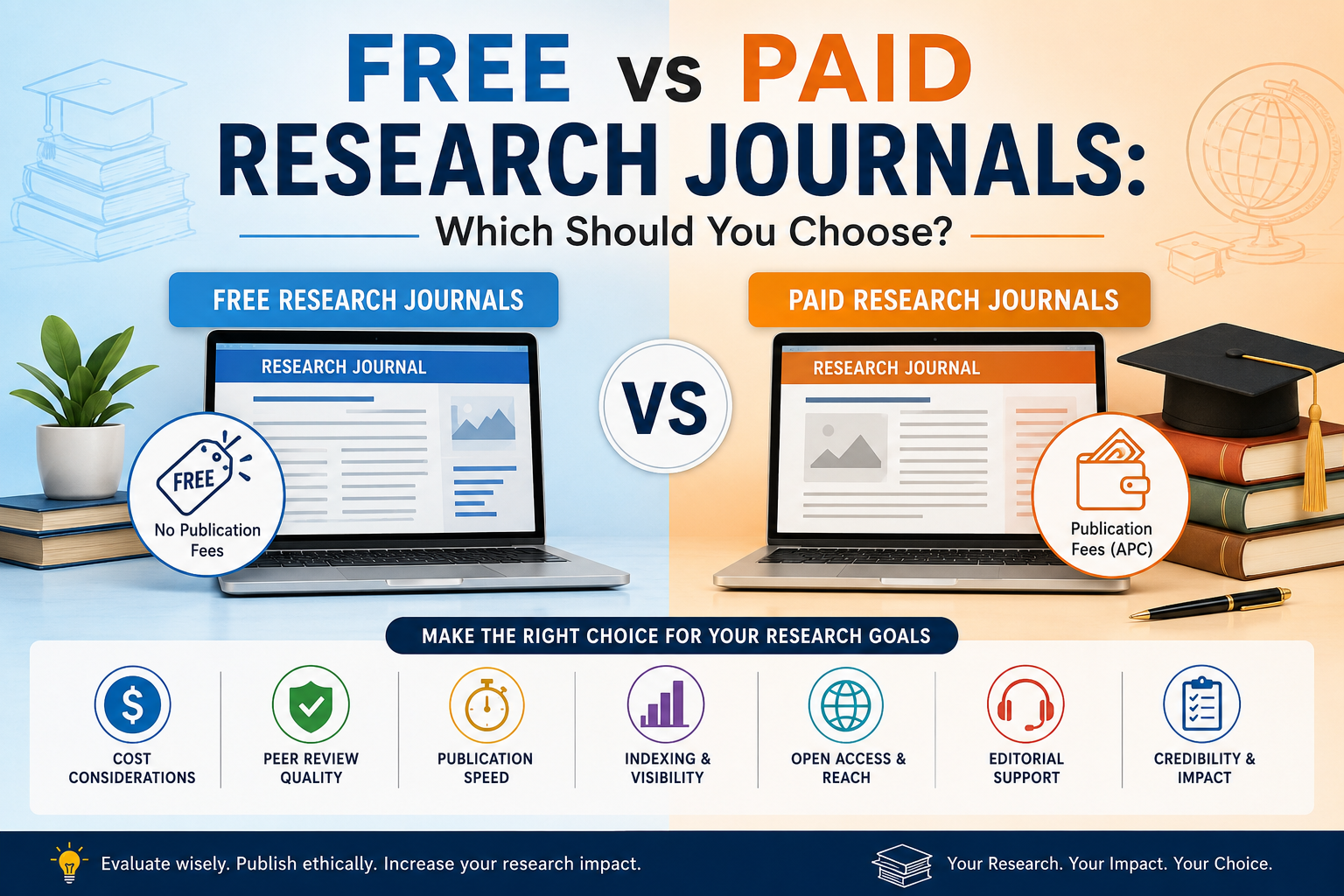 One of the most common questions researchers ask before submitting a manuscript is whether they should publish in a free research journal or a paid research journal. Many authors assume that paid journals are always better, while others believe free journals provide the same academic value without publication charges.
The truth is more nuanced. Publication fees do not automatically determine a journal's quality. Excellent journals exist in both categories, while some low-quality journals also charge significant publication fees. Understanding the differences helps researchers choose the right publication venue based on quality, visibility, indexing, budget, and career goals.
This comprehensive guide explains the advantages, disadvantages, myths, and decision-making factors that every researcher should know before submitting a manuscript.
Free research journals are journals that do not charge authors for submitting, processing, or publishing their manuscripts. These journals are usually supported by universities, academic societies, research institutions, government organizations, or non-profit publishers.
Authors can submit manuscripts without worrying about publication costs while still benefiting from peer review and academic publication.
Paid research journals charge authors an Article Processing Charge (APC) or publication fee. These fees help cover editorial management, peer review administration, copyediting, DOI registration, website maintenance, digital preservation, indexing services, and open-access publication.
Paying a publication fee does not guarantee acceptance. Reputable journals maintain independent peer review standards regardless of payment.
No.
This is one of the biggest misconceptions in academic publishing.
Legitimate paid journals reject manuscripts that fail to meet their editorial standards. Acceptance depends on originality, research quality, ethical compliance, methodology, and successful peer review—not on the author's ability to pay.
Researchers should avoid journals that promise guaranteed publication without proper peer review, as these may be predatory publishers.
| Feature | Free Research Journals | Paid Research Journals |
|---|---|---|
| Submission Fee | Usually Free | May Charge APC After Acceptance |
| Publication Cost | No Publication Fee | Article Processing Charge (APC) |
| Peer Review | Yes (Reputable Journals) | Yes (Reputable Journals) |
| Publication Speed | Often Slower | Usually Faster |
| Acceptance Rate | Generally More Competitive | Depends on Journal Quality |
| Open Access | Some Are Open Access | Frequently Open Access |
| Editorial Support | Limited Resources | More Comprehensive Editorial Services |
| Funding Requirement | No | May Require Research Funding or Institutional Support |
Not necessarily.
The quality of a research journal depends on several factors, including its editorial board, peer-review process, publication ethics, indexing, citation impact, and transparency. While many highly respected journals charge publication fees, numerous reputable journals also publish articles free of charge.
Instead of focusing only on whether a journal is free or paid, researchers should evaluate the journal using objective quality indicators.
A free journal can be an excellent option if publication speed is not your highest priority and you want to avoid publication costs.
Free journals are especially suitable for:
If the journal follows ethical publishing practices and has a rigorous peer-review process, a free journal can provide excellent academic value.
Paid journals may be a better choice when faster publication, wider accessibility, and professional publishing services are important for your research goals.
Paid journals are often appropriate when:
Always ensure that any publication fee is clearly explained on the journal's website and is charged only after the manuscript has successfully passed peer review and been accepted.
Whether a journal is free or paid, researchers should remain cautious of predatory publishers that prioritize profit over academic integrity.
Choosing a trustworthy journal requires careful evaluation rather than simply selecting the cheapest or fastest publication option.
Selecting the right journal is one of the most important decisions in the publication process. Rather than deciding based only on publication fees, researchers should evaluate whether the journal aligns with their research goals, subject area, and target audience.
Ensure that your manuscript matches the aims and scope of the journal. A well-matched submission has a higher chance of passing the initial editorial screening and moving to peer review.
A reputable journal clearly explains its peer-review model, editorial workflow, review timelines, and publication ethics. Transparent peer review is a strong indicator of publication quality.
Before submitting your manuscript, verify where the journal is indexed. Indexing in recognized databases improves discoverability, increases citation potential, and enhances the credibility of your published work.
Browse recently published articles to evaluate the quality of research, writing standards, formatting, and editorial consistency. This also helps determine whether your manuscript fits the journal's style and audience.
If the journal charges an Article Processing Charge (APC), make sure the fee structure is transparent. Reputable journals clearly explain when the fee is payable and what services it covers. Avoid journals that request payment before peer review or guarantee acceptance after payment.
If your institution, funding agency, or academic program has strict deadlines, compare the journal's average review and publication time. Choose a journal that can realistically meet your required schedule without compromising peer-review quality.
Reality: Publication fees do not determine academic quality. Many highly respected journals charge APCs, while many equally reputable journals publish free of charge.
Reality: Numerous free journals follow rigorous peer-review processes and maintain high editorial standards.
Reality: Legitimate journals accept manuscripts based on originality, scientific merit, methodology, and reviewer recommendations—not payment.
Reality: Efficient editorial management can reduce publication time while maintaining a thorough peer-review process. Speed alone should not be considered a sign of poor quality.
Use the following checklist to evaluate any journal before submitting your manuscript:
| Your Goal | Recommended Option |
|---|---|
| Publish without spending money | Free Research Journal |
| Need faster publication | Reputable Paid Journal |
| Limited research funding | Free Journal or APC Waiver Journal |
| Increase research visibility | Open Access Journal |
| Meet graduation or promotion deadlines | Journal with Transparent Fast Review Process |
| Reach an international audience | International Peer-Reviewed Journal |
Whether you choose a free or paid research journal, the most important consideration is the journal's academic quality and ethical publishing standards. A well-managed journal with a transparent editorial process will provide greater long-term value than a journal chosen solely because it is free or because it promises rapid publication.
Before submitting your manuscript, take time to review the journal's policies, peer-review process, indexing information, publication ethics, and recent issues. Publishing in a credible journal strengthens your academic profile and increases the impact of your research.
The International Journal of Multidisciplinary Research and Explorer (IJMRE) provides a transparent and ethical publishing platform for researchers across multiple disciplines. The journal follows a structured peer-review process, publishes original research, and is committed to maintaining high editorial standards.
IJMRE welcomes submissions from researchers, academicians, industry professionals, and students working in multidisciplinary fields. Authors benefit from an efficient editorial workflow, open-access publishing, DOI assignment, and clear publication policies.
Useful resources for prospective authors include:
Yes. Many free research journals are published by universities, scholarly societies, and non-profit organizations. Their reliability depends on editorial quality, peer review, and ethical publishing practices—not on whether they charge publication fees.
No. Reputable paid journals accept manuscripts only after successful peer review and editorial evaluation. Paying an Article Processing Charge (APC) does not guarantee acceptance.
An APC is a publication fee charged by some journals after a manuscript has been accepted. It helps cover editorial management, production, online hosting, digital preservation, and open-access publishing services.
Look for warning signs such as guaranteed acceptance, fake indexing claims, hidden fees, poor website quality, missing editorial information, and the absence of a transparent peer-review process.
Students should prioritize reputable journals that match their research field and maintain high editorial standards. If funding is limited, a quality free journal can be an excellent choice.
Many paid journals are open access, making articles freely available to readers worldwide. However, visibility depends on factors such as indexing, discoverability, and the quality of the published research rather than publication fees alone.
Choosing between a free and a paid research journal is not about determining which option is universally better—it is about selecting the journal that best fits your research objectives, budget, publication timeline, and academic requirements.
Free journals offer an excellent opportunity for researchers seeking cost-effective publication, while paid journals may provide additional publishing services, faster processing, and broader open-access visibility. In both cases, researchers should focus on journals with transparent editorial policies, rigorous peer review, ethical publishing standards, and a strong reputation within the academic community.
By evaluating journals carefully and avoiding predatory publishers, you can ensure that your research reaches the right audience and contributes meaningfully to the advancement of knowledge.
The International Journal of Multidisciplinary Research and Explorer (IJMRE) is a non-profit, open-access journal that does not charge any submission, processing, or publication fees. Donations made through this button are entirely voluntary and are used solely to support the maintenance, technical infrastructure, and continued accessibility of open research. Contributions do not influence editorial decisions or the peer review process in any way.