Publishing a research paper is an important part of an academic and professional career. However, publication costs can sometimes become a concern, particularly for students, early-career researchers, independent scholars, and researchers working with limited institutional funding. In 2026, researchers have more publication options than ever, but choosing an affordable journal should involve much more than simply looking for the lowest publication fee.
A genuinely suitable research journal should provide a transparent publication process, clearly defined peer-review procedures, appropriate editorial standards, ethical publishing policies, licensing information, and reliable article access. Researchers should also verify a journal's indexing claims independently rather than selecting a publication venue solely because it advertises itself as inexpensive.
This guide explains how to evaluate budget-friendly research publication options in 2026 and highlights how the International Journal of Multidisciplinary Research and Explorer (IJMRE) can be considered by researchers looking for an affordable multidisciplinary publication venue.
What Does Budget-Friendly Research Publication Mean?
Budget-friendly research publication does not necessarily mean that a journal must be completely free. Instead, it generally refers to a publication option where the total cost is reasonable and clearly communicated to authors.
Publication-related expenses may include article processing charges, additional page charges, optional fast-publication services, language editing, formatting, or other services. Researchers should examine the complete fee policy before submitting a manuscript.
An affordable journal should therefore be evaluated using both cost and quality-related criteria.
Why Publication Cost Matters to Researchers
Research publication can involve significant expenses. Researchers may already have to manage costs related to data collection, laboratory work, software, conference participation, travel, research assistants, and thesis preparation.
For researchers without institutional publication funding, a high article processing charge can become a barrier to sharing their work.
Affordable publication options can be particularly useful for:
- Postgraduate and doctoral researchers
- Early-career academics
- Independent researchers
- Researchers from institutions with limited publication budgets
- Students preparing research papers or dissertations
- Authors working on multidisciplinary research projects
However, affordability should never be the only factor used to select a journal. A low-cost journal with unclear editorial practices may create greater academic risks than a transparent journal with a reasonable publication model.
Free Publication vs Low-Cost Publication
One of the most common questions researchers ask is whether they should choose a completely free journal or a journal with a modest publication charge.
| Factor | Free Publication | Low-Cost Publication |
|---|---|---|
| Author Cost | No publication charge under the journal's stated conditions | Reasonable fee according to the journal's policy |
| Peer Review | Should still be independently verified | Should still be independently verified |
| Open Access | May or may not be open access | May or may not be open access |
| Licensing | Check the stated reuse license | Check the stated reuse license |
| Indexing | Must be independently verified | Must be independently verified |
| Best For | Researchers with very limited publication budgets | Researchers seeking affordability with clearly defined publication services |
The important point is that free does not automatically mean better, and paid does not automatically mean higher quality. The journal's editorial policies, peer-review process, ethics, transparency, and suitability for the research should be considered first.
How to Identify a Reliable Budget-Friendly Research Journal
Researchers should conduct a basic quality and transparency check before submitting a manuscript. The following factors can help distinguish a legitimate affordable journal from a potentially unreliable publication venue.
1. Check the Journal's Scope
Start by reading the journal's aims and scope. Your research should fit naturally within the subjects covered by the journal.
For multidisciplinary research, a journal with a broad but clearly defined scope can be useful because research projects increasingly combine multiple fields such as computer science, engineering, management, economics, artificial intelligence, data science, and other disciplines.
Submitting a paper simply because a journal is inexpensive, without checking its scope, can lead to unnecessary rejection or poor academic alignment.
2. Examine the Peer-Review Policy
Peer review is one of the most important parts of scholarly publishing. Before submission, researchers should determine whether the journal publicly explains how manuscripts are evaluated.
Look for information about:
- Editorial screening
- Reviewer selection
- Confidentiality
- Conflict-of-interest procedures
- Evaluation criteria
- Revision procedures
- Final editorial decisions
For detailed information about the IJMRE publication process, authors can review the IJMRE Author Guidelines before submitting a manuscript.
Why IJMRE Can Be Considered a Budget-Friendly Publication Option
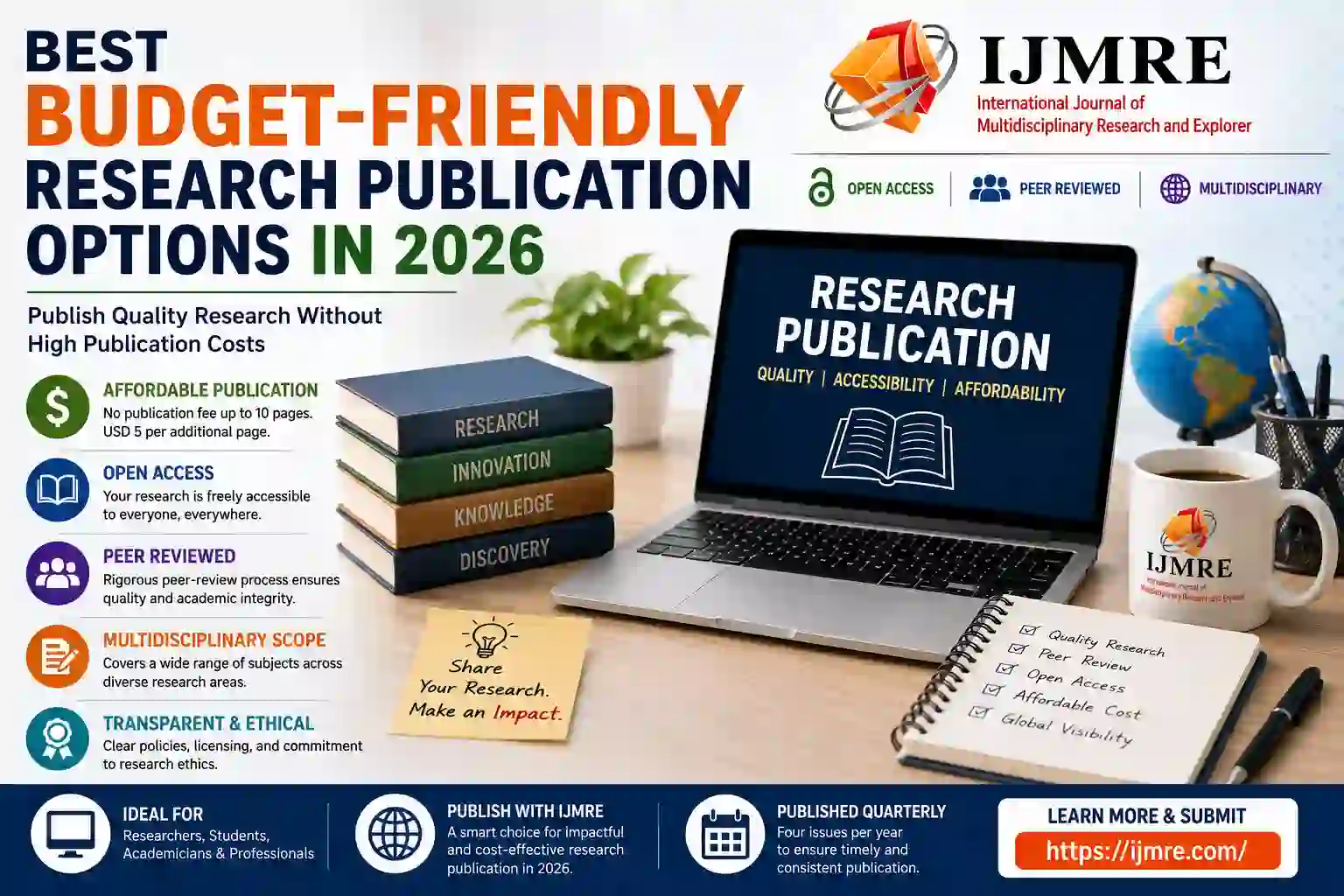
The International Journal of Multidisciplinary Research and Explorer (IJMRE) is an open-access, peer-reviewed multidisciplinary journal published quarterly.
IJMRE publishes research covering selected multidisciplinary areas and provides researchers with an option to make their published work openly accessible to readers.
One of the important considerations for authors is the journal's stated publication fee structure. IJMRE currently provides no publication fee for articles up to 10 pages. Articles exceeding 10 pages are subject to an additional charge of USD 5 per extra page, according to the journal's current publication-fee information.
This model can be particularly relevant for researchers who want to control publication expenses while still publishing through a formal scholarly journal.
IJMRE Publication Cost Structure
| Article Length | Publication Fee |
|---|---|
| Up to 10 pages | No publication fee |
| More than 10 pages | USD 5 per additional page |
Authors should always review the current fee information and journal policies before submitting, because publication policies can change over time.
Affordable Does Not Mean Skipping Peer Review
A common misconception is that a journal offering free or low-cost publication must have a weaker editorial process. Cost and editorial quality are separate issues.
Researchers should ask whether the journal explains its peer-review and editorial procedures clearly. A reasonable publication fee can support journal operations, but a fee itself should not be treated as evidence of quality.
Similarly, a journal offering free publication should not automatically be assumed to be high quality. Authors should evaluate the complete publication record and policies before making a decision.
Open Access and Affordable Research Publication
Open access publishing allows readers to access scholarly articles without necessarily encountering a subscription paywall. This can make research more accessible to students, researchers, educators, professionals, and readers outside traditional academic institutions.
For authors, open access can be an important consideration when choosing a publication venue because the accessibility of the final article may influence how easily other researchers can read and use the work.
IJMRE publishes articles under the Creative Commons Attribution 4.0 International (CC BY 4.0) license. This licensing model allows reuse under the conditions of the license, including appropriate attribution.
Why Licensing Matters When Choosing a Journal
Publication cost is only one part of the decision. Authors should also understand what happens to their copyright and how readers can reuse the published article.
Before submitting, check:
- Who retains copyright?
- What license is applied to published articles?
- Can readers share the article?
- Can the article be reused under the stated license?
- Are attribution requirements clearly explained?
Clear licensing information can help authors understand their rights and responsibilities after publication.
Check Indexing Claims Carefully
Indexing is another important factor when comparing research journals. However, researchers should be careful with statements such as "internationally indexed," "Scopus indexed," or "Web of Science indexed."
An ISSN, DOI, Google visibility, website presence, or inclusion in a general academic search engine should not automatically be interpreted as equivalent to inclusion in every major indexing database.
Before relying on an indexing claim, visit the official website of the indexing service and verify the journal title, ISSN, publisher information, and current status.
Researchers can also read our practical guide on how to avoid fake Scopus journals and misleading indexing claims.
Do Not Choose a Journal Only Because It Is Cheap
The lowest publication fee should not automatically determine your choice of journal.
A useful way to evaluate a publication venue is to consider several factors together:
| Evaluation Factor | What to Check |
|---|---|
| Scope | Does the journal publish research related to your subject? |
| Peer Review | Is the review process clearly explained? |
| Editorial Board | Are editorial responsibilities and affiliations transparent? |
| Publication Fee | Are all mandatory charges clearly stated? |
| Open Access | Can readers access published articles? |
| License | Is the article licensing policy clearly explained? |
| Indexing | Can indexing claims be independently verified? |
| Archiving | Does the journal provide information about preservation? |
| Ethics | Are publication ethics and misconduct policies available? |
| Transparency | Are submission, review, publication, and withdrawal procedures explained? |
Budget-Friendly Publication for Multidisciplinary Researchers
Multidisciplinary research has become increasingly important as researchers address complex problems that cannot always be solved from a single academic perspective.
For example, a research project may combine artificial intelligence with mechanical engineering, Internet of Things technologies with healthcare, data analytics with business management, or cybersecurity with social science.
Researchers working across disciplines may therefore benefit from carefully selecting a journal whose scope accommodates interdisciplinary and multidisciplinary research.
IJMRE focuses on multidisciplinary research and provides a publication venue for research and review work within its stated areas of scope.
Researchers can explore the journal's research and academic publishing resources for additional information on publication-related topics.
How Students Can Reduce Research Publication Costs
Students and early-career researchers can take several practical steps to manage publication expenses.
Prepare the Manuscript Carefully
A well-prepared manuscript can reduce the need for repeated formatting and revision. Authors should follow the journal's submission requirements before uploading their paper.
Stay Within the Recommended Length
If a journal has page-based charges, keeping the manuscript within the stated free or standard page limit can help control costs. At the same time, authors should never remove necessary methodology, results, references, or discussion simply to reduce the page count.
Check All Fees Before Submission
Read the complete fee policy before submitting. Determine whether there are charges for additional pages, optional services, corrections, color figures, or other publication-related services.
Avoid Unnecessary Paid Services
Authors should distinguish between mandatory publication charges and optional services. If an author can independently prepare formatting, language editing, figures, or other materials to an acceptable scholarly standard, unnecessary expenses may sometimes be avoided.
Free or Affordable Journal: Which Is Better?
There is no universal answer. The best option depends on the researcher's requirements, funding, discipline, institutional expectations, and publication goals.
| Researcher Situation | Potential Priority |
|---|---|
| Student with limited funding | Free or very low-cost publication with transparent policies |
| Researcher with institutional funding | Journal quality, scope, indexing, and academic relevance |
| Multidisciplinary researcher | Journal scope and suitability for interdisciplinary work |
| Early-career researcher | Peer review, transparency, licensing, and discoverability |
| Independent researcher | Affordable publication and open accessibility |
Publication Checklist for Researchers in 2026
Before submitting a manuscript to an affordable research journal, use the following checklist:
- Read the journal's aims and scope.
- Confirm that your manuscript matches the journal's subject areas.
- Read the author guidelines carefully.
- Check the peer-review policy.
- Review the editorial board information.
- Check the current publication fee policy.
- Identify any additional or optional charges.
- Review the copyright and licensing terms.
- Verify indexing claims through official indexing databases.
- Check whether the journal provides article-level information such as DOI and publication details.
- Review publication ethics and malpractice policies.
- Check the journal's archive and previously published articles.
- Prepare the manuscript according to the submission requirements.
- Submit only after confirming that the journal is appropriate for your research.
Why Researchers Should Read Previous Issues
Reading previously published articles is one of the easiest ways to evaluate whether a journal is appropriate for your manuscript.
Researchers should examine the subject areas, article types, research methodologies, citation practices, formatting, publication frequency, and overall relevance of recently published papers.
The IJMRE Current Issue provides an opportunity to review recently published research and understand the type of work appearing in the journal.
Authors can also explore the IJMRE Archives to review earlier issues and published articles.
How to Submit a Research Paper to IJMRE
Researchers interested in submitting to IJMRE should first review the journal's requirements and determine whether their manuscript fits the scope.
The general preparation process can be summarized as follows:
- Select a research topic that fits the journal's scope.
- Prepare the manuscript according to the author guidelines.
- Check the manuscript for originality and proper citation.
- Ensure that tables, figures, references, and other components meet the requirements.
- Complete the required author declarations and submission information.
- Submit the manuscript through the journal's submission system.
- Respond carefully to reviewer or editorial comments if revisions are requested.
- Review the final article information before publication.
For detailed submission requirements, authors should consult the IJMRE Author Guidelines and the journal's submission information before preparing their final manuscript.
Common Mistakes to Avoid When Choosing an Affordable Journal
Mistake 1: Selecting the Journal Only Because It Is Free
Free publication is attractive, but it should not be the only selection criterion. Always evaluate peer review, scope, editorial transparency, ethics, licensing, and indexing.
Mistake 2: Trusting Unverified Indexing Claims
Do not rely solely on logos or claims displayed on a journal website. Verify the journal directly through the official database or indexing organization's website.
Mistake 3: Ignoring the Journal's Scope
A low-cost publication option is not useful if the journal does not publish research in your academic field.
Mistake 4: Not Reading the Fee Policy
Some journals may have different charges for additional pages or optional services. Read the complete fee information before submission.
Mistake 5: Ignoring Publication Ethics
A responsible journal should provide information about plagiarism, research misconduct, conflicts of interest, corrections, retractions, authorship, and related ethical issues.
Frequently Asked Questions
What is the most affordable way to publish a research paper in 2026?
The most affordable option depends on the journal and its fee policy. Some journals provide free publication under specific conditions, while others charge a modest article processing or page fee. Researchers should compare the complete publication policies rather than choosing a journal solely on price.
Can I publish a research paper without paying an APC?
Yes. Some journals publish articles without charging an article processing charge, either for all papers or under specific conditions. Authors should verify the journal's current official fee policy before submission.
Does a free journal mean that it is low quality?
No. Publication cost and academic quality are separate considerations. A journal should be evaluated based on its peer-review process, editorial standards, scope, ethics, transparency, licensing, publication record, and other relevant factors.
Is IJMRE a budget-friendly research journal?
IJMRE can be considered by researchers looking for an affordable multidisciplinary publication option. Its current fee policy states that there is no publication fee for articles up to 10 pages, while additional pages beyond 10 pages are charged at USD 5 per page.
Is IJMRE an open-access journal?
Yes. IJMRE is an open-access journal, allowing readers to access its published research online.
What subjects does IJMRE publish?
IJMRE is a multidisciplinary journal covering selected areas of research. Authors should review the current aims and scope before submitting to determine whether their manuscript is appropriate.
How can I verify whether a journal is indexed in Scopus?
Researchers should verify Scopus coverage directly through the official Scopus or Elsevier sources rather than relying only on claims displayed on a journal website. The exact journal title and ISSN should be checked carefully.
Does having a DOI mean that a journal is indexed?
No. A DOI identifies a digital object such as a research article, while indexing refers to inclusion in a particular scholarly database. DOI registration and database indexing are separate matters.
Should I choose a paid journal or a free journal?
The decision should depend on your research requirements and the journal's overall credibility. Compare scope, peer review, publication ethics, licensing, accessibility, indexing, fees, and editorial transparency before making a decision.
Final Thoughts
Finding a budget-friendly research publication option in 2026 is possible, but researchers should look beyond the publication fee. An affordable journal should also provide clear information about its scope, peer review, editorial process, publication ethics, licensing, article access, and applicable charges.
For researchers working in multidisciplinary fields, the International Journal of Multidisciplinary Research and Explorer (IJMRE) is one publication venue worth evaluating. Its current publication policy provides no publication fee for articles up to 10 pages, with an additional USD 5 per page beyond the first 10 pages.
Ultimately, the right journal is not necessarily the cheapest journal. It is the journal that provides the right combination of academic relevance, transparent peer review, ethical publishing practices, accessibility, reasonable cost, and suitability for the research.
Researchers should therefore compare journals carefully, verify important claims independently, read the latest author guidelines, and select a publication venue based on long-term academic value rather than publication price alone.
About IJMRE
The International Journal of Multidisciplinary Research and Explorer (IJMRE) is a peer-reviewed, open-access multidisciplinary research journal published quarterly. The journal publishes original research, review papers, and other scholarly contributions within its stated areas of scope.
Authors interested in submitting their research should review the About IJMRE, Author Guidelines, current issue, archives, and publication policies before submission.
Keywords
budget-friendly research publication options 2026, affordable research journals, affordable research publication, low cost research journal, free research publication, free research journals, low APC journals 2026, affordable academic journals, research paper publication fees, research journal publication cost, open access research journal, multidisciplinary research journal, peer reviewed research journal, affordable multidisciplinary journal, research publication for students, journals without APC, publish research paper for free, low cost academic publishing, IJMRE, International Journal of Multidisciplinary Research and Explorer