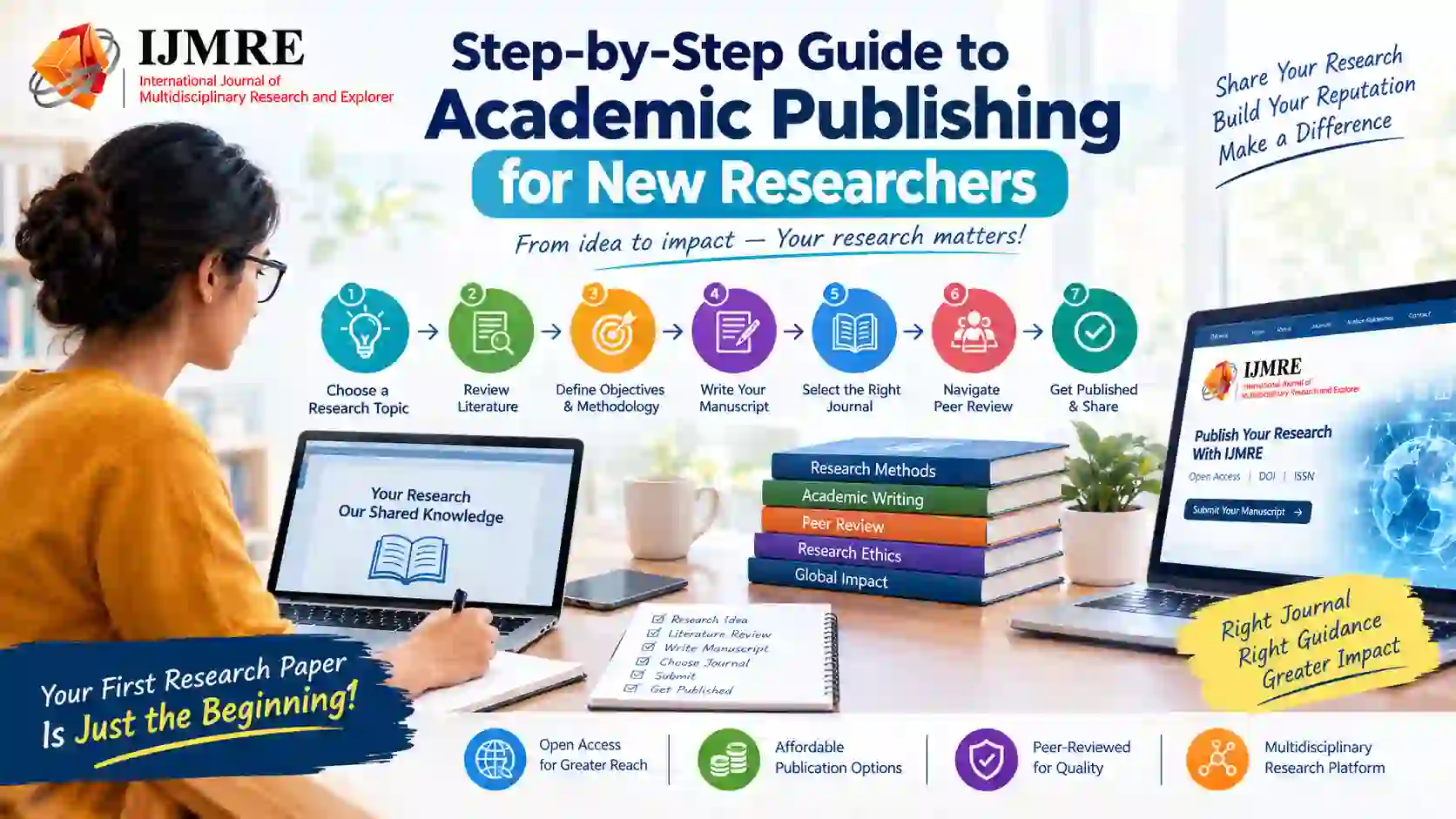
Publishing your first research paper is an important milestone in an academic career. It gives you an opportunity to communicate your findings, receive feedback from other researchers, contribute to your field, and build a record of scholarly work. However, for new researchers, the publication process can seem complicated. Questions about manuscript preparation, journal selection, peer review, publication fees, and research ethics often create uncertainty.
The good news is that academic publishing becomes more manageable when you approach it step by step. You do not need to know everything before beginning. You need a clear research question, a reliable method, an honest presentation of your findings, and a journal that genuinely fits your work.
This practical guide explains the academic publishing process from selecting a research topic to preparing a manuscript, choosing a journal, responding to reviewers, and sharing your published article. It also introduces the International Journal of Multidisciplinary Research and Explorer (IJMRE) as a potential publication venue for researchers whose manuscripts fit its scope and author requirements.
What Is Academic Publishing?
Academic publishing is the process of communicating scholarly work through journals, conference proceedings, books, or other recognized research outlets. Journal publishing commonly involves editorial screening, peer review where applicable, revisions, an editorial decision, and publication.
A research article should do more than present information. It should address a defined question, explain how the investigation was conducted, provide evidence for its conclusions, acknowledge limitations, and connect its contribution to existing knowledge.
For new researchers, publishing is not simply about getting a paper accepted. It is about producing work that other scholars can understand, evaluate, cite, and potentially build upon.
Step 1: Choose a Research Topic That Can Be Investigated
Start with a problem that interests you and can be investigated using the time, data, equipment, expertise, and resources available to you. A broad subject is a useful starting point, but it usually needs to be narrowed into a specific research question.
For example, “artificial intelligence in education” is a broad subject. A more focused question might examine how a particular AI-supported learning method affects a defined learning outcome in a particular student group.
Similarly, “renewable energy” can be narrowed to a study of the performance of a specified solar-thermal system under defined operating conditions.
How to evaluate a research topic
- Relevance: Does the question matter to a research community or practical problem?
- Research gap: What remains unclear in existing studies?
- Feasibility: Can you obtain the necessary data, equipment, permissions, and resources?
- Originality: What new evidence, analysis, method, or interpretation will your study contribute?
- Ethics: Can the investigation be conducted responsibly and in accordance with applicable requirements?
A strong research topic does not have to be completely unprecedented. It can offer a useful replication, a better evaluation, a new application, a different dataset, or evidence that challenges an existing assumption.
Step 2: Review Existing Research Before Starting
Before collecting data or developing a solution, examine what researchers have already published about your topic. A literature review helps you understand established findings, identify disagreements, recognize methodological limitations, and explain why your study is needed.
Search academic databases, scholarly search engines, institutional repositories, and relevant journal archives. Use combinations of keywords and related terms rather than relying on a single search phrase.
A practical literature-review method
- List the main concepts in your research question.
- Identify relevant keywords, synonyms, and technical terms.
- Search for recent studies alongside important foundational publications.
- Read abstracts to identify relevant papers, then examine the full texts of the most useful studies.
- Record each study's objective, method, sample or dataset, findings, and limitations.
- Compare the studies and identify the gap your work will address.
Use a reference manager or a structured spreadsheet to organize sources. Verify every citation against the original publication and avoid citing a paper solely because it appears in another article's reference list.
Practical tip: A literature review should synthesize evidence, not merely list one paper after another. Explain where findings agree, where they differ, and how those differences influence your research question.
Step 3: Define Your Research Objectives and Methodology
Once you understand the existing literature, formulate clear research objectives or hypotheses. These should connect directly to the research question and guide the study design.
Your methodology should explain what you did and why. Depending on the field, this may include experimental procedures, sampling, survey design, interviews, computational models, simulation parameters, statistical analyses, datasets, or evaluation criteria.
What a clear methodology should include
- Research design and rationale
- Data sources, materials, participants, or equipment, as applicable
- Procedures for collecting or generating evidence
- Analytical methods and evaluation measures
- Ethics approval and consent information where required
- Software, model settings, and other details necessary for reproducibility
- Known methodological limitations
Methods should be described accurately enough for readers to understand how the results were obtained. Never invent data, alter findings to fit a hypothesis, or omit important methodological details merely to make the study appear stronger.
Step 4: Conduct the Research and Document Your Findings
Follow your approved research plan and keep accurate records of data collection, experiments, analyses, and changes to the method. If the original plan needs to change, document the reason and explain material changes in the manuscript.
Analyze the evidence using methods appropriate to the research question. Report results clearly, including findings that do not support your original expectations.
Distinguish between results and interpretation. Results describe what the analysis found; the discussion explains what those findings may mean in relation to previous research, theory, and practical applications.
Where relevant, report uncertainty, limitations, negative results, and alternative explanations. These details help readers judge how far the conclusions are supported by the evidence.
Step 5: Write the Research Paper
Most research articles follow a recognizable structure, although the exact format depends on the discipline and journal.
| Section | Purpose | What to include |
|---|---|---|
| Title | Communicates the subject of the study | Specific, accurate wording that reflects the research |
| Abstract | Summarizes the article | Problem, objective, methods, main findings, and conclusion |
| Keywords | Help readers locate the paper | Relevant technical terms and research concepts |
| Introduction | Establishes the research problem | Context, literature gap, rationale, and objectives |
| Literature Review | Positions the study in existing knowledge | Relevant evidence, critical synthesis, and research gap |
| Methodology | Explains how the study was conducted | Research design, procedures, data, and analysis |
| Results | Presents the evidence | Findings, figures, tables, and relevant analyses |
| Discussion | Interprets the findings | Meaning, comparisons with previous work, implications, and limitations |
| Conclusion | Summarizes the contribution | Main findings, significance, and justified future directions |
| References | Credits previous work | Complete and consistently formatted source details |
Not every article requires a separate literature-review section. Follow the structure specified by your target journal and research design.
Writing tips for new researchers
- Use direct, precise language and define unfamiliar technical terms.
- Ensure the title, abstract, objectives, results, and conclusion are consistent.
- Support factual claims with appropriate sources.
- Use figures and tables to clarify evidence, not to decorate the paper.
- Check that every in-text citation appears in the reference list and vice versa.
- Ask a knowledgeable colleague to review clarity and logic before submission.
Step 6: Follow Research Ethics and Publication Integrity
Research integrity is essential at every stage of academic publishing. A technically sophisticated paper can still be unsuitable for publication if it contains fabricated data, unattributed copying, misleading authorship, undisclosed conflicts of interest, or inappropriate use of research participants' information.
Before submission, consider the following requirements:
- Originality: Clearly distinguish your contribution from previously published work.
- Accurate reporting: Present methods and findings honestly.
- Proper attribution: Cite ideas, data, figures, and text obtained from other sources.
- Authorship: Agree on authorship and author order based on genuine contributions and applicable standards.
- Research ethics: Obtain required approvals and consent for studies involving human participants, animals, or sensitive information.
- Conflicts of interest: Disclose relevant financial, professional, or personal relationships.
- Duplicate submission: Do not submit the same manuscript to multiple journals simultaneously unless the relevant policies explicitly permit it.
- AI-assisted work: Follow the target journal's policy on generative AI, verify any generated material, and disclose use where required.
Plagiarism-detection and AI-detection tools can assist editorial or author checks, but their outputs are not definitive proof of misconduct. Authors remain responsible for the accuracy, originality, attribution, and integrity of their manuscripts.
For guidance on responsible AI use, read Use of Generative AI in Research Paper Publication: A Guide for Beginners.
Step 7: Choose the Right Journal for Your Research
Journal selection is one of the most important decisions a new researcher makes. A suitable journal should publish work relevant to your subject, use a transparent editorial process, and meet your requirements for access, licensing, publication costs, and indexing.
Do not choose a journal based only on its name, a promise of rapid publication, or a claim that it is indexed in a particular database. Examine its actual policies and recent articles.
Evaluate these factors before submitting
- Scope: Does the journal publish research in your specific area?
- Recent articles: Are comparable topics and methods represented?
- Peer review: Is the review model and editorial process explained?
- Publication fees: Are all charges and conditions clearly stated?
- Access and licensing: Can readers access the paper as you intend, and what reuse rights apply?
- Editorial information: Are the editors, affiliations, contact details, and policies transparent?
- Indexing: Have you verified the journal's status directly in the relevant database?
- Publication schedule: Does the stated schedule suit your needs without requiring you to compromise quality?
Use our guide on how to select the right peer-reviewed journal for publication to organize your evaluation.
New researchers can also read budget-friendly research publication options and what open-access publishing means before deciding where to submit.
Step 8: Understand Open Access, DOI, ISSN, and Indexing
Academic publishing uses several terms that new authors often confuse. Understanding the differences will help you evaluate journal claims more accurately.
| Term | What it means | What it does not automatically prove |
|---|---|---|
| Open access | Readers can access published content without a subscription, subject to the publication's terms | That publication is free for authors or that the journal is high quality |
| DOI | A persistent identifier for a digital object, such as an article | Peer-review quality or inclusion in a specific index |
| ISSN | An identifier for a continuing publication such as a journal | Academic reputation or indexing status |
| Peer review | Evaluation of a manuscript by qualified reviewers according to a journal's process | Guaranteed acceptance or flawless research |
| Indexing | Inclusion in a specified scholarly database or discovery service | Inclusion in every other database |
Verify each feature independently. For example, if your institution requires Scopus coverage, consult Scopus directly and match the journal title and ISSN. Do not rely solely on a journal's promotional claims.
Read Scopus Journals vs Peer-Reviewed Journals and How to Avoid Fake Scopus Journals for more guidance.
Step 9: Prepare and Submit Your Manuscript
After selecting a journal, read its author guidelines carefully. Manuscripts may be returned before peer review if they do not follow basic submission requirements.
Pre-submission checklist
- The paper fits the journal's scope.
- The manuscript follows the required structure and template.
- The title and abstract accurately describe the work.
- Figures and tables are legible and correctly cited.
- References follow the journal's required style.
- All authors have approved the final manuscript.
- Required ethics statements, permissions, and declarations are included.
- Funding and conflicts of interest are disclosed where applicable.
- The manuscript is not under simultaneous consideration elsewhere.
- Any required cover letter or supplementary files are prepared.
Write a concise cover letter that identifies the manuscript, explains its contribution, and shows why it fits the journal. Avoid exaggerated claims about novelty or impact.
Step 10: Respond Professionally to Peer Review
After submission, an editor may conduct an initial screening to assess scope, completeness, originality, and suitability. Manuscripts that proceed may be sent to reviewers, who assess aspects such as methodology, evidence, clarity, significance, and limitations.
Possible outcomes include rejection, revision, or acceptance. A request for revision is a normal part of scholarly publishing and can help improve a paper.
How to handle reviewer comments
- Read all comments carefully before drafting a response.
- Prepare a point-by-point response document.
- Explain what you changed and where the change appears in the manuscript.
- Support responses with evidence or methodological reasoning when needed.
- If you disagree with a comment, respond respectfully and explain your reasoning.
- Do not claim to have made a change that is absent from the revised paper.
- Check the revised manuscript and response letter for consistency before resubmission.
For a more detailed process, see How to Revise a Manuscript After Peer Review and How Peer Review Works in Academic Journals.
Step 11: Consider IJMRE if Your Research Fits Its Scope
The International Journal of Multidisciplinary Research and Explorer (IJMRE) is a peer-reviewed, open-access journal covering research across multiple fields, including science, engineering, technology, management, social sciences, education, humanities, and interdisciplinary subjects.
For new researchers whose work connects different areas of knowledge, a multidisciplinary journal may be worth considering when the research question and contribution align with its stated scope. Examples could include AI applications in education, IoT-based engineering systems, technology-supported healthcare studies, sustainable energy, or research combining management and data analytics.
Before submitting to IJMRE, take these steps:
- Read the journal's About page and check whether your topic fits its scope.
- Review the Author Guidelines and prepare your manuscript accordingly.
- Read the Peer-Review Policy to understand the evaluation process.
- Check the official publication-fee information and any conditions that may apply.
- Examine the Current Issue and Archives to assess the relevance of recently published work.
- Submit only when the manuscript is complete, ethically prepared, and suitable for the journal.
IJMRE's regular publication information states that publication is free for articles up to 10 pages, with a charge of USD 5 for each additional page. Because publication terms can change, confirm the current fee policy on the official website before submitting.
Choosing IJMRE should be based on scope, editorial standards, publication policies, and suitability—not on an assumption that every manuscript will be accepted. As with any scholarly journal, acceptance depends on editorial assessment and the outcome of the review process.
If your research genuinely crosses disciplinary boundaries, explore the IJMRE multidisciplinary research journal page and determine whether it is an appropriate home for your work.
Step 12: Share and Build on Your Published Research
Publication is not necessarily the end of a research project. After publication, share the article responsibly with relevant academic communities and colleagues. Add the citation to your academic profile, present the findings at seminars, and discuss the work with researchers who may benefit from it.
Follow the journal's licensing terms and any publisher or funder requirements when sharing the published version or an accepted manuscript. Where appropriate, deposit permitted versions in an institutional repository or other approved platform.
Keep records of citations, follow-up questions, corrections, and opportunities for further study. A first paper can become the foundation for a more detailed investigation, a replication study, a new dataset, or a collaborative project.
Common Mistakes New Researchers Should Avoid
- Choosing a journal too early: Write and refine the research question before committing to a publication venue.
- Ignoring journal scope: A journal that accepts many subjects may still not be suitable for every paper.
- Submitting without proofreading: Formatting errors, unclear writing, and inconsistent references can weaken the submission.
- Overstating results: Conclusions should be proportional to the evidence.
- Ignoring research ethics: Approvals, consent, permissions, and disclosures should be addressed before submission where applicable.
- Trusting indexing claims without verification: Check the relevant database directly.
- Focusing only on speed or cost: Evaluate editorial transparency and scholarly suitability as well.
- Responding emotionally to rejection: Use editorial and reviewer feedback to improve the paper and identify a better-fitting journal.
A Practical Academic Publishing Timeline
The time needed to publish a paper varies by research design, field, journal, reviewer availability, and the number of revision rounds. The following is a planning framework, not a promise of publication speed.
| Stage | Key task | Planning consideration |
|---|---|---|
| Topic development | Define the problem and research question | Allow enough time to refine the scope |
| Literature review | Evaluate existing evidence and identify a gap | Update searches as the project develops |
| Study design | Plan methods, data, and ethical requirements | Obtain approvals before relevant data collection |
| Research and analysis | Collect evidence and evaluate results | Document methods and limitations |
| Writing and revision | Prepare the paper and obtain feedback | Check clarity, accuracy, and references |
| Journal submission | Submit according to the journal's instructions | Check fees, scope, and declarations |
| Peer review and revisions | Respond to editorial and reviewer feedback | Timing depends on the journal and revision requirements |
| Publication and sharing | Review the final article and share it responsibly | Check the published version and citation details |
Frequently Asked Questions
How can a beginner publish a first research paper?
Begin with a clear research question, review relevant literature, use a suitable methodology, report results honestly, and prepare the manuscript according to a journal's author guidelines. Select a journal that fits the work and follow its submission process carefully.
Do new researchers need a PhD to publish in an academic journal?
Not necessarily. Journal eligibility depends on the journal's policies and the quality, relevance, and integrity of the manuscript. Students, early-career researchers, independent researchers, and established academics may submit where the journal permits.
How do I find a journal that does not charge high publication fees?
Review official publication-fee pages, compare no-APC and low-cost options, and confirm whether page limits or optional services involve charges. Never sacrifice journal suitability or editorial standards solely to reduce cost.
What is the difference between peer review and indexing?
Peer review is a process for evaluating a manuscript. Indexing refers to inclusion in a specific database. A journal's peer-review status does not prove that it is included in Scopus, Web of Science, or another database.
Can I submit my first paper to a multidisciplinary journal?
Yes, if the journal accepts the subject area and the manuscript meets its requirements. Interdisciplinary studies can be suitable when they clearly explain the relationship between fields and offer a coherent contribution.
Why should I read author guidelines before submitting?
Author guidelines explain the required format, article types, references, declarations, and submission documents. Following them reduces avoidable administrative problems and helps editors assess the manuscript.
What should I do if my paper is rejected?
Read the decision and comments carefully. Identify whether the concerns involve scope, methods, evidence, clarity, or originality. Improve the manuscript where appropriate and select another suitable journal. Do not submit a revised version elsewhere until any previous submission has been formally closed.
Conclusion: Take the First Step Toward Academic Publishing
Academic publishing can feel difficult when you are starting out, but a structured process makes it easier to manage. Choose a researchable question, understand the existing literature, design an appropriate methodology, document your evidence, write clearly, and follow ethical research practices. Then select a journal based on scope, peer review, transparency, access, fees, and relevant indexing requirements.
Remember that a successful research career is built through credible work, careful learning, and continuous improvement—not through publication speed alone. Reviewer feedback, including requests for major revision or rejection, can help you develop as a researcher when you respond constructively.
If your manuscript fits a multidisciplinary subject area, consider reviewing the official scope and author requirements of the International Journal of Multidisciplinary Research and Explorer (IJMRE). Explore its Author Guidelines, Peer-Review Policy, and Current Issue before deciding whether to submit.
Your first research paper does not have to be perfect from the beginning. It should be honest, carefully prepared, relevant to its field, and ready for critical evaluation. Start with a clear question, improve the work step by step, and take the next step toward contributing to scholarly knowledge.
Related IJMRE Resources
- Research Paper Publication Guide for Beginners
- How to Publish Research in Multidisciplinary Journals
- How to Select the Right Peer-Reviewed Journal
- How Peer Review Works in Academic Journals
- Budget-Friendly Research Publication Options
- What Is an Open Access Journal and Why Does It Matter?
- How to Avoid Fake Scopus Journals
SEO Keywords
academic publishing for beginners, step-by-step academic publishing guide, how to publish a research paper, research paper publication for new researchers, academic journal submission process, first research paper publication, peer-reviewed journals for beginners, journal selection guide, research manuscript preparation, academic publishing ethics, open access journal publication, affordable research publication, multidisciplinary research journal, IJMRE, International Journal of Multidisciplinary Research and Explorer