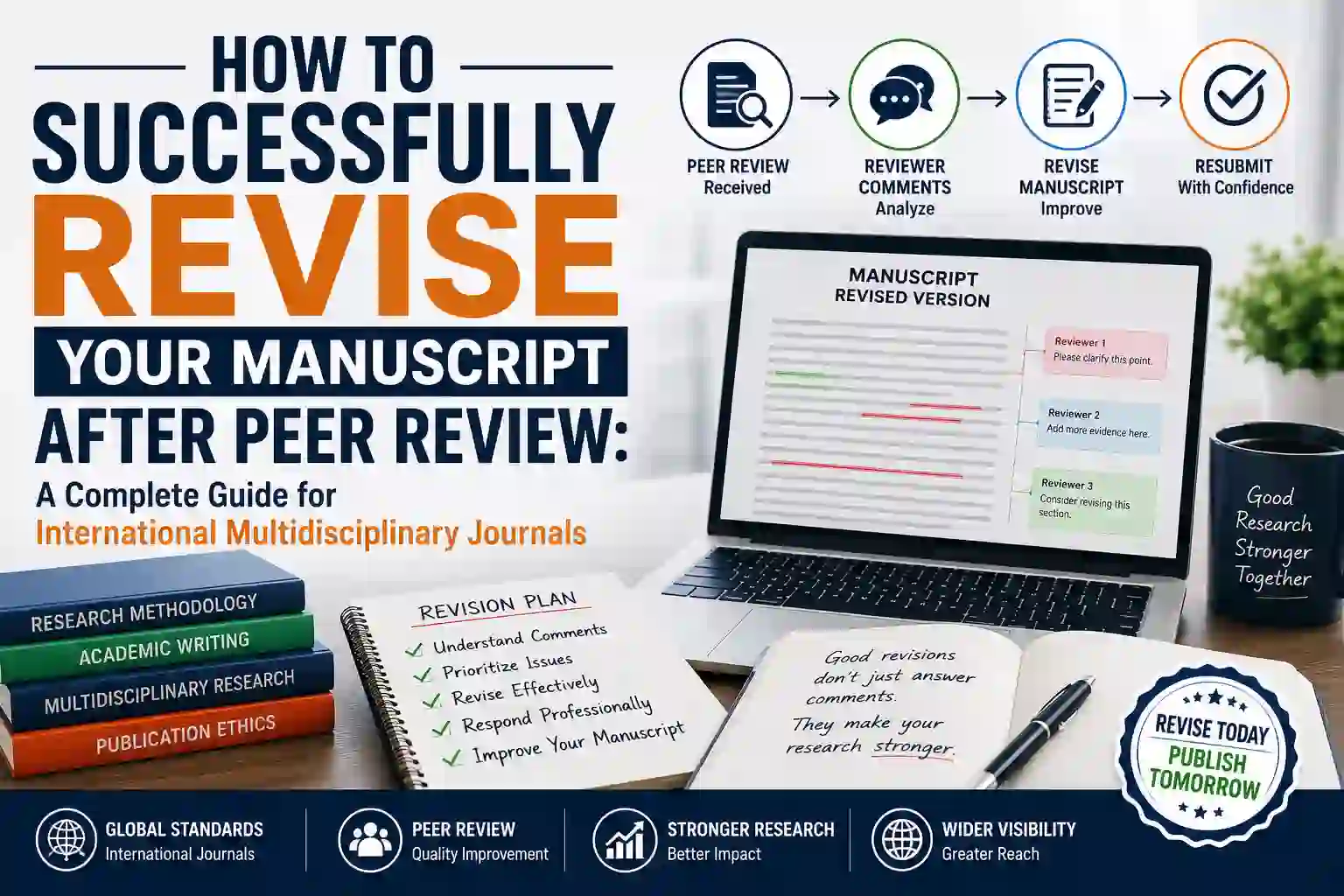
Receiving a decision of “revision required,” “minor revisions,” or “major revisions” can feel overwhelming, especially after spending months preparing a research paper. Reviewers may question your methodology, request additional explanations, challenge your interpretation of results, or suggest substantial changes to the manuscript.
However, a revision request is usually an opportunity to strengthen your research paper. It means the manuscript has entered an important stage of the scholarly publishing process and that the editor and reviewers have identified issues that may need to be addressed before a final editorial decision can be made.
The way you respond to peer-review comments can significantly influence the next stage of evaluation. A strong revision is not simply a corrected manuscript. It is a carefully documented response showing that you have considered each reviewer comment, improved the paper where appropriate, and clearly explained any recommendations you did not follow.
This complete guide explains how to successfully revise your manuscript after peer review, respond professionally to reviewer comments, prepare a point-by-point response letter, manage conflicting suggestions, and improve your chances of moving your manuscript toward publication in an international multidisciplinary journal.
What Does a Revision Decision Actually Mean?
After peer review, a journal editor may issue several possible decisions. The exact terminology varies between journals, but common outcomes include:
- Accept;
- Minor revision;
- Major revision;
- Revise and resubmit;
- Reject with an invitation to submit a substantially revised manuscript;
- Reject.
A revision decision should not automatically be interpreted as acceptance. The manuscript may still require another round of peer review, and the editor may make a different decision after evaluating the revised version.
At the same time, revision provides authors with a structured opportunity to improve weaknesses identified by independent readers.
Key principle: Treat every reviewer comment as a question your manuscript must answer—either through a revision or through a clear, evidence-based explanation.
Minor Revision vs. Major Revision: What Is the Difference?
Understanding the editorial decision is the first step in planning your revision.
Minor Revision
A minor revision generally indicates that the manuscript may require limited changes that do not fundamentally alter the central research design or conclusions.
Examples may include:
- clarifying specific sentences or arguments;
- correcting minor inconsistencies;
- improving figures or tables;
- adding methodological details;
- correcting references;
- strengthening parts of the discussion;
- addressing language or formatting issues.
Authors should not assume that “minor” means the comments can be answered casually. Every point should still be addressed carefully.
Major Revision
A major revision usually involves more substantial concerns that may affect the manuscript's methodology, analysis, interpretation, structure, or scholarly contribution.
Reviewers may request:
- additional analysis;
- stronger justification of the methodology;
- substantial rewriting of sections;
- clarification of the research gap;
- improved interpretation of findings;
- additional discussion of limitations;
- better alignment between objectives, methods, results, and conclusions.
A major revision can require significant work, but it can also lead to a much stronger manuscript.
Why Authors Often Struggle With Peer-Review Comments
Peer-review reports can be difficult to process because authors are deeply familiar with their own research. Information that seems obvious to the research team may not be clear to an independent reader.
Common challenges include:
- receiving a long list of requested changes;
- interpreting vague reviewer comments;
- dealing with criticism of the research design;
- responding to reviewers who disagree with each other;
- deciding whether every suggestion must be accepted;
- making substantial changes without weakening the manuscript's central argument;
- preparing a professional response letter.
The most effective approach is to treat revision as a structured editorial project rather than making changes randomly throughout the document.
Step 1: Read the Editor's Decision Letter Before the Reviewer Reports
Many authors immediately focus on reviewer comments and overlook the editor's decision letter. This can be a mistake.
The editor may:
- identify the most important concerns;
- indicate which reviewer comments require particular attention;
- provide instructions for resubmission;
- specify a revision deadline;
- request tracked changes or a clean manuscript;
- ask for a separate point-by-point response document.
Editorial instructions should generally take priority when organizing the revision.
Create a revision checklist containing every requirement from the editor before working through the individual reviewer reports.
Step 2: Organize Every Reviewer Comment
Do not rely on memory when revising a manuscript. Create a structured system for tracking comments.
A simple revision table can include:
| Reviewer Comment | Required Action | Manuscript Section | Status |
|---|---|---|---|
| Clarify the research gap | Rewrite the final part of the introduction | Introduction | Pending |
| Explain participant selection | Add sampling details | Methodology | Pending |
| Discuss study limitations | Add limitations paragraph | Discussion | Pending |
This approach reduces the risk of accidentally overlooking a comment and helps co-authors divide revision responsibilities.
Step 3: Classify Reviewer Comments by Importance
Not all reviewer comments require the same amount of work. Classifying them can make the revision process more efficient.
Category A: Essential Scientific or Methodological Changes
These may involve:
- research design;
- statistical analysis;
- data interpretation;
- ethical approval or reporting;
- missing methodological information;
- unsupported conclusions.
These comments usually require the greatest attention because they may affect the reliability or interpretation of the study.
Category B: Clarity and Interpretation
These comments may request:
- better explanation of the research gap;
- clearer research objectives;
- stronger discussion of findings;
- improved organization;
- additional context for readers.
Category C: Presentation and Technical Corrections
These may include:
- grammar corrections;
- reference formatting;
- figure labels;
- table formatting;
- abbreviation definitions;
- typographical errors.
Addressing the most consequential comments first can prevent authors from spending excessive time polishing sections that may later require substantial rewriting.
Step 4: Revise the Manuscript Before Writing the Final Response Letter
A useful workflow is to make the substantive manuscript changes first and then finalize the response letter.
For each reviewer comment:
- Identify what the reviewer is asking.
- Decide whether a manuscript change is needed.
- Make the revision.
- Record exactly where the change was made.
- Draft a concise response explaining the action.
This helps ensure that the response letter accurately reflects the revised manuscript.
How to Respond to Reviewer Comments Professionally
A strong response should be respectful, specific, and easy to verify.
A useful structure is:
Reviewer Comment:
The research gap is not sufficiently clear in the introduction.
Author Response:
Thank you for this important observation. We revised the final paragraphs of the Introduction to clarify the research gap and explain how the present study differs from previous work. The revised text appears in the Introduction, pages X–Y, lines XX–XX.
This format allows the editor and reviewer to quickly understand what was changed and where the revision can be found.
Avoid One-Word Responses to Reviewer Comments
Responses such as:
- “Done.”
- “Corrected.”
- “Changed.”
- “Agreed.”
are usually too vague.
Instead, briefly explain the specific action taken.
Weak response: Corrected.
Stronger response: Thank you for identifying this issue. We revised the Methods section to clarify the participant-selection criteria and added the inclusion and exclusion criteria in Section 2.2.
The stronger response saves reviewers from having to search the entire manuscript to determine what changed.
Should You Accept Every Reviewer Suggestion?
Not necessarily.
Reviewers provide expert recommendations, but authors may occasionally have valid reasons for not implementing a particular suggestion.
For example:
- the requested analysis may not be appropriate for the study design;
- the requested data may not have been collected;
- a suggestion may fall outside the stated objectives of the study;
- two reviewers may provide conflicting recommendations;
- a proposed change may introduce a methodological problem.
If you disagree, do not ignore the comment. Explain your reasoning respectfully and, where possible, support your response with methodological or scholarly justification.
Example:
Thank you for this suggestion. We carefully considered adding the proposed analysis. However, because the study was not designed or powered to evaluate this additional outcome, we believe that performing the analysis could lead to an unreliable interpretation. We have instead clarified this limitation in the Discussion section.
A reasoned response is generally more effective than a defensive refusal.
The Golden Rule of Manuscript Revision
Never leave a reviewer comment unanswered.
Even when no manuscript change is made, the response letter should explain why.
A complete response demonstrates careful engagement with the review process and makes the revised submission easier for editors and reviewers to evaluate.
What Comes Next?
Successfully responding to reviewer comments involves more than correcting individual sentences. Authors must also manage conflicting reviewer requests, revise major sections without creating inconsistencies, prepare a persuasive point-by-point response letter, and complete a final quality check before resubmission.
The next part of this guide explains how to handle difficult or conflicting reviewer comments, revise each major section of a research paper, and avoid the most common mistakes that can weaken a revised manuscript.