Reading Time: 12–15 minutes
Introduction: When Publication Costs Become a Researcher's Problem
After months of collecting data, reviewing literature, conducting experiments, and preparing a manuscript, researchers often face another challenge: finding an affordable journal for publication.
For many students, PhD scholars, early-career researchers, independent researchers, and academics, publication fees can become a significant consideration. Some journals charge substantial Article Processing Charges (APCs), while others offer more affordable or no-cost publishing options.
This is why the search for a low APC open access journal has become increasingly important for researchers who want their work to be publicly accessible without taking on unnecessarily high publication expenses.
However, low cost should not be the only selection criterion. A suitable journal should also have a relevant scope, transparent editorial policies, a clearly explained peer-review process, publication ethics, and reliable information about DOI, ISSN, copyright, and article processing charges.
This guide explains what researchers should look for when choosing an affordable open access journal and how to submit a manuscript with greater confidence.
What Is a Low APC Open Access Journal?
A low APC open access journal is an academic publication that makes research articles freely accessible to readers while charging authors a relatively low Article Processing Charge compared with higher-cost publishing options.
APC stands for Article Processing Charge. Depending on the journal's publishing model, an APC may help cover editorial administration, peer review management, production, online hosting, article preparation, DOI registration, archiving, and other publishing-related services.
Open access means that readers can generally access published articles online without paying a subscription fee for the individual article.
For authors, the important point is that affordable publication should not mean reduced editorial standards. A journal should be evaluated according to its policies, peer-review procedures, editorial transparency, ethics, and overall publishing practices.
Why Researchers Search for Low APC Journals
Publication costs can affect researchers differently depending on their academic position, institution, country, funding availability, and research project.
Low APC journals can be particularly relevant to:
- PhD scholars working with limited research budgets
- Postgraduate students
- Early-career researchers
- Independent researchers
- University faculty members
- Researchers without dedicated publication funding
- Authors from institutions with limited research budgets
- Researchers publishing interdisciplinary studies
For these authors, an affordable international research journal can provide an opportunity to publish research while managing publication expenses responsibly.
Low APC Does Not Mean Low Quality
One of the biggest misconceptions about academic publishing is that a journal's quality can be determined solely by its publication fee.
Publication cost and academic quality are two different considerations.
| Factor | What Researchers Should Evaluate |
|---|---|
| APC | Is the publication fee clearly disclosed? |
| Peer Review | Does the journal explain how manuscripts are evaluated? |
| Editorial Board | Are editorial roles and affiliations clearly presented? |
| Journal Scope | Does the journal publish research in your subject area? |
| Publication Ethics | Are ethical standards and policies clearly explained? |
| DOI | Does the journal explain how article identification is handled? |
| ISSN | Is the journal's ISSN information clearly displayed? |
| Copyright | Are author rights and licensing terms transparent? |
| Archives | Are previously published articles accessible? |
Therefore, researchers should not automatically assume that a low APC journal is inferior or that an expensive journal is automatically better. The entire publication model should be evaluated.
What Is an APC in Academic Publishing?
An Article Processing Charge is a fee that some journals ask authors to pay after or during the publication process. APCs are commonly associated with open access publishing models, although not every open access journal charges authors.
The amount can vary substantially between journals.
Some journals may offer:
- No APC publication
- Low APC publication
- Standard APC publication
- Different fees based on article length
- Waivers for eligible authors
- Discounts or institutional arrangements
Researchers should always check the journal's current official publication-fee policy before submitting a manuscript.
Low APC vs. No APC: What Is the Difference?
| Feature | Low APC Journal | No APC Journal |
|---|---|---|
| Author Fee | Small or relatively affordable charge | No standard publication charge |
| Open Access | May be available | May be available |
| Peer Review | Should be independently evaluated | Should be independently evaluated |
| DOI | May be provided | May be provided |
| Journal Quality | Depends on editorial standards | Depends on editorial standards |
| Best Selection Method | Evaluate the complete publication policy | Evaluate the complete publication policy |
The most important consideration is not simply whether a journal is free or paid. Researchers should determine whether the journal follows transparent and ethical scholarly publishing practices.
Benefits of Publishing in an Affordable Open Access Journal
1. Lower Financial Burden
The primary advantage of a low APC journal is the possibility of reducing publication expenses. This can be especially useful for researchers who do not have institutional or grant funding for article processing charges.
2. Wider Reader Accessibility
Open access publishing can make published research more accessible to students, researchers, professionals, and other readers who may not have access to subscription-based academic databases.
3. International Research Visibility
Making an article accessible online can help researchers share their findings with an international audience. However, visibility should never be confused with guaranteed citations or indexing.
4. Support for Early-Career Researchers
Affordable publication models can be particularly useful for students and early-career researchers who are beginning to build their academic publication records.
5. Interdisciplinary Opportunities
Researchers working across multiple disciplines may benefit from journals with broad scopes. Explore why researchers prefer multidisciplinary journals for publication.
How to Find a Reliable Low APC Open Access Journal
Finding an affordable journal is easy. Finding an affordable journal that is also suitable and transparent requires more careful evaluation.
Step 1: Check the Journal's Scope
Begin by identifying whether the journal publishes research in your field. A journal may cover Computer Science, Engineering, Management, Education, Social Sciences, Healthcare, Artificial Intelligence, IoT, or multiple disciplines.
Read the aims and scope before submitting.
Step 2: Examine the Peer-Review Policy
A reputable journal should explain its peer-review procedure clearly. Authors should be able to understand whether the journal uses single-blind, double-blind, or another review model.
For additional background, read How Peer Review Works in Academic Journals.
Step 3: Check the Publication Fee Page
Do not rely solely on advertisements or third-party lists. Check the journal's official website for current publication charges and determine whether additional fees may apply.
Step 4: Review the Editorial Board
Look for clearly presented editorial information and relevant academic expertise.
Step 5: Examine Previous Articles
Read several recently published articles. Check whether the research quality, formatting, subject coverage, references, and presentation appear consistent with your expectations.
Step 6: Check DOI and ISSN Information
Researchers should understand the journal's DOI and ISSN information before submitting. A DOI provides a persistent identifier for an article, while an ISSN identifies a continuing publication such as a journal.
For additional guidance, see Paid Journals with DOI and ISSN for International Research.
Important Features to Compare Before Choosing a Low APC Journal
| Feature | Questions to Ask |
|---|---|
| Journal Scope | Does my research fit the journal? |
| APC | Is the fee affordable and clearly disclosed? |
| Peer Review | Is the review procedure explained? |
| Publication Ethics | Are ethical policies available? |
| Editorial Board | Is editorial information transparent? |
| DOI | Is article identification clearly explained? |
| ISSN | Is ISSN information available? |
| Copyright | Are author rights clearly explained? |
| Submission | Is there a clear manuscript submission process? |
Who Should Consider a Low APC Open Access Journal?
Affordable open access publication can be useful for researchers across a wide range of disciplines.
- PhD researchers
- Master's students
- University professors
- Assistant professors
- Research scholars
- Independent researchers
- Engineering researchers
- Computer Science researchers
- Artificial Intelligence researchers
- IoT researchers
- Management researchers
- Education researchers
- Social Science researchers
- Interdisciplinary research teams
Popular Research Areas for Affordable Journal Publication
A multidisciplinary journal can be particularly useful when research combines multiple fields.
| Research Area | Example Topics |
|---|---|
| Computer Science | Software Engineering, Algorithms, Networks |
| Artificial Intelligence | Machine Learning, Generative AI, Computer Vision |
| Internet of Things | Smart Systems, Sensors, Connected Devices |
| Engineering | Mechanical, Electrical, Civil, Electronics |
| Education | Digital Learning, Educational Technology |
| Management | Business Analytics, Finance, Entrepreneurship |
| Social Sciences | Society, Communication, Policy Studies |
| Healthcare | Health Technology, Data Analysis, Public Health |
How to Avoid Choosing a Journal Based Only on Low APC
Low publication cost can be attractive, but price alone should never determine the final decision.
Researchers should be cautious when a journal:
- Promises guaranteed acceptance
- Guarantees publication without meaningful review
- Provides unclear editorial information
- Hides publication fees
- Uses misleading indexing claims
- Does not provide clear author guidelines
- Has unclear publication ethics policies
- Uses aggressive or misleading solicitation
Read How to Avoid Fake Scopus Journals for additional journal-selection guidance.
Low APC Open Access Journals and Peer Review
Researchers sometimes assume that an affordable journal must compromise on peer review. This is not necessarily true.
Peer review and APC pricing are separate aspects of publishing. A journal can adopt an affordable publishing model while maintaining a defined editorial and peer-review workflow.
Authors should therefore ask:
- Who reviews submitted manuscripts?
- Is the review process explained?
- Are reviewer comments used to improve manuscripts?
- Does the editor make the final publication decision?
- Are conflicts of interest addressed?
For more information about selecting a suitable publication venue, read How to Select the Right Peer-Reviewed Journal for Publication.
Affordable Publication Does Not Mean Guaranteed Publication
This distinction is important for every researcher.
A legitimate journal should not promise acceptance simply because an author pays an APC. Publication decisions should be based on editorial assessment and peer-review outcomes.
A transparent journal should clearly distinguish between:
- Submission
- Editorial screening
- Peer review
- Revision
- Acceptance or rejection
- Production
- Publication
Researchers should be particularly careful with websites advertising guaranteed acceptance or guaranteed publication in an unrealistically short period.
Low APC Open Access Journal vs. High APC Journal
| Factor | Low APC Journal | High APC Journal |
|---|---|---|
| Author Cost | Relatively affordable | May be substantial |
| Open Access | May be available | May be available |
| Peer Review | Should be evaluated independently | Should be evaluated independently |
| Research Quality | Depends on journal standards | Depends on journal standards |
| DOI | May be provided | May be provided |
| Selection Criteria | Scope, peer review, ethics, transparency, editorial quality, and suitability | |
The comparison demonstrates an important point: APC price alone does not establish journal quality.
How to Prepare Your Manuscript Before Submission
Once you have selected a suitable affordable journal, the next step is preparing a strong manuscript.
1. Follow the Journal's Author Guidelines
Check the required manuscript structure, reference style, formatting, tables, figures, word limits, and submission requirements.
2. Write a Clear Title
Your title should accurately communicate the subject and contribution of your research without unnecessary complexity.
3. Prepare a Strong Abstract
The abstract should clearly communicate the research problem, methodology, major findings, and conclusion.
4. Check References
Ensure that citations are accurate and relevant. Avoid unnecessary references and verify bibliographic information before submission.
5. Check Originality
Review your manuscript for plagiarism, duplicate publication, inappropriate text reuse, and other academic integrity concerns.
6. Proofread the Manuscript
Grammar, formatting, figures, tables, references, and technical terminology should be carefully checked before submission.
Why Open Access Matters for Researchers
Open access can make research more accessible to readers who do not have institutional subscriptions to expensive academic databases.
Depending on the journal and its distribution practices, open access publishing can help research reach:
- University students
- Researchers
- Academic institutions
- Industry professionals
- Independent researchers
- International readers
- Interdisciplinary research communities
Researchers should remember that open access does not automatically guarantee higher citations, indexing, or academic impact. These outcomes depend on many factors, including research quality, relevance, discoverability, and scholarly engagement.
Why Multidisciplinary Journals Can Be Useful for Researchers
Many modern research projects cross traditional disciplinary boundaries. For example, an Artificial Intelligence project may involve Computer Science, Healthcare, Data Science, Statistics, and Engineering.
A multidisciplinary publication platform can therefore be suitable for research that does not fit neatly into a single academic discipline.
Read what a multidisciplinary research journal is and learn more about multidisciplinary vs. specialized journals.
Why Researchers Consider IJMRE for Affordable Publication
The International Journal of Multidisciplinary Research and Explorer (IJMRE) provides a publication platform for researchers working across multiple academic and research disciplines.
Authors considering IJMRE should review the journal's current aims and scope, author guidelines, peer-review information, publication policies, and current fee information before submitting.
This is particularly important because publication charges and journal policies can change over time. Authors should always rely on the journal's current official information rather than outdated third-party listings.
Step-by-Step: How to Submit a Research Paper to a Low APC Journal
- Select a suitable journal: Confirm that the journal's scope matches your research.
- Read the author guidelines: Follow all formatting and submission requirements.
- Prepare the manuscript: Complete the title, abstract, keywords, methodology, results, discussion, conclusion, and references.
- Check publication policies: Review peer review, ethics, copyright, licensing, and APC information.
- Complete author information: Verify names, affiliations, email addresses, and corresponding-author details.
- Submit the manuscript: Use the journal's official submission system.
- Respond to editorial communication: Monitor your submission and respond appropriately to requests.
- Complete revisions: Address reviewer comments carefully and provide a response where required.
- Await the final decision: Acceptance should depend on editorial and peer-review assessment.
Frequently Asked Questions About Low APC Open Access Journals
1. What is a low APC open access journal?
A low APC open access journal is a journal that provides open access to published research while charging authors a relatively affordable Article Processing Charge compared with higher-cost publishing options.
2. Are low APC journals legitimate?
Some are, while others may not meet appropriate publishing standards. Authors should evaluate peer review, editorial transparency, publication ethics, journal scope, DOI and ISSN information, and fee policies before submitting.
3. Does a low APC mean poor journal quality?
No. APC pricing alone does not determine academic quality. Researchers should evaluate the journal's complete editorial and publishing practices.
4. Can I publish research in an open access journal with a low APC?
Yes. Researchers can find open access journals with affordable publication models. The journal should first be evaluated for suitability, transparency, peer review, and ethical publishing practices.
5. Do low APC journals provide DOI?
Some low APC journals provide DOI assignment, but authors should verify the journal's current DOI policy before submission.
6. Do low APC journals have ISSN?
A legitimate journal should provide clear information about its ISSN. Authors should verify the journal's official ISSN information before submitting.
7. Is open access the same as free publication?
No. Open access describes reader access to published research. A journal may be open access while charging authors an APC, while some open access journals may publish without charging authors.
8. Should I select a journal only because it has a low APC?
No. Cost should be only one part of your decision. Scope, peer review, editorial quality, publication ethics, transparency, and suitability for your research are equally important.
9. Can students submit papers to low APC journals?
Yes. Students and research scholars can submit manuscripts when their research meets the journal's scope and submission requirements.
10. How can I submit my research paper?
After selecting a suitable journal and preparing your manuscript according to its guidelines, submit through the journal's official submission system. For IJMRE, authors can begin through the official manuscript submission page.
Low APC Open Access Journal Checklist
Before submitting your manuscript, use this checklist:
| Question | Check |
|---|---|
| Does the journal match my research topic? | ☐ |
| Is the APC clearly disclosed? | ☐ |
| Is peer review explained? | ☐ |
| Are editorial details available? | ☐ |
| Are publication ethics policies available? | ☐ |
| Is DOI information available? | ☐ |
| Is ISSN information available? | ☐ |
| Are copyright and licensing policies clear? | ☐ |
| Are previous articles accessible? | ☐ |
| Are author guidelines available? | ☐ |
| Have I checked the current official publication fee? | ☐ |
Related Reading
- Paid Journals That Accept Multidisciplinary Research Papers
- Best International Multidisciplinary Journal with Low Publication Fee
- Fast Publication Journals with Low Publication Fees
- Free vs Paid Research Journals: Which Should You Choose?
- Paid Research Journals for Fast Publication
- International Peer-Reviewed Journals: Open Access Publication Opportunities
- Best International Journals for Multidisciplinary Research
- How to Publish Research in Multidisciplinary Journals
Conclusion
Finding a low APC open access journal can help researchers manage publication expenses while making their research accessible to a wider audience. However, affordability should always be evaluated alongside peer review, editorial transparency, publication ethics, journal scope, DOI and ISSN information, copyright policies, and overall suitability.
The best journal is not necessarily the cheapest journal. Instead, researchers should look for a publication venue that provides a reasonable balance between affordability, transparency, accessibility, editorial quality, and academic suitability.
If you are ready to submit your research, review the journal's current requirements and begin your manuscript submission through the International Multidisciplinary Research Journal platform.
Submit Your Research Paper
Have you completed your research manuscript? Before submitting, verify that your paper matches the journal's scope and follows all author guidelines.
SEO-Friendly Keywords
Low APC Open Access Journal | Low APC Journal | Affordable Open Access Journal | Low Publication Fee Journal | Affordable Research Publication | Open Access Journal | Peer-Reviewed Journal | International Research Journal | Research Paper Publication | Journal with DOI
Suggested Featured Image Prompt
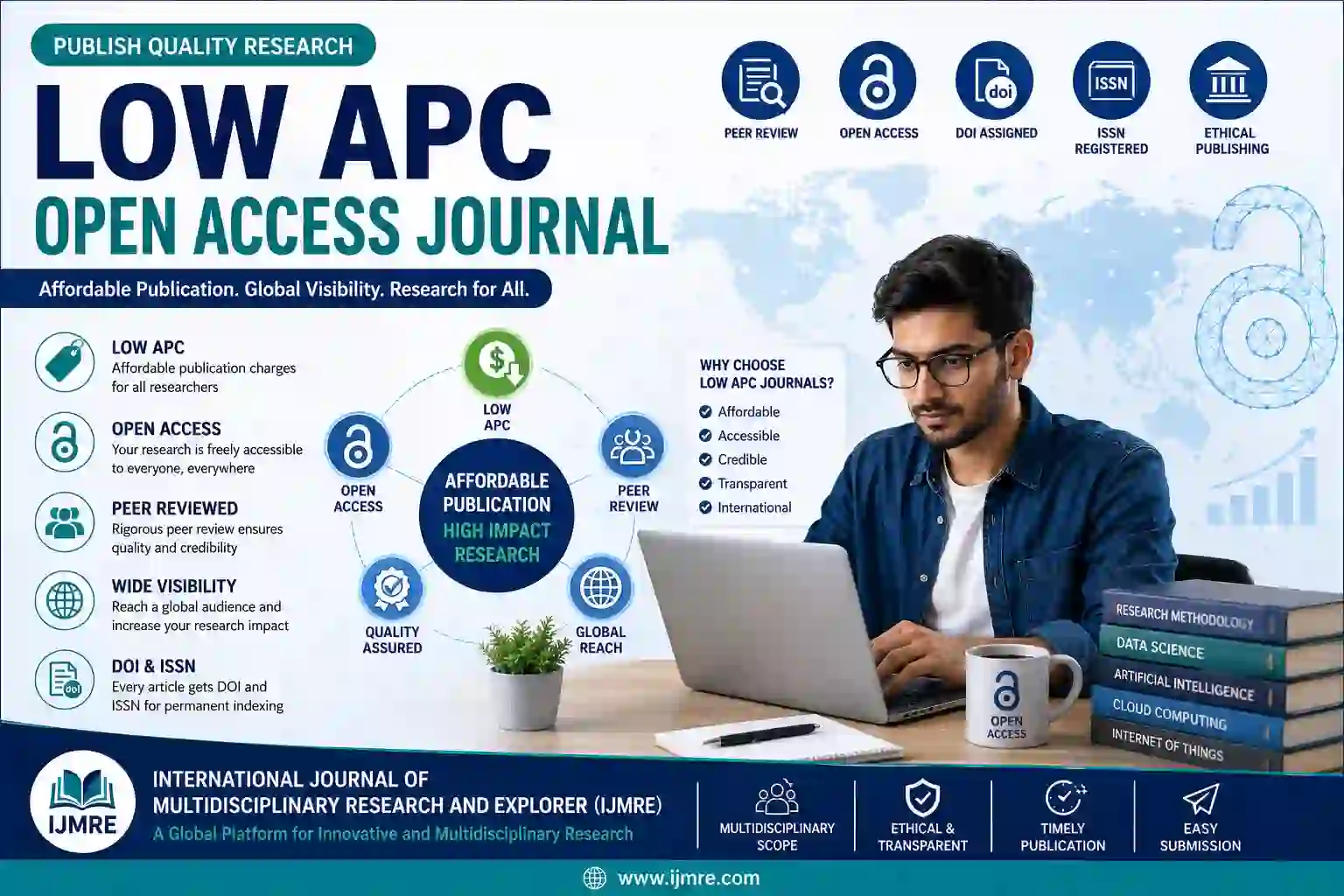
AI Image Prompt: Create a professional 16:9 academic blog banner for the title "Low APC Open Access Journal". Show a researcher preparing a manuscript on a laptop while comparing affordable academic publishing options, with visual elements representing low publication costs, open access, peer review, DOI, ISSN, research papers, and global academic readership. Include a subtle comparison between expensive publication fees and affordable APC options without suggesting guaranteed acceptance. Use a clean modern academic design with blue, white, and teal tones, digital research graphics, books, manuscript pages, a world map, and scholarly publishing symbols. Leave generous space for the title text and add subtle footer branding: International Journal of Multidisciplinary Research and Explorer (IJMRE) and www.ijmre.com. High-resolution, professional, trustworthy, suitable for an academic journal website and social media.
Image Alt Text Suggestions
- Low APC Open Access Journal for Affordable Research Publication
- Affordable Open Access Journal with Low Publication Fee
- Low APC Peer-Reviewed Journal for Researchers
- Affordable Research Paper Publication Journal
- Open Access Academic Journal with Low APC