ISSN (Online): 2833-7298
ISSN (Print): 2833-7301
Publication Fees: Free (Free up to 10 pages; USD 5 per additional page)

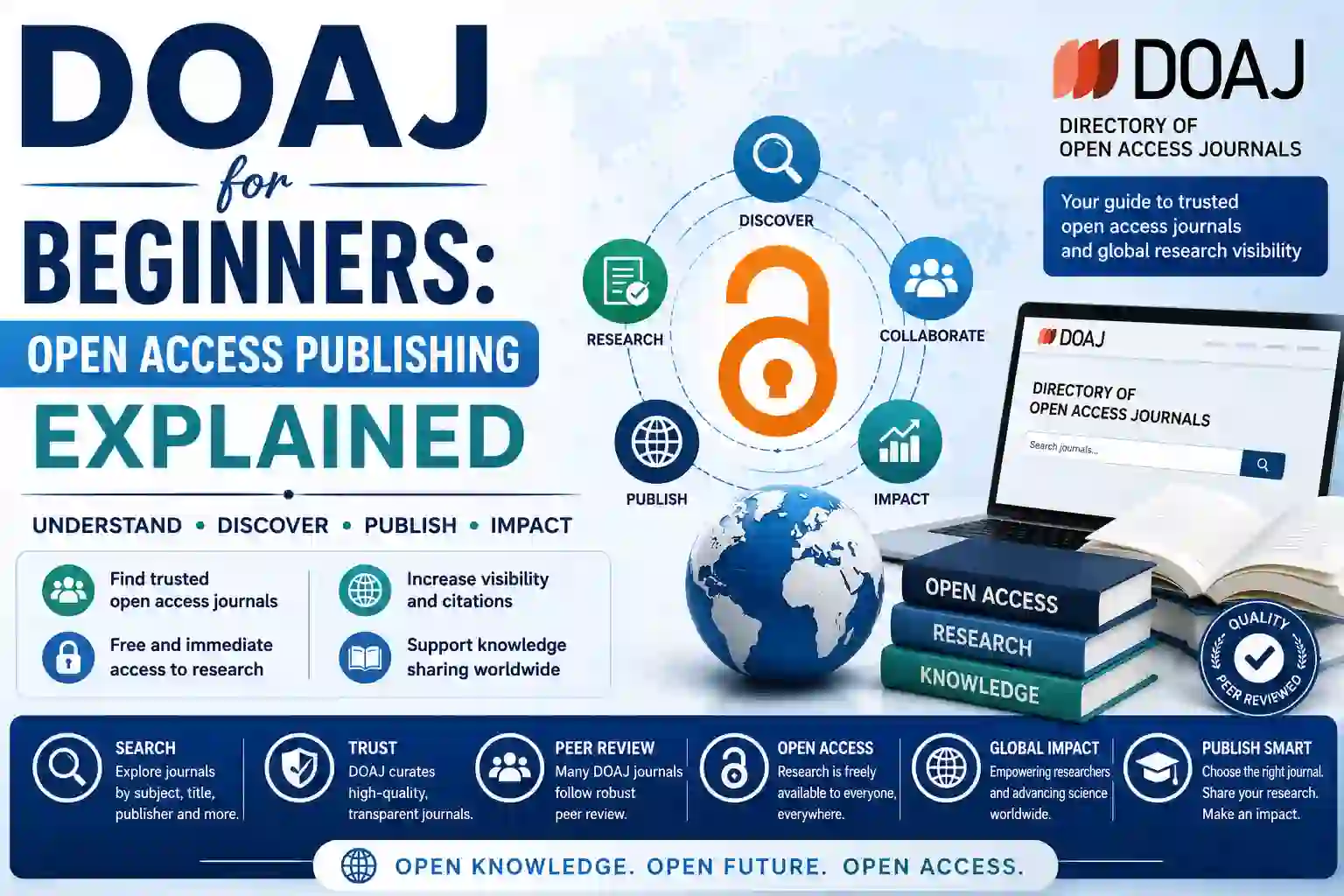
Open access publishing has transformed academic communication by making research freely available to readers worldwide. As researchers increasingly seek trustworthy open access journals, the Directory of Open Access Journals (DOAJ) has become one of the most recognized resources for identifying quality open access publications.
For new researchers, PhD scholars, and first-time authors, understanding DOAJ can help in selecting credible journals and avoiding questionable publication venues. This guide explains what DOAJ is, how it works, and why it is important for open access publishing.
Researchers interested in scholarly publishing can also explore the International Journal of Multidisciplinary Research and Explorer (IJMRE).
DOAJ (Directory of Open Access Journals) is an online directory that indexes high-quality open access journals from around the world. Its mission is to improve the visibility, accessibility, reputation, and quality of open access scholarly publishing.
Unlike general journal databases, DOAJ focuses specifically on journals that provide immediate and free access to research articles without subscription barriers.
To learn more about DOAJ and its purpose, read What is DOAJ? Understanding the Directory of Open Access Journals.
Open access publishing allows research articles to be freely available online for anyone to read, download, and cite. Readers do not need institutional subscriptions or paid memberships to access the content.
Open access publishing helps:
As a result, open access publishing has become increasingly popular among researchers, universities, and funding agencies.
Researchers often face challenges when choosing a journal for publication. With thousands of journals available online, identifying trustworthy publication venues can be difficult.
DOAJ helps researchers by providing a directory of journals that meet specific quality and transparency standards.
Benefits include:
Researchers can further explore this topic through How DOAJ Helps Researchers Find Trusted Open Access Journals.
Journals must apply for inclusion and undergo an evaluation process before being accepted into DOAJ.
The evaluation typically examines:
Only journals that meet DOAJ's requirements are included in the directory.
Many researchers mistakenly assume that all open access journals have the same quality standards. In reality, journal quality depends on factors such as peer review and editorial oversight.
Many journals listed in DOAJ use peer review to evaluate submitted manuscripts before publication.
Authors should understand the peer review process before selecting a journal. Learn more in How Peer Review Works in Academic Journals.
Additional guidance is available in Peer Reviewed Articles in Scientific Report Journal.
One of the advantages of DOAJ is its user-friendly search system. Researchers can search journals by:
This makes it easier to identify suitable journals that align with a researcher's field and publication goals.
For detailed guidance, read How to Search Journals in the DOAJ Database.
Researchers often compare DOAJ with indexing services such as Scopus and Web of Science. While these platforms may overlap in some cases, they serve different purposes.
Understanding these differences helps researchers make informed publication decisions.
Useful resources include:
For early-career researchers and graduate students, DOAJ provides a valuable starting point for identifying credible open access journals.
DOAJ can help researchers:
Although open access publishing offers many benefits, researchers should remain cautious when selecting journals.
Before submitting a manuscript, verify:
Researchers can learn more from How to Avoid Fake Scopus Journals.
Selecting the right journal remains one of the most important steps in the publication process.
Authors should evaluate:
Researchers may find additional guidance in:
DOAJ plays an important role in modern scholarly communication by helping researchers identify trustworthy open access journals. For beginners, understanding how DOAJ works can simplify the journal selection process and improve publication decisions.
By combining DOAJ searches with careful evaluation of peer review, editorial standards, and publication ethics, researchers can confidently choose journals that support the visibility, accessibility, and impact of their academic work.
DOAJ for beginners, open access publishing explained, directory of open access journals, DOAJ journals, open access research publishing, peer reviewed open access journals, academic publishing guide, DOAJ database, research publication, scholarly journals
The International Journal of Multidisciplinary Research and Explorer (IJMRE) is a non-profit, open-access journal that does not charge any submission, processing, or publication fees. Donations made through this button are entirely voluntary and are used solely to support the maintenance, technical infrastructure, and continued accessibility of open research. Contributions do not influence editorial decisions or the peer review process in any way.