Choosing a research journal is an academic decision, not simply a publishing decision. Researchers often spend months designing a study, collecting data, analyzing results, and preparing a manuscript. The next challenge is finding a journal that genuinely matches the research topic, methodology, audience, publication requirements, and academic goals.
This becomes particularly important for interdisciplinary and multidisciplinary research. A paper may combine areas such as artificial intelligence and healthcare, mechanical engineering and IoT, computer science and education, civil engineering and environmental science, or management and data analytics. In such cases, a specialized journal may not always provide the most appropriate audience.
This guide explains how to find the right multidisciplinary research journal in 2026, what researchers should verify before submission, and how to evaluate the international multidisciplinary research journal IJMRE as a potential publication venue.
What Is a Multidisciplinary Research Journal?
A multidisciplinary research journal publishes scholarly work covering research from multiple academic disciplines or research areas. Such journals can be particularly useful when a study crosses traditional subject boundaries.
For example, consider a research project developing an AI-based system for monitoring patients remotely. The study could involve:
- Artificial Intelligence
- Machine Learning
- Healthcare
- Computer Science
- Data Science
- Internet of Things
Rather than viewing the research from only one disciplinary perspective, a multidisciplinary journal may provide an audience interested in the interaction between these fields.
Researchers can also read what a multidisciplinary research journal means and explore the broader role of multidisciplinary publishing before selecting a journal.
Why Choosing the Right Journal Matters
Journal selection can influence how effectively your research reaches its intended scholarly audience. However, researchers should not select a journal only because it appears popular or promises rapid publication.
A suitable journal should provide a reasonable match between:
- Your research topic
- The journal's aims and scope
- The journal's readership
- Peer-review process
- Publication ethics
- Article and formatting requirements
- Publication fees
- Copyright and licensing terms
- Indexing and discoverability requirements
- Publication history and recent articles
The objective should therefore be to find a journal that is academically appropriate, transparent, ethically managed, and realistically suitable for your manuscript.
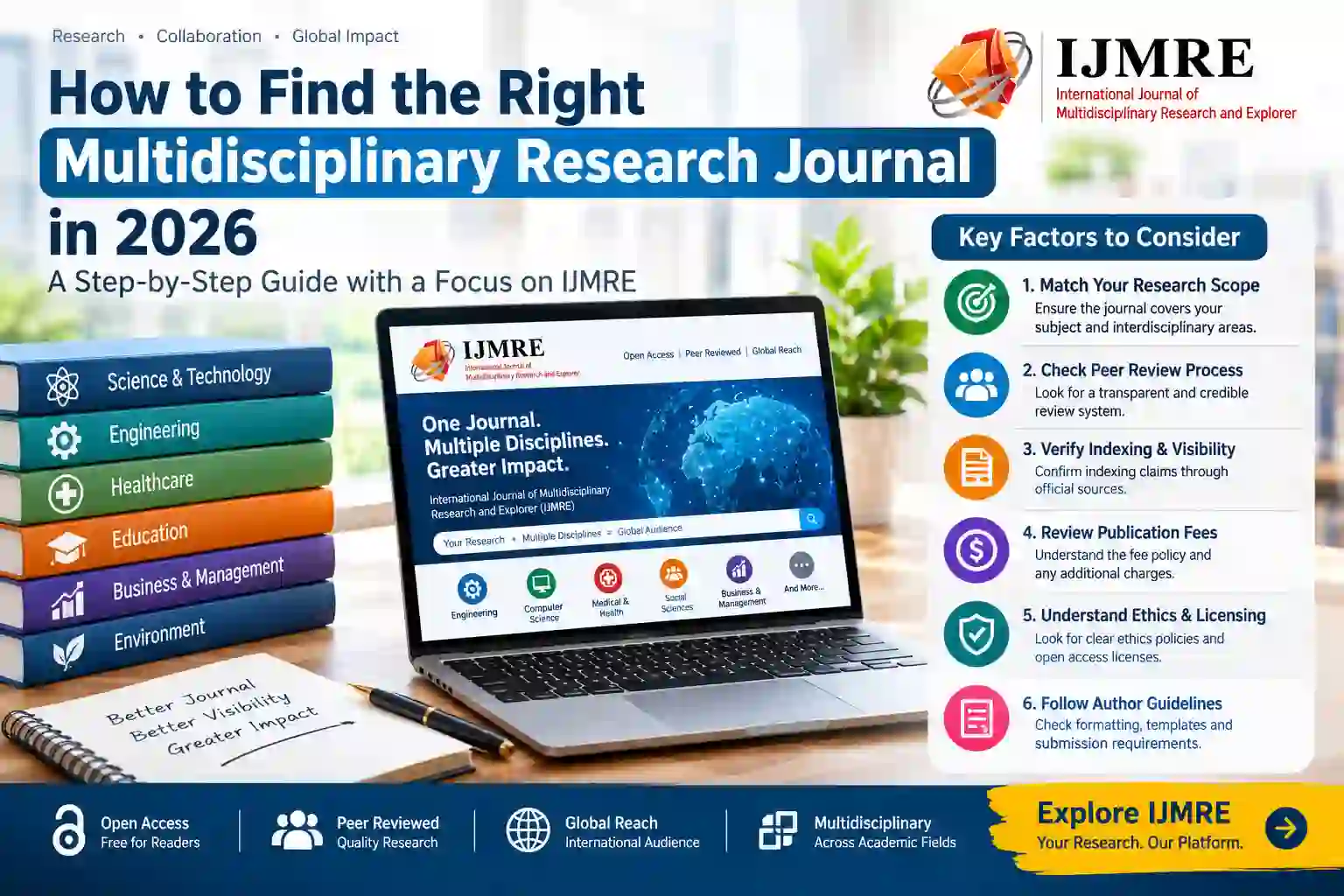
7 Steps to Find the Right Multidisciplinary Research Journal in 2026
1. Start With Your Research Topic
The first step is to understand exactly where your research fits academically.
Identify the main subject and any secondary disciplines involved in your research. For example:
| Research Topic | Possible Disciplines |
|---|---|
| AI-based medical diagnosis | Artificial Intelligence, Computer Science, Healthcare, Data Science |
| Smart agriculture using IoT | IoT, Agriculture, Electronics, Computer Science, Data Analytics |
| AI-based traffic management | AI, Civil Engineering, Transportation, Data Science |
| Digital learning analytics | Education, Computer Science, AI, Data Analytics |
| Predictive maintenance in manufacturing | Mechanical Engineering, AI, IoT, Industrial Engineering |
Once you identify the interdisciplinary nature of your research, look for journals whose scope accommodates the combination rather than focusing only on one keyword.
2. Check the Journal's Aims and Scope
Scope compatibility should be one of the first checks you make. A journal can have an excellent reputation and still be unsuitable for your manuscript if your research falls outside its scope.
Before submitting, ask:
- Does the journal publish research in my primary field?
- Does it accept interdisciplinary or multidisciplinary studies?
- Has it recently published papers similar to mine?
- Would the journal's readers be interested in my findings?
- Does my research contribute to the areas described in the journal scope?
For authors considering IJMRE, reviewing the journal's current scope and recent publications is more useful than relying only on the phrase "multidisciplinary."
3. Read Recent Articles Before Submitting
One of the most practical ways to evaluate a journal is to read several recently published papers.
Do not evaluate a journal only from its homepage. Open recent articles and compare them with your manuscript.
| What to Compare | Questions to Ask |
|---|---|
| Research topics | Are similar subjects being published? |
| Methodology | Does the journal publish studies using similar methods? |
| Article structure | Can your manuscript follow the journal's expected structure? |
| Research quality | Do recently published papers meet your academic expectations? |
| References | Are scholarly and relevant sources being used? |
| Publication frequency | Does the journal maintain a consistent publication record? |
IJMRE's published issues provide an opportunity for prospective authors to examine the types of multidisciplinary research already appearing in the journal. Researchers can also explore the IJMRE archives before making a submission decision.
4. Verify the Peer-Review Process
Peer review is an important part of scholarly publishing. However, simply seeing the words "peer reviewed" on a website is not enough. Researchers should look for a clearly described review process.
Useful questions include:
- Is the review model clearly explained?
- Who selects the reviewers?
- Are conflicts of interest addressed?
- Are reviewers expected to maintain confidentiality?
- Are revision decisions explained?
- Does the editor make the final publication decision?
IJMRE currently describes a double-blind peer-review process, in which author and reviewer identities are kept confidential. Its published policy also explains editorial screening, reviewer selection, evaluation criteria, revision, and final editorial decisions.
Researchers can review the complete IJMRE peer-review policy before submission.
5. Check Publication Fees Carefully
Publication cost is important, particularly for students, independent researchers, early-career researchers, and authors without institutional publication funding.
However, free publication and open access are not the same thing.
| Term | Meaning |
|---|---|
| Open Access | Readers can access published research without a traditional subscription barrier. |
| APC | Article Processing Charge paid by the author, institution, or funder. |
| No publication fee | The author does not pay a publication fee under the applicable journal policy. |
| Page charge | A fee may apply when an article exceeds a specified page limit. |
IJMRE currently states that there is no publication fee for articles up to 10 pages, while articles exceeding 10 pages are subject to an additional charge of USD 5 per page. Authors should always check the current official fee policy before submission because journal policies can change.
For a broader discussion, researchers can read whether paid journals are worth the publication fee.
6. Examine Open-Access and Licensing Policies
Researchers should understand what happens to their article after publication.
Check:
- Whether articles are openly accessible
- What copyright arrangement applies
- Whether authors retain copyright
- Which Creative Commons license is used
- What readers are permitted to reuse
IJMRE currently publishes articles under the Creative Commons Attribution 4.0 International (CC BY 4.0) license. The journal's licensing policy states that authors retain copyright while granting the journal a non-exclusive right of first publication.
Authors should read the complete IJMRE licensing terms before submission.
7. Verify Indexing Claims Independently
Indexing is one of the areas where researchers need to be especially careful.
A journal may mention several databases or search platforms, but authors should distinguish between:
- Journal indexing
- Article discovery
- DOI registration
- Search-engine visibility
- Abstracting databases
- Major citation indexes
A DOI does not mean that a journal is indexed in Scopus or Web of Science. Similarly, appearing in a search engine does not automatically mean that a journal has been accepted into a specific scholarly indexing database.
If Scopus indexing is important for your institution or academic requirement, verify the journal's status directly through the official Scopus/Elsevier source rather than relying solely on a journal website or third-party directory.
You can also read the IJMRE guide on how to check whether a journal is Scopus indexed and peer reviewed.
Why IJMRE May Be Relevant to Multidisciplinary Researchers
The International Journal of Multidisciplinary Research and Explorer (IJMRE) is an open-access, peer-reviewed journal designed for research across selected multidisciplinary areas.
For researchers whose manuscripts cross conventional disciplinary boundaries, a multidisciplinary publication venue can provide a potentially appropriate audience, provided that the manuscript matches the journal's current aims and scope.
Examples of interdisciplinary research that can naturally fit a multidisciplinary environment include:
| Research Area | Possible Multidisciplinary Connection |
|---|---|
| Artificial Intelligence | Healthcare, education, engineering, finance, cybersecurity |
| Internet of Things | Smart cities, agriculture, healthcare, manufacturing |
| Computer Science | AI, data science, education, business, engineering |
| Civil Engineering | AI, IoT, environmental science, smart infrastructure |
| Mechanical Engineering | Robotics, automation, AI, manufacturing, materials science |
| Management | Data analytics, digital transformation, AI, economics |
| Education | AI, learning analytics, psychology, technology |
Researchers interested in interdisciplinary publishing can also explore why researchers choose multidisciplinary journals for publication.
What Makes IJMRE Different From a Specialized Journal?
A specialized journal concentrates on a relatively narrow academic area. A multidisciplinary journal is broader and may publish research from several fields.
| Factor | Specialized Journal | Multidisciplinary Journal |
|---|---|---|
| Subject coverage | Narrower | Broader |
| Interdisciplinary research | Depends on scope | Often more naturally accommodated |
| Audience | Primarily subject specialists | Researchers across multiple fields |
| Cross-disciplinary topics | May require stronger scope alignment | Can be appropriate when within scope |
| Journal selection priority | Subject specialization | Interdisciplinary relevance and scope |
Neither model is automatically better. The correct choice depends on the research question, methodology, audience, and publication requirements.
How to Decide Whether IJMRE Is Suitable for Your Paper
Before submitting to IJMRE, use the following practical checklist:
| Question | What You Should Check |
|---|---|
| Does the topic fit? | Compare your research with the journal's current scope. |
| Is the research original? | Ensure the manuscript presents an original contribution and has not been published elsewhere. |
| Is the manuscript well structured? | Follow the journal's article and formatting requirements. |
| Have you checked recent articles? | Compare your topic, methodology, article structure, and quality with recent publications. |
| Have you checked peer review? | Read the journal's peer-review policy. |
| Have you checked fees? | Review the latest publication-fee information before submission. |
| Have you checked licensing? | Understand copyright and reuse conditions. |
| Have you checked indexing requirements? | Independently verify any database requirement important to your institution. |
Follow the IJMRE Author Guidelines Before Submission
One of the easiest ways to avoid unnecessary delays is to prepare the manuscript according to the journal's current requirements.
IJMRE's author guidance provides information about submission requirements, article types, manuscript preparation, ethical responsibilities, and formatting. The journal accepts manuscripts in the formats specified in its current guidelines.
Authors should also check the journal's current manuscript template and use the appropriate version for new submissions.
Before submission, review the IJMRE Author Guidelines carefully.
Common Mistakes Researchers Make When Choosing a Journal
Choosing a Journal Only Because It Is Cheap
Publication cost should be considered, but it should not be the primary measure of academic quality.
A better approach is to evaluate cost together with peer review, scope, editorial standards, ethics, licensing, publication history, and accessibility.
Choosing a Journal Because It Promises Extremely Fast Publication
Fast publication can be useful when there is a legitimate academic deadline, but researchers should examine the editorial and peer-review process rather than selecting a journal solely because of a short timeline.
A credible journal should provide transparent information about how manuscripts are evaluated.
Assuming Open Access Means Free Publication
Open access describes reader access. It does not automatically mean that authors pay nothing.
Always read the journal's fee policy before submitting.
Assuming a DOI Means Indexing
A DOI provides a persistent identifier for a digital publication. It does not by itself prove inclusion in Scopus, Web of Science, DOAJ, or another indexing database.
Ignoring the Journal's Scope
Submitting an excellent manuscript to an unsuitable journal can still result in rejection. Scope alignment should therefore be evaluated before formatting and submission.
Not Reading Recent Articles
Recent articles provide practical evidence about the topics, methodologies, writing standards, and research areas being published by a journal.
How to Improve Your Chances of a Smooth Submission to IJMRE
No legitimate journal can guarantee acceptance, but authors can improve the quality of their submission by following a disciplined preparation process.
- Read the current IJMRE aims and scope.
- Read several recent IJMRE articles related to your research.
- Follow the current manuscript template.
- Use an accurate and concise research title.
- Write a self-contained abstract.
- Explain the research problem and contribution clearly.
- Describe methodology sufficiently for evaluation and reproducibility.
- Present results objectively.
- Use accurate and complete references.
- Check tables, figures, citations, and formatting.
- Check plagiarism and research-ethics requirements.
- Ensure that the manuscript is not simultaneously submitted elsewhere.
- Complete all required author declarations and permissions.
Researchers can also read the complete guide to publishing research in multidisciplinary journals for additional preparation advice.
Is IJMRE a Good Choice for Your Research?
There is no universal "best journal" for every researcher. The right journal depends on the individual manuscript and the author's academic requirements.
IJMRE may be worth considering when:
- Your research falls within its multidisciplinary scope.
- Your research connects two or more academic areas.
- You want an open-access publication venue.
- You want to understand the journal's peer-review process before submission.
- You are looking for a publication option with a clearly stated fee policy.
- You are willing to follow the journal's author guidelines and ethical requirements.
However, researchers should still independently evaluate whether IJMRE meets any specific requirements imposed by their university, funding body, employer, promotion policy, or degree program.
Frequently Asked Questions
What is the best way to find a multidisciplinary research journal in 2026?
Start by identifying your research area, then compare journal scope, recent articles, peer-review procedures, publication ethics, licensing, publication fees, indexing requirements, and submission guidelines. Do not select a journal based on publication speed or cost alone.
Is IJMRE a multidisciplinary research journal?
Yes. The International Journal of Multidisciplinary Research and Explorer (IJMRE) is an open-access, peer-reviewed multidisciplinary journal covering selected research areas across disciplines.
Is IJMRE open access?
Yes. IJMRE publishes research as an open-access journal, allowing readers to access published content without a traditional subscription barrier.
Does IJMRE charge a publication fee?
IJMRE's current regular publication information states that there is no publication fee for articles up to 10 pages. Articles exceeding 10 pages are subject to the stated additional charge of USD 5 per page. Authors should verify the latest fee policy before submission.
Does IJMRE use peer review?
Yes. IJMRE currently describes its review model as double-blind peer review and publishes information about editorial screening, reviewer selection, review criteria, revisions, and editorial decisions.
Does a multidisciplinary journal accept research from every subject?
No. Multidisciplinary does not mean unlimited scope. Authors must check the journal's current aims, scope, and recently published research before submitting.
Should I choose a multidisciplinary or specialized journal?
If your research is strongly focused on one narrow subject, a specialized journal may be appropriate. If the study genuinely combines multiple disciplines, a multidisciplinary journal may provide a more suitable publication environment. The final decision should be based on scope and readership.
Does a DOI prove that a journal is indexed?
No. A DOI and database indexing serve different purposes. Authors should independently verify important indexing claims through the relevant database.
Final Checklist: Finding the Right Multidisciplinary Journal
Before submitting your research paper, ask yourself:
- ✓ Does the journal's scope match my research?
- ✓ Have I read recent articles from the journal?
- ✓ Is the peer-review process clearly explained?
- ✓ Are publication ethics clearly stated?
- ✓ Have I checked the complete fee policy?
- ✓ Do I understand the copyright and licensing terms?
- ✓ Have I independently verified important indexing requirements?
- ✓ Does the journal's readership match my research audience?
- ✓ Have I followed the current author guidelines?
- ✓ Have I checked the manuscript template?
- ✓ Is my manuscript original and not under consideration elsewhere?
Conclusion
Finding the right multidisciplinary research journal in 2026 requires more than searching for a journal with a suitable title. Researchers should evaluate the complete publication environment, including scope, recent articles, peer review, editorial transparency, ethics, licensing, publication costs, indexing requirements, and author guidelines.
For interdisciplinary researchers, IJMRE can be considered as one potential publication venue when the manuscript fits its current scope and publication requirements. Its open-access model, stated peer-review process, multidisciplinary orientation, licensing policy, and transparent publication-fee information are useful factors to evaluate alongside the quality and relevance of its published research.
The most important principle is simple: do not choose a journal merely because it is free, inexpensive, fast, or widely advertised. Choose a journal because it is academically appropriate for your research and transparent about how it operates.
Researchers interested in exploring IJMRE can visit the International Journal of Multidisciplinary Research and Explorer, review the published archives, read the current issue, and review the author guidelines before deciding whether the journal is suitable for their manuscript.
Related IJMRE Resources
- How to Select the Right Peer-Reviewed Journal for Publication
- Multidisciplinary vs Specialized Journals: Which Is Better?
- Best International Journals for Multidisciplinary Research
- Best International Journals for Multidisciplinary Research
- How to Find International Peer-Reviewed Journals for Academic Research
- Research Paper Publication Guide for Beginners
- How Peer Review Works in Academic Journals
- Why Artificial Intelligence Research Needs Multidisciplinary Journals
About IJMRE
The International Journal of Multidisciplinary Research and Explorer (IJMRE) is an open-access, peer-reviewed multidisciplinary research journal publishing scholarly research across selected academic disciplines. Researchers should always review the latest official journal information, scope, author guidelines, policies, and publication fees before submitting a manuscript.
SEO Keywords
Primary Keyword: how to find the right multidisciplinary research journal
Secondary Keywords: multidisciplinary research journal 2026, best multidisciplinary research journals, how to choose a research journal, international multidisciplinary journals, multidisciplinary journal for research paper, peer reviewed multidisciplinary journals, open access multidisciplinary journals, research journal selection guide, how to select a journal for publication, IJMRE journal, international research journal, multidisciplinary research publication, affordable multidisciplinary research journals, research paper publication 2026