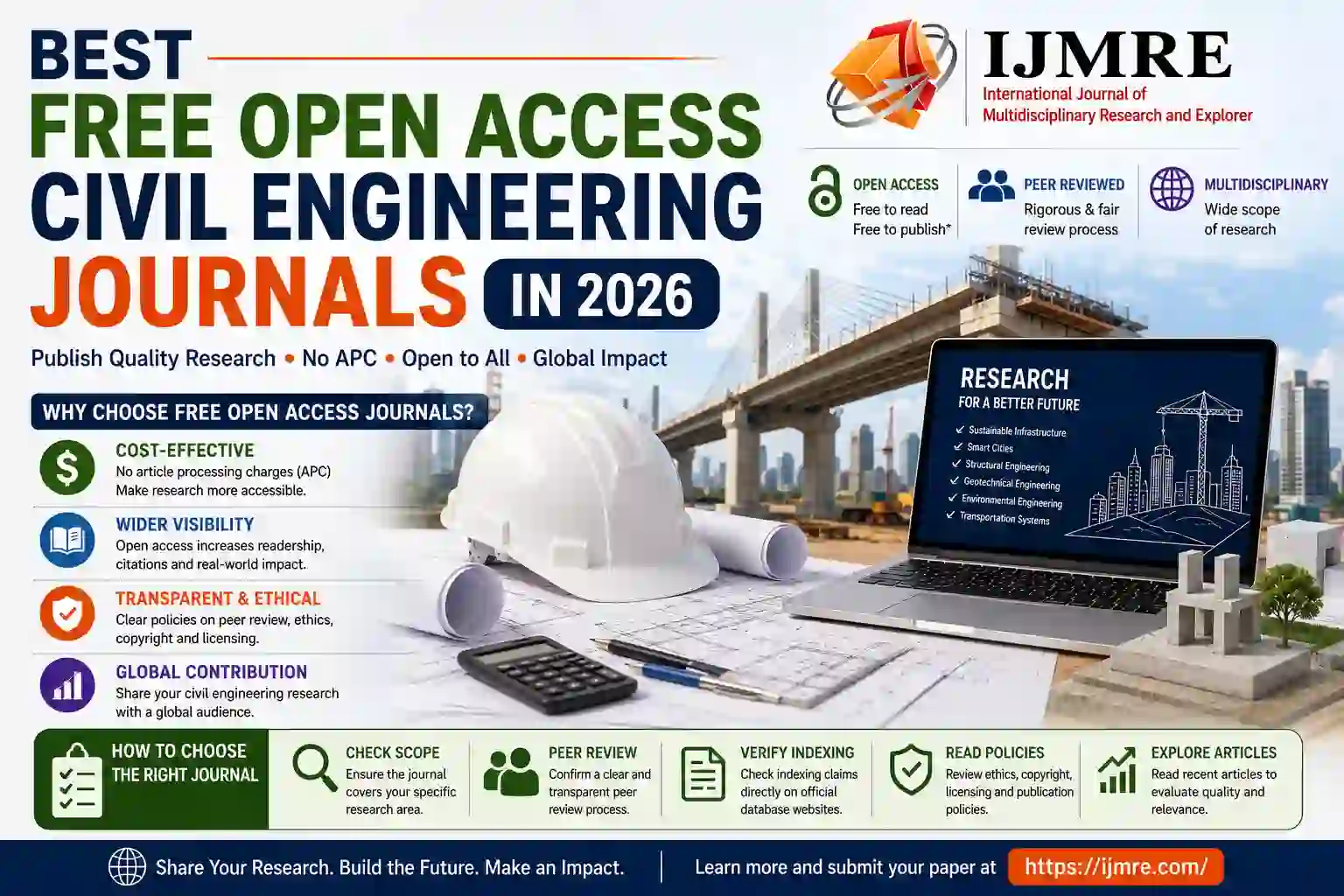
For civil engineering researchers, publishing a research paper is an important step in sharing new findings, engineering methods, experimental results, design approaches, and sustainable solutions with the academic and professional community. However, publication costs can be a major concern for students, PhD scholars, early-career researchers, independent researchers, and authors working with limited research funding.
This is why many researchers search for free open access civil engineering journals where they can publish their work without paying a high Article Processing Charge (APC). But choosing a journal simply because it advertises free publication is not enough. Researchers should also evaluate peer review, journal scope, editorial transparency, publication ethics, licensing, indexing claims, DOI information, author guidelines, and the quality of previously published articles.
This guide explains how to identify suitable free and affordable open access journals for civil engineering research in 2026, what authors should check before submission, and why a multidisciplinary journal such as the open access research journal IJMRE may be relevant for civil engineering research that crosses traditional disciplinary boundaries.
What Is a Free Open Access Civil Engineering Journal?
A free open access civil engineering journal is generally understood as a scholarly journal that makes its published research freely accessible to readers while offering authors publication without a mandatory article processing charge under its stated publication policy.
However, the terms free publication and open access describe different aspects of publishing.
- Free publication: The author does not have to pay a mandatory publication fee under the applicable journal policy.
- Open access: Readers can access published research online without a traditional subscription barrier.
- Free open access: A journal may provide open access to readers while also offering publication without an author APC.
Researchers should therefore check both the author's publication cost and the reader-access model before selecting a journal.
Why Civil Engineering Researchers Look for Free Journals
Civil engineering research can involve substantial expenses before a manuscript is submitted. Laboratory testing, field surveys, structural modelling, construction-material testing, geotechnical investigations, environmental measurements, software, equipment, and data collection can all require funding.
Publication expenses can add another financial burden, especially for researchers who do not have institutional or project funding for article processing charges.
Free or affordable publication options can therefore be particularly useful for:
- Undergraduate and postgraduate students
- PhD scholars
- Early-career civil engineering researchers
- Independent researchers
- Faculty members with limited publication funding
- Researchers from institutions with restricted research budgets
- Authors conducting interdisciplinary civil engineering research
Nevertheless, free publication should never be treated as a substitute for journal quality. The most appropriate journal is one that combines affordability with suitable academic standards and transparent publishing practices.
What Makes a Good Free Civil Engineering Journal?
There is no single feature that automatically makes a journal the best choice for every civil engineering researcher. A suitable journal should be evaluated according to the requirements of the manuscript and the author's academic objectives.
Before submitting a paper, researchers should examine the following factors:
| Evaluation Factor | What Researchers Should Check |
|---|---|
| Scope | Does the journal publish research related to your civil engineering topic? |
| Peer Review | Is the review process clearly described? |
| Publication Fee | Is publication genuinely free under the stated conditions? |
| Open Access | Are published articles freely accessible to readers? |
| Editorial Board | Are editors and their academic affiliations clearly identified? |
| Publication Ethics | Does the journal provide policies concerning plagiarism, authorship, conflicts of interest and research misconduct? |
| Licensing | Does the journal clearly explain copyright and reuse rights? |
| Indexing | Can indexing claims be independently verified? |
| DOI | Does the journal clearly explain article identification and DOI information? |
| Author Guidelines | Are formatting, submission and manuscript requirements available? |
| Previous Articles | Can researchers examine recently published papers? |
Popular Civil Engineering Research Areas
Civil engineering is a broad discipline covering many research areas. When searching for a free open access journal, authors should first identify the specific area of their manuscript.
| Civil Engineering Area | Example Research Topics |
|---|---|
| Structural Engineering | Structural analysis, earthquake engineering, concrete structures, steel structures and structural health monitoring |
| Construction Engineering | Construction management, project planning, construction automation and productivity |
| Geotechnical Engineering | Soil mechanics, foundations, slope stability and ground improvement |
| Transportation Engineering | Traffic management, intelligent transportation, pavement engineering and sustainable mobility |
| Environmental Engineering | Water treatment, wastewater management, pollution control and environmental sustainability |
| Water Resources Engineering | Hydrology, flood management, drainage systems and water resource modelling |
| Construction Materials | Concrete technology, recycled materials, sustainable materials and material performance |
| Urban Infrastructure | Smart cities, urban planning, resilient infrastructure and intelligent infrastructure systems |
| Renewable Energy Infrastructure | Solar infrastructure, energy-efficient buildings and sustainable energy systems |
| Computational Civil Engineering | Artificial intelligence, machine learning, BIM, digital twins, simulation and data analytics |
Why Multidisciplinary Journals Can Be Useful for Civil Engineering
Modern civil engineering increasingly overlaps with other areas of science and technology. A research project may combine civil engineering with artificial intelligence, Internet of Things technology, environmental science, data analytics, renewable energy, computer science, economics, or urban planning.
For example, a smart-city research project may involve:
- Civil and infrastructure engineering
- Internet of Things sensors
- Artificial intelligence
- Traffic management
- Environmental monitoring
- Data analytics
- Urban planning
Similarly, research on sustainable construction may combine civil engineering with environmental science, materials science, energy management, and economics.
For such research, a multidisciplinary publication venue may be more appropriate than a highly specialized journal, provided that the journal's scope covers the technical subject of the manuscript.
Researchers interested in understanding the role of multidisciplinary publishing can read this guide to multidisciplinary research journals.
IJMRE as an Option for Civil Engineering Researchers
The International Journal of Multidisciplinary Research and Explorer (IJMRE) is a peer-reviewed, open-access multidisciplinary research journal. Its multidisciplinary approach makes it potentially relevant to civil engineering research that fits within its stated scope, particularly research that connects engineering with technology, environmental science, artificial intelligence, data science, or other related areas.
Researchers should always compare their manuscript with the journal's current aims and scope before submitting. A broad journal title does not mean that every type of civil engineering manuscript is automatically suitable.
IJMRE's publication model is also relevant to researchers searching for affordable publication opportunities. According to its current publication policy, articles up to 10 pages have no publication fee, while additional pages beyond 10 pages are charged at USD 5 per page.
Authors should verify the current fee policy before submission because journal policies may be updated over time.
Why Open Access Matters for Civil Engineering Research
Civil engineering research has practical applications beyond universities and research institutions. Findings can be relevant to engineers, architects, construction professionals, infrastructure planners, environmental specialists, government agencies, consultants, and students.
Open access can make research easier for a wider audience to read without requiring access to a subscription-based academic library.
This can be particularly valuable for research involving:
- Sustainable construction
- Climate-resilient infrastructure
- Smart cities
- Transportation systems
- Water management
- Disaster-resistant structures
- Construction materials
- Environmental engineering
- Infrastructure monitoring
- Artificial intelligence in civil engineering
However, open access itself should not be interpreted as proof of journal quality. Researchers should evaluate the journal's editorial and peer-review practices independently.
Free vs Paid Civil Engineering Journals
Researchers often ask whether they should select a free journal or a paid journal. There is no universal answer because both publishing models can include reputable and unsuitable journals.
| Factor | Free / No-APC Journal | Paid / APC Journal |
|---|---|---|
| Author Cost | No mandatory publication fee under the applicable policy | Publication or article processing charge may apply |
| Open Access | Depends on the journal's publishing model | Often available, depending on the journal |
| Peer Review | Must be evaluated individually | Must be evaluated individually |
| DOI | Depends on the journal | Depends on the journal |
| Indexing | Must be independently verified | Must be independently verified |
| Quality | Cannot be determined from price alone | Cannot be determined from price alone |
The important lesson is that publication cost is only one part of journal selection. A researcher should never assume that an expensive journal is automatically better or that a free journal is automatically inferior.
For a broader discussion of publication costs, see Free vs Paid Civil Engineering Journals.
How to Check Whether a Journal Is Really Free
The word "free" can sometimes be confusing because journals may use different publication models.
Before submission, look for a clearly stated fee policy and determine whether the journal charges for any of the following:
- Article processing
- Additional pages
- Figures or colour pages
- Language editing
- Formatting services
- Fast-track publication
- Certificates
- Additional editorial services
Authors should distinguish between mandatory charges and optional services. A journal with a transparent fee policy allows researchers to understand the expected cost before submitting.
Why Peer Review Is Important for Civil Engineering Papers
Civil engineering research often includes technical calculations, experimental data, simulations, structural models, field observations, laboratory results, numerical methods, and engineering design approaches.
Peer review provides an important mechanism for evaluating the academic and technical quality of a manuscript before publication.
Reviewers may examine areas such as:
- Originality of the research
- Research methodology
- Experimental design
- Engineering calculations
- Data quality
- Statistical analysis
- Simulation methodology
- Interpretation of results
- Literature review
- Technical significance
- Clarity of presentation
Researchers should therefore read a journal's peer-review policy before submission rather than assuming that a journal follows a particular review model.
For additional information, read How Peer Review Works in Academic Journals.
How to Evaluate an Open Access Civil Engineering Journal
1. Read the Aims and Scope
The first step is to determine whether the journal publishes research in your specific civil engineering area. A manuscript about structural engineering may have different requirements from a paper about transportation, geotechnical engineering, environmental engineering, or construction management.
2. Examine Recent Articles
Read several recently published papers. Check whether the research topics, methodologies, technical depth, and article structure are reasonably similar to your manuscript.
3. Check the Peer-Review Policy
A journal should provide meaningful information about how manuscripts are evaluated and how editorial decisions are made.
4. Review the Publication Fee
Confirm whether the journal is completely free, conditionally free, or charges for particular article lengths or services.
5. Verify Indexing Claims
Do not rely only on logos displayed on a journal website. If a journal claims inclusion in a particular database, verify the journal directly through the official database.
Researchers can also read this guide to Scopus-indexed journals to understand why indexing claims should be checked carefully.
6. Check the Editorial Board
Look for clearly identified editors and their institutional affiliations. The editorial board should be relevant to the journal's stated academic scope.
7. Examine Publication Ethics
Responsible journals should provide policies addressing authorship, plagiarism, conflicts of interest, research integrity, corrections, and retractions.
8. Check Copyright and Licensing
Authors should understand what rights they retain and how published research may be reused or distributed.
9. Review Author Guidelines
Before submission, check manuscript formatting, word limits, references, figures, tables, submission procedures, and other requirements.
Important Civil Engineering Research Topics for 2026
Civil engineering research is increasingly influenced by sustainability, digital transformation, automation, artificial intelligence, climate adaptation, and smart infrastructure.
Researchers may find growing interest in topics such as:
- Artificial intelligence in structural engineering
- Machine learning for construction management
- Smart infrastructure
- Digital twins for buildings and infrastructure
- Building Information Modelling (BIM)
- Sustainable construction materials
- Recycled aggregate concrete
- Low-carbon construction
- Climate-resilient infrastructure
- Smart transportation systems
- Intelligent traffic management
- IoT-based structural health monitoring
- Flood prediction and management
- Water resource management
- Earthquake-resistant construction
- Green buildings
- Energy-efficient infrastructure
- Waste management and circular construction
- Geotechnical monitoring
- Infrastructure automation
Artificial Intelligence and Civil Engineering Research
One of the fastest-growing areas of interdisciplinary engineering research is the combination of artificial intelligence and civil engineering.
Machine learning can be investigated in areas such as structural health monitoring, construction scheduling, traffic prediction, material performance prediction, building energy analysis, infrastructure maintenance, and risk assessment.
When a civil engineering paper incorporates AI, data science, IoT, or computer vision, a multidisciplinary journal may provide an appropriate publication environment if the manuscript fits the journal's scope.
Researchers can explore why AI research benefits from multidisciplinary journals for more information.
How Civil Engineering Researchers Can Reduce Publication Costs
Researchers can take several practical steps to control publication expenses without compromising the quality of their work.
Prepare the Manuscript Before Submission
Carefully prepare the title, abstract, methodology, results, discussion, references, figures, and tables before submission. Following the journal's guidelines can reduce avoidable formatting problems.
Choose the Appropriate Article Length
If the journal uses page-based charges, researchers should prepare an appropriately concise manuscript while retaining all essential technical information.
Check the Fee Policy Before Submission
Do not wait until acceptance to investigate publication charges. Review the journal's official fee information before submitting your manuscript.
Use Institutional Resources Where Available
Universities and research institutions may provide access to language editing, statistical support, plagiarism checking, reference-management software, or publication funding.
Avoid Unnecessary Paid Services
Authors should determine whether services offered by third parties are actually required. Researchers should never feel pressured to purchase unnecessary services simply to submit a manuscript.
Common Mistakes When Searching for Free Civil Engineering Journals
Mistake 1: Choosing a Journal Only Because It Is Free
A free publication model is financially attractive, but it does not provide enough information to determine whether a journal is suitable.
Mistake 2: Confusing Open Access With No APC
Open access describes reader accessibility, while APC-free publishing concerns the author's publication cost. Always check both policies separately.
Mistake 3: Trusting Unverified Indexing Claims
Authors should independently verify claims about Scopus, Web of Science, DOAJ, Google Scholar, or other databases rather than relying only on promotional statements.
Mistake 4: Ignoring Journal Scope
A journal may be affordable but unsuitable for a highly specialized manuscript. Scope should be checked before cost.
Mistake 5: Ignoring Publication Ethics
Researchers should avoid journals that provide little information about ethical publishing practices, authorship, plagiarism, conflicts of interest, corrections, or retractions.
Mistake 6: Not Reading Previous Articles
Recent articles provide useful evidence about the type of research and technical content published by a journal.
IJMRE and Civil Engineering Research
IJMRE provides a multidisciplinary publication environment that can be relevant to civil engineering studies that fit its scope. This can be particularly useful for research connecting civil engineering with emerging technologies and other disciplines.
Examples of potentially interdisciplinary civil engineering topics include:
- AI-based structural monitoring
- IoT-enabled infrastructure monitoring
- Smart-city infrastructure
- Machine learning for transportation planning
- Data-driven construction management
- Environmental monitoring systems
- Digital twins for infrastructure
- Sustainable engineering solutions
- Renewable energy and infrastructure
- Computer vision for construction safety
Authors should confirm that their particular manuscript matches the current journal scope before submission.
What Authors Should Check Before Submitting to IJMRE
Before submitting a civil engineering manuscript, authors should review the journal's official information and ensure that their paper satisfies the requirements.
- Review the About IJMRE page.
- Read the IJMRE Author Guidelines.
- Review the Peer Review Policy.
- Check the current Current Issue.
- Explore the Journal Archives.
- Review the Licensing Terms.
- Confirm the current publication fee policy.
- Verify that the manuscript fits the journal's scope.
Civil Engineering Journal Selection Checklist
| Question | Before Submission |
|---|---|
| Does the journal publish civil engineering research? | Yes / No |
| Does the manuscript fit the journal's scope? | Yes / No |
| Is the peer-review process explained? | Yes / No |
| Is the publication fee clearly stated? | Yes / No |
| Is the open-access policy clear? | Yes / No |
| Is the editorial board identifiable? | Yes / No |
| Are publication ethics policies available? | Yes / No |
| Is the licensing policy available? | Yes / No |
| Are indexing claims independently verified? | Yes / No |
| Are recent articles available? | Yes / No |
| Are author guidelines available? | Yes / No |
| Does the journal meet your institution's requirements? | Yes / No |
Frequently Asked Questions
What are the best free open access civil engineering journals in 2026?
There is no single journal that is best for every civil engineering researcher. Authors should compare journal scope, peer review, publication cost, open-access policy, editorial transparency, ethics, indexing, licensing, and relevance to their manuscript. Researchers working on interdisciplinary civil engineering topics may also consider suitable multidisciplinary journals.
Can I publish a civil engineering research paper without paying an APC?
Yes. Some journals offer publication without an APC under their stated policies. However, authors should carefully check whether the journal is genuinely free and whether additional charges may apply.
Is a free civil engineering journal automatically trustworthy?
No. Free publication is a cost characteristic, not a complete measure of journal quality. Researchers should independently evaluate peer review, editorial practices, ethics, scope, licensing, indexing claims, and previously published articles.
Is IJMRE suitable for civil engineering research?
IJMRE is a multidisciplinary research journal, so civil engineering research may be relevant when it fits the journal's stated scope. This can be especially useful for interdisciplinary research connecting civil engineering with technology, environmental science, artificial intelligence, data science, or other related areas.
Does IJMRE offer free publication?
IJMRE's current publication policy states that there is no publication fee for articles up to 10 pages. Additional pages beyond 10 pages are subject to a USD 5 per-page charge. Authors should check the latest official fee policy before submission.
What civil engineering topics can be submitted to a multidisciplinary journal?
Potential topics include structural engineering, sustainable construction, smart infrastructure, transportation, environmental engineering, water resources, construction materials, geotechnical engineering, infrastructure monitoring, AI applications, IoT-based systems, digital twins, and other areas that fit the journal's scope.
Should I choose a specialist civil engineering journal or a multidisciplinary journal?
The answer depends on the research. A highly specialized structural or geotechnical study may be better suited to a specialist journal, while a study combining civil engineering with AI, IoT, environmental science, smart cities, or data analytics may be suitable for a multidisciplinary journal.
How can I verify whether a journal is indexed?
Researchers should verify indexing claims directly through the official website or database of the indexing organization. The journal's exact title and ISSN should be checked carefully.
Does open access guarantee more citations?
No. Open access can improve accessibility because readers can access the article without a subscription barrier, but citation performance depends on many factors including research quality, relevance, discoverability, field, methodology, communication, and scholarly use.
Related IJMRE Resources for Civil Engineering Researchers
Researchers interested in affordable and multidisciplinary publication can explore the following resources:
- Free vs Paid Civil Engineering Journals: What Researchers Should Know
- Free Open Access Mechanical Engineering Journals
- Best Budget-Friendly Research Publication Options in 2026
- What Is an Open Access Journal and Why Does It Matter?
- Best Multidisciplinary Research Journals for International Authors in 2026
- How to Select the Right Peer-Reviewed Journal for Publication
- Research Paper Publication Guide for Beginners
- How to Avoid Fake Scopus Journals
Final Thoughts
Finding the best free open access civil engineering journal requires more than searching for a journal with a zero publication fee. Researchers should evaluate the complete publishing environment, including scope, peer review, editorial standards, publication ethics, licensing, open-access policy, indexing claims, author guidelines, and previously published research.
For civil engineering researchers, multidisciplinary publishing can be particularly valuable when a study combines engineering with artificial intelligence, Internet of Things technology, environmental science, data analytics, smart cities, sustainability, or other emerging fields.
IJMRE can be considered by researchers whose civil engineering manuscripts fit its multidisciplinary scope and publication requirements. Its current publication policy provides no publication fee for articles up to 10 pages, making it a potentially useful option for authors seeking an affordable open-access publication venue.
However, authors should always make their final journal selection based on academic suitability, transparency, peer review, ethical publishing practices, accessibility, and institutional requirements rather than publication cost alone.
About IJMRE
The International Journal of Multidisciplinary Research and Explorer (IJMRE) provides an open-access multidisciplinary platform for researchers, academicians, students, and professionals. Researchers interested in submitting civil engineering or interdisciplinary engineering research should review the journal's current scope, author guidelines, peer-review policy, publication fee information, and recent issues before submission.
Keywords
best free open access civil engineering journals, free civil engineering journals, open access civil engineering journals, free engineering journals 2026, civil engineering research journals, free research publication, no APC civil engineering journals, civil engineering journals without APC, affordable civil engineering journals, open access engineering journals, peer reviewed civil engineering journals, civil engineering research paper publication, civil engineering journal publication, multidisciplinary civil engineering journal, international civil engineering journals, civil engineering research publication, civil engineering journals for students, civil engineering journals for PhD scholars, sustainable civil engineering research, structural engineering journals, construction engineering journals, geotechnical engineering journals, transportation engineering journals, environmental engineering journals, smart infrastructure research, AI in civil engineering, IoT in civil engineering, IJMRE, International Journal of Multidisciplinary Research and Explorer