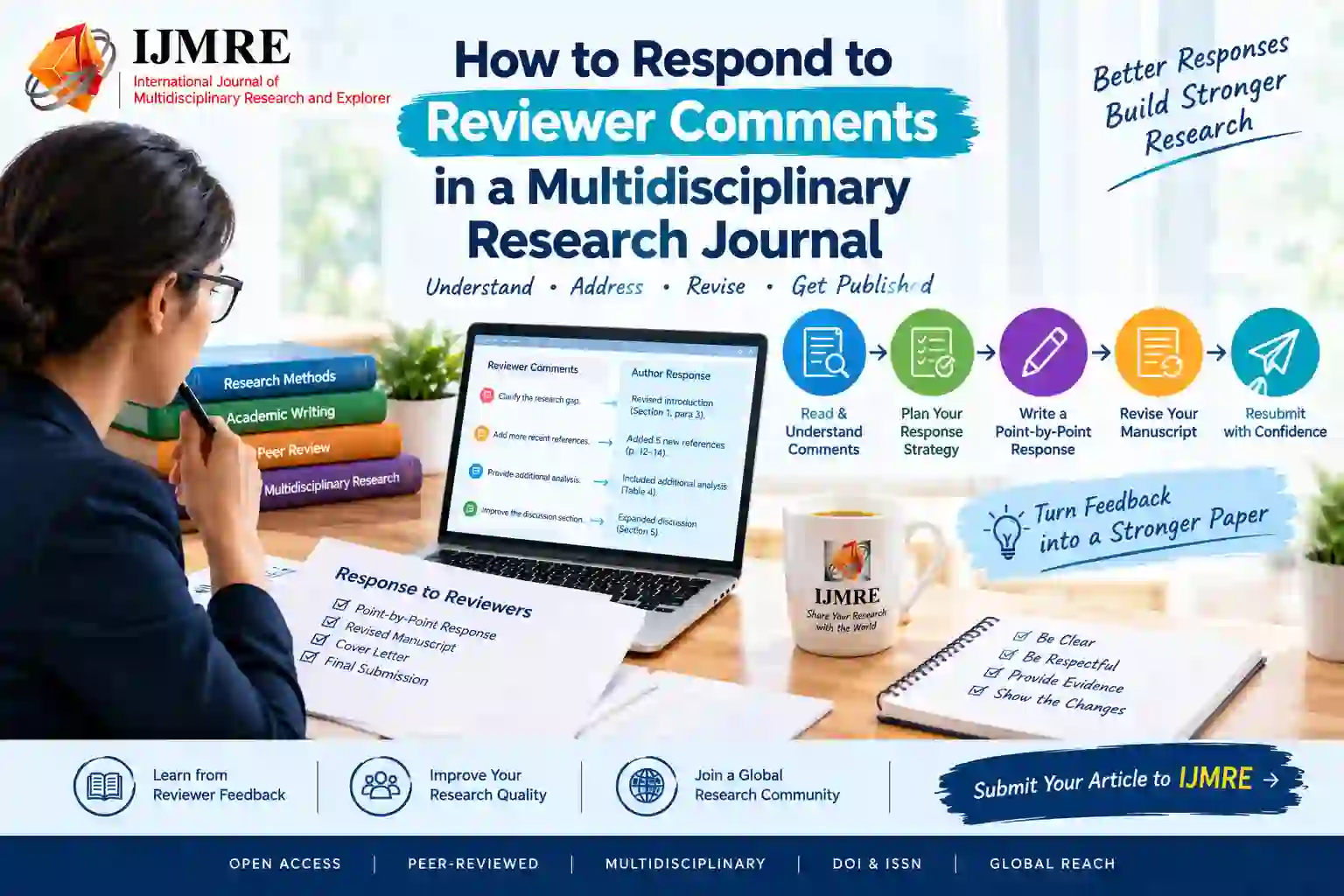
 Receiving reviewer comments is an important stage in academic publishing. A manuscript may contain valuable findings and still require clarification, stronger evidence, methodological explanation, or better alignment between its objectives and conclusions. For researchers submitting to a multidisciplinary journal, the revision process can be especially demanding because reviewers may evaluate the same study from different disciplinary perspectives.
Learning how to respond to reviewer comments in a multidisciplinary research journal involves more than correcting sentences. Authors must understand the concerns behind each comment, decide what changes are justified, provide evidence for their decisions, and communicate respectfully with the editor and reviewers.
This guide explains how to interpret peer-review feedback, prepare an effective point-by-point response, handle disagreements, revise interdisciplinary manuscripts, and check a revised paper before resubmission. It includes practical examples and reusable response templates for researchers at different career stages.
Table of Contents
- Understand the Editorial Decision
- Analyze Reviewer Comments Before Revising
- Prepare a Point-by-Point Response
- Examples of Effective Responses
- Address Feedback in Multidisciplinary Research
- How to Disagree Professionally with a Reviewer
- Common Mistakes to Avoid
- Manuscript Revision Checklist
- Preparing a Revised Manuscript for IJMRE
- Frequently Asked Questions
1. Understand the Editorial Decision Before Revising
Begin by reading the editor's decision letter carefully. Reviewer comments provide detailed feedback, but the editor's instructions explain what is expected for the next stage of consideration. The terminology used for decisions varies among journals, so always follow the wording and requirements in the actual decision letter.
Minor revision
A minor revision generally involves changes such as clarifying an explanation, correcting inconsistencies, improving presentation, adding relevant references, or addressing relatively limited concerns. However, authors should not assume that every comment is optional merely because the decision is described as minor.
Major revision
A major revision may require substantial clarification of the research design, additional analysis, stronger engagement with literature, improved reporting, or a more careful interpretation of findings. Authors should separate changes that can be completed with existing evidence from requests that would require new data collection or a different study design.
Resubmission after substantial changes
Some journals invite a substantially revised manuscript for further consideration. In this situation, the authors should carefully follow the editor's instructions, address the principal concerns, and explain the scope of the revision. An invitation to resubmit does not guarantee eventual acceptance.
Rejection with feedback
A rejection does not necessarily mean that the research has no value. The comments may identify weaknesses that can be addressed before submission elsewhere. Authors should consider the feedback objectively, while recognizing that a rejected manuscript should not be described as accepted or approved by the original journal.
For a deeper explanation of the evaluation process, read IJMRE's guide to how peer review works in academic journals.
2. Analyze Reviewer Comments Before Revising
One of the most common revision problems is responding too quickly. Authors may start editing the manuscript immediately and overlook related comments, conflicting recommendations, or a central concern raised by the editor.
Before making changes, read all reviewer reports and the editorial letter together. Identify what each comment is asking you to do, why the request may matter, and what evidence or explanation would address it.
Classify the comments
| Comment category | Typical concern | Possible response strategy |
|---|---|---|
| Research question and contribution | The study's novelty or research gap is unclear. | Clarify the problem, objective, research gap, and specific contribution. |
| Literature review | Important concepts or relevant studies are missing. | Evaluate relevant sources and revise the synthesis where justified. |
| Methodology | The design, sample, instruments, or procedures are insufficiently explained. | Provide accurate methodological details and acknowledge limitations. |
| Analysis and results | Evidence does not adequately support a claim or interpretation. | Recheck the analysis, add justified explanations, or qualify the claim. |
| Interdisciplinary integration | The connection between disciplines is not sufficiently clear. | Explain how the disciplines contribute to the same research problem. |
| Writing and structure | The manuscript is difficult to follow or contains inconsistent terminology. | Improve organization, definitions, transitions, and presentation. |
| Research ethics and reporting | Ethics approval, consent, conflicts, data availability, or disclosures need clarification. | Provide accurate information and follow applicable ethical and journal requirements. |
Use a revision tracking table
A simple tracking table reduces the risk of overlooking feedback. Create one row for every reviewer comment, even when several comments appear similar.
| Reviewer comment | Required action | Manuscript location | Status |
|---|---|---|---|
| Clarify the research gap. | Revise the introduction and contribution statement. | Introduction, final paragraphs | Pending / completed |
| Explain the sampling procedure. | Add the actual sampling method and relevant details. | Methods section | Pending / completed |
| Limit the conclusion to the evidence. | Review claims and acknowledge study limitations. | Discussion and conclusion | Pending / completed |
The table is a working document for the authors. The final response letter should still reproduce each comment clearly and provide a direct answer.
3. Prepare a Point-by-Point Response to Reviewers
A point-by-point response is usually the clearest way to demonstrate how the manuscript has changed. Follow the journal's instructions if it specifies a different format.
A useful response contains four elements:
- Reviewer comment: Reproduce or accurately summarize the comment without changing its meaning.
- Response: Acknowledge the concern and explain the action taken or the reason for a different approach.
- Revision made: Describe the specific change, analysis, clarification, or limitation added.
- Location: Identify the revised section, page, paragraph, table, figure, or line numbers where possible.
Recommended response letter structure
Start with a short, professional opening that thanks the editor and reviewers for their assessment. Briefly summarize the major changes, then address every comment in the order presented in the reports.
Example opening:
Dear Editor, We thank you and the reviewers for evaluating our manuscript and providing constructive feedback. We have carefully considered the comments and revised the manuscript where appropriate. The responses below address each comment individually and identify the corresponding changes in the revised manuscript. Where a suggested change was not adopted, we explain our reasoning and clarify the relevant evidence.
Use clear labels to distinguish reviewer comments from author responses. If the journal requires a separate response file or a version with tracked changes, prepare those files in the requested format.
4. Examples of Effective Responses to Reviewer Comments
The following examples are illustrative. Replace the sample wording with the actual changes made to your manuscript. Never claim that an analysis, experiment, reference check, or textual revision was completed unless it was genuinely performed.
Example 1: The research gap is unclear
Reviewer comment: The introduction does not clearly explain how this study differs from previous research.
Weak response: Thank you. We have improved the introduction.
Stronger response:
Thank you for identifying this issue. We agree that the distinction between the existing literature and the contribution of the present study required clearer explanation. We revised the final part of the Introduction to specify the research gap, summarize the relevant limitations in prior work, and state the contribution of this study. The revised discussion appears in the Introduction, Section [X], paragraph [Y].
Why it works: The response acknowledges the concern, identifies the revision, and tells the reviewer where to find it. Use this wording only if the described changes have been made.
Example 2: The methodology lacks detail
Reviewer comment: The methods section does not provide sufficient information about participant selection.
Stronger response:
Thank you for this important observation. We revised the Methods section to clarify the participant selection procedure, the eligibility criteria, and the rationale for the selected approach. We also clarified the relevant methodological limitations. The additional information is provided in Section [X].
If the study did not record a requested detail, do not invent it. Explain the limitation honestly and assess whether the missing information affects the validity or interpretation of the findings.
Example 3: A reviewer requests additional references
Reviewer comment: The discussion should engage with more recent research on this topic.
Stronger response:
Thank you for this suggestion. We evaluated additional literature relevant to the study's research question and incorporated the sources that materially strengthen the discussion. We revised the comparison between our findings and previous work in Section [X]. All newly added references have been checked against their original publication records.
Do not add references solely to satisfy a numerical target. Each source should be relevant, accurately cited, and used to support a meaningful point.
Example 4: A reviewer asks for an additional analysis
Reviewer comment: The authors should provide a further analysis to determine whether the main finding is robust.
Stronger response when the analysis is completed:
Thank you for this recommendation. We conducted the additional analysis using [briefly identify the actual method and data]. The results are reported in Section [X] and Table [Y]. We have also updated the Discussion to explain how these results affect the interpretation of the main finding.
Alternative when the requested analysis is not appropriate or possible:
Thank you for raising this point. We considered the suggested analysis but determined that it would not be appropriate for the available data because [provide the specific methodological reason]. Rather than report an unsupported result, we clarified this limitation in Section [X] and revised the relevant interpretation. We believe this makes the scope of the conclusions more transparent.
Use the alternative only when the reason is genuine and scientifically defensible. If the analysis is feasible and important, consider conducting it rather than dismissing the request.
Example 5: A reviewer disagrees with the interpretation
Reviewer comment: The conclusion appears stronger than the results justify.
Stronger response:
Thank you for highlighting this concern. We re-examined the relationship between the reported results and the conclusion. We revised the wording in Sections [X and Y] to avoid extending the interpretation beyond the evidence and added a clearer statement of the study's limitations. The revised conclusion now reflects the scope of the data and the design used.
5. Address Feedback in Multidisciplinary Research
Responding to reviewers can be more complex when a manuscript connects two or more disciplines. A study combining artificial intelligence and education, engineering and environmental science, or management and information technology may be evaluated using different disciplinary assumptions.
One reviewer may prioritize technical validation, another may focus on theoretical contribution, and a third may examine practical or social implications. The goal is not to make every disciplinary perspective identical. It is to demonstrate that the manuscript integrates the relevant perspectives into a coherent and defensible research contribution.
Clarify the contribution of each discipline
Explain what each discipline contributes to the research question and why the combination is necessary. For example, a study using machine learning to investigate educational outcomes may need to explain both the model's evaluation procedure and the educational meaning of the outcome measures.
Define specialized terminology
A term familiar to a computer scientist may be unclear to an education researcher or social scientist. Define important technical terms when they first appear, explain discipline-specific measures, and use terminology consistently throughout the manuscript.
Distinguish methodological disagreement from misunderstanding
When reviewers interpret a method differently, check whether the manuscript has explained the procedure clearly enough. Sometimes the best response is to improve the explanation rather than argue that the reviewer has misunderstood the study.
Resolve conflicting reviewer recommendations carefully
Reviewers may offer recommendations that cannot all be followed. For example, one may request a shorter theoretical section while another asks for additional background. Identify the underlying concern in each comment and consider whether a reorganized section can address both.
If the recommendations remain incompatible, explain the decision in the response letter and, when necessary, ask the editor for guidance. The editor is responsible for determining how the review reports inform the editorial decision.
Authors considering this publication route may also read IJMRE's guide to revising a manuscript after peer review in an international multidisciplinary journal and its discussion of multidisciplinary versus specialized journals.
6. How to Disagree Professionally with a Reviewer
Authors are not required to accept every recommendation automatically. A reviewer may request an analysis that does not fit the study design, propose an interpretation unsupported by the data, or misunderstand a procedure that was already performed. However, disagreement should be evidence-based and expressed respectfully.
Use the following approach:
- Restate the concern fairly so that the reviewer can see it has been understood.
- Explain the methodological, theoretical, or evidential reason for your position.
- Provide relevant evidence or a precise reference to the manuscript.
- Clarify the manuscript where the original explanation may have been ambiguous.
- Where appropriate, acknowledge the reviewer's broader concern and revise the paper in a way that addresses it without adopting an unsuitable recommendation.
Example:
Thank you for this thoughtful suggestion. We understand the rationale for the proposed approach. However, the present study was designed to address [specific research objective], and the available data do not support the proposed additional inference. We have clarified the study design and its limitations in Section [X] and revised the Discussion to avoid implying that the data answer a broader question than the one investigated.
Avoid statements such as “the reviewer is wrong,” “this comment is unnecessary,” or “we do not agree” without an explanation. A professional response demonstrates why a decision was made rather than relying on the authors' authority.
If the disagreement concerns a major issue affecting the validity or scope of the paper, explain the matter clearly to the editor. Do not attempt to pressure reviewers or contact them outside the journal's authorized process.
7. Common Mistakes to Avoid When Responding to Reviewers
| Mistake | Why it creates a problem | Better practice |
|---|---|---|
| Giving vague replies | The reviewer cannot tell what changed. | Identify the actual revision and its location. |
| Ignoring a comment | An unanswered concern may remain unresolved. | Address each comment or explain why it does not apply. |
| Using an aggressive tone | It distracts from the scientific issue. | Use courteous, precise, evidence-based language. |
| Claiming changes that were not made | It undermines trust and creates inconsistencies. | Verify every statement in the response letter against the revised manuscript. |
| Adding unsupported results | It risks compromising research integrity. | Report only analyses and findings that are supported by the actual work. |
| Accepting every suggestion without evaluation | Some requests may be inappropriate for the study design. | Assess each request and explain justified decisions. |
| Forgetting changes elsewhere in the paper | A revised objective or method may conflict with the abstract or conclusion. | Review the manuscript as a whole after making changes. |
| Missing the resubmission deadline | The manuscript may not progress as expected under the journal's process. | Plan the work early and contact the editorial office if an extension is genuinely needed. |
8. Manuscript Revision Checklist Before Resubmission
Before uploading the revised manuscript, use the following checklist to check both the response letter and the paper.
- Every reviewer comment has a corresponding response.
- Each response explains the action taken or provides a reasoned explanation when a suggestion was not adopted.
- All claimed revisions are present in the manuscript.
- Page, section, paragraph, table, figure, and line references are accurate where supplied.
- New references have been verified and are relevant to the discussion.
- Any new analysis is accurately described and supported by the reported evidence.
- The abstract, methods, results, discussion, and conclusion remain consistent after revision.
- Research ethics statements, consent information, funding details, conflicts of interest, and data availability statements remain accurate and complete where applicable.
- The revised manuscript follows the journal's requested file format and tracked-change requirements.
- The response letter is courteous, clear, and free of unnecessary argument.
- The final files have been checked for missing tables, figures, supplementary files, or other required documents.
- The resubmission follows the editor's instructions and deadline.
For additional preparation, consult the journal's author guidelines and read the IJMRE peer-review policy before submitting or revising a manuscript for the journal.
9. Preparing a Revised Manuscript for IJMRE
The International Journal of Multidisciplinary Research and Explorer (IJMRE) publishes peer-reviewed, open-access multidisciplinary research. Authors working across science, engineering, technology, education, management, social sciences, humanities, and related areas should ensure that their manuscript clearly explains its contribution and fits the journal's published scope.
Before submitting a new manuscript or responding to a revision request, authors should:
- Review the journal's scope and confirm that the manuscript is appropriate for its readership.
- Prepare a clear research question, a justified methodology, and conclusions supported by evidence.
- Check the current author instructions and required submission documents.
- Follow the journal's applicable research ethics, authorship, originality, and disclosure requirements.
- Read the relevant peer-review instructions and respond to editorial correspondence within the specified process.
If your research is ready for submission, visit the IJMRE peer-reviewed multidisciplinary research journal homepage to learn about the journal. Review the Author Guidelines, consult the Peer-Review Policy, and follow the official submission instructions.
Submission does not guarantee acceptance. Each manuscript must undergo the journal's applicable editorial assessment and peer-review process. Authors should make their submission decision after reviewing the scope, requirements, publication terms, and current policies.
10. Frequently Asked Questions
How should I start a response to reviewer comments?
Begin with a concise, professional statement thanking the editor and reviewers for their assessment. Then respond to every comment individually, explain the changes made, and identify the revised manuscript locations where possible.
Should I answer every reviewer comment?
Yes. Address each comment, even if you believe a suggested change is unnecessary or unsuitable. In that case, provide a clear, respectful explanation supported by the study design, evidence, or relevant literature.
What is a point-by-point response to reviewers?
It is a structured document that presents each reviewer comment alongside the authors' response and details of the revision. It helps the editor and reviewers assess whether the concerns have been addressed.
How do I respond to a reviewer when I disagree?
Explain the concern you understand, provide a scientific or methodological reason for your decision, and clarify the manuscript where appropriate. Avoid personal or defensive language and seek editorial guidance for significant unresolved disagreements.
What should I do if two reviewers give conflicting comments?
Identify the underlying concerns and determine whether the manuscript can be revised to address both. If the recommendations are incompatible, explain your approach in the response letter and ask the editor for guidance when necessary.
Can I use the same response letter for another journal?
You may reuse relevant explanations from your own earlier work, but you should adapt the response to the current manuscript, actual reviewer comments, and target journal's instructions. Do not submit a response that refers to revisions or decisions that did not occur in the current review process.
Does responding to all reviewer comments guarantee acceptance?
No. A complete response demonstrates that the feedback has been considered, but the editorial decision also depends on the manuscript's quality, validity, contribution, suitability, and the journal's assessment process.
Where can I learn more about manuscript revision for multidisciplinary journals?
Read IJMRE's guide to revising a manuscript after peer review, its explanation of peer review, and its author guidelines.
Conclusion
Responding to reviewer comments is an opportunity to improve the clarity, rigor, and contribution of a research paper. The most effective approach is to read the decision carefully, organize the feedback, respond point by point, revise the manuscript consistently, and explain disagreements using evidence rather than emotion.
For multidisciplinary research, authors should pay particular attention to the connection between disciplines, the clarity of specialized terminology, and the alignment between methods and conclusions. A transparent response letter helps reviewers understand the work completed and the reasoning behind decisions that were not adopted.
Whether you are preparing your first manuscript or revising an established research project, careful revision is an important part of responsible scholarly communication. Review the submission requirements of your target journal, prepare an accurate response, and ensure that every revision reflects the work actually performed.
Researchers planning to submit original work in a relevant field can learn more about the International Journal of Multidisciplinary Research and Explorer (IJMRE) and consult its official author and peer-review policies before submission.