ISSN (Online): 2833-7298
ISSN (Print): 2833-7301
Publication Fees: Free (Free up to 10 pages; USD 5 per additional page)

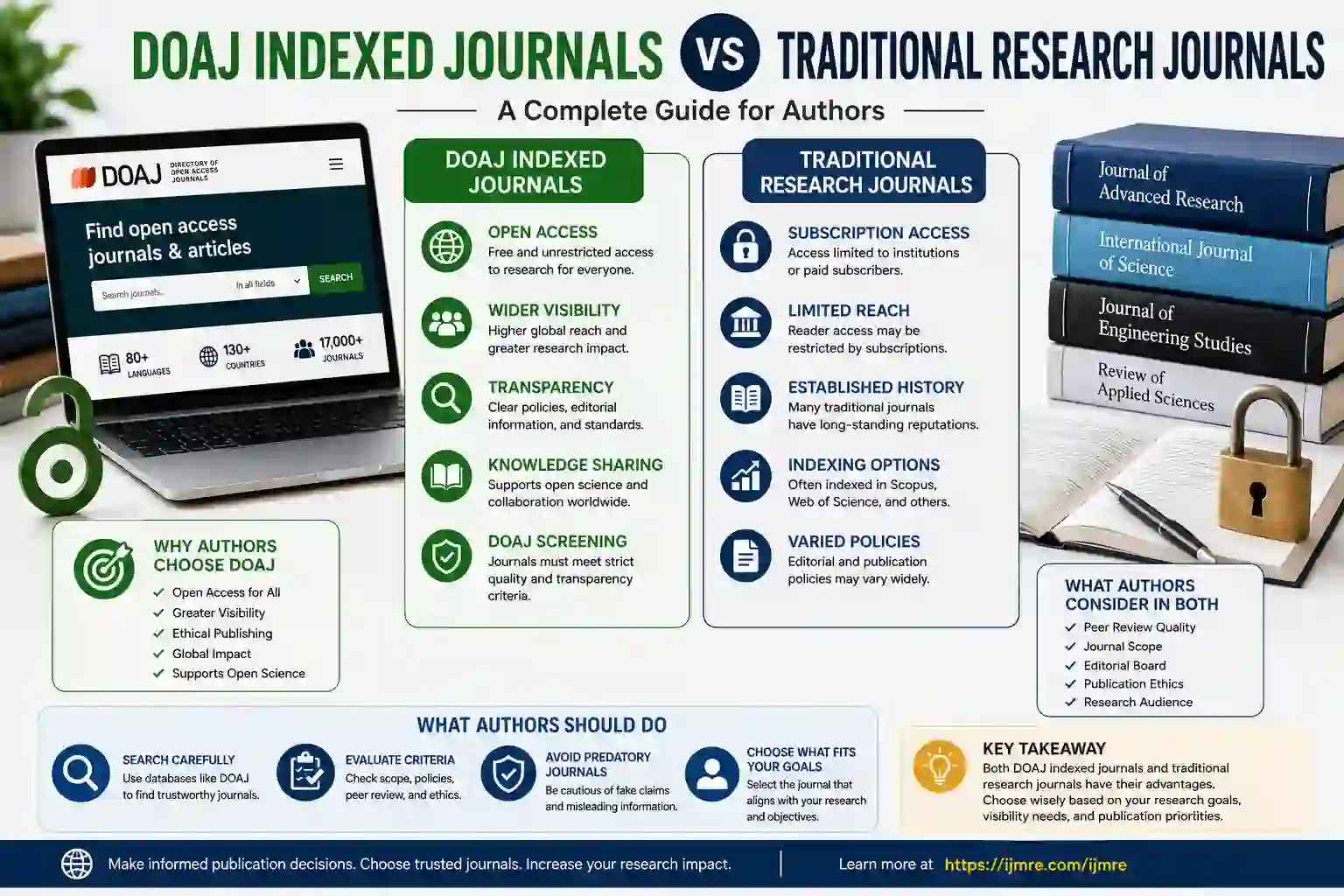
Selecting the right journal is a critical step in the research publication process. Researchers today have access to a wide range of publishing options, including open access journals listed in the Directory of Open Access Journals (DOAJ) and traditional subscription-based research journals.
Many authors, especially early-career researchers and doctoral scholars, often wonder whether publishing in a DOAJ indexed journal offers greater advantages than publishing in a traditional research journal.
The answer depends on your publication goals, target audience, funding requirements, and research visibility objectives. This guide explains the key differences between DOAJ indexed journals and traditional research journals to help researchers make informed publication decisions.
Researchers looking for publication guidance can also visit the IJMRE Journal Platform.
DOAJ (Directory of Open Access Journals) is a global directory that indexes quality open access scholarly journals. Journals included in DOAJ must demonstrate transparency in publishing practices, editorial policies, and access to research content.
Unlike subscription-based journals, DOAJ indexed journals generally make research articles freely available to readers worldwide.
To learn more, read What is DOAJ? Understanding the Directory of Open Access Journals.
Traditional research journals are scholarly publications that typically operate under a subscription-based model. Readers, universities, and libraries often pay subscription fees to access published research.
Many traditional journals have long publication histories and established academic reputations. Some are indexed in major databases, while others operate independently within specialized research communities.
| Feature | DOAJ Indexed Journals | Traditional Research Journals |
|---|---|---|
| Access Model | Open Access | Subscription Based |
| Reader Access | Free Worldwide | Limited to Subscribers |
| Research Visibility | Generally Higher Accessibility | May Be Restricted |
| Knowledge Sharing | Broad Public Access | Institutional Access |
| Publication Model | Open Access Publishing | Traditional Publishing |
| Global Reach | Very Broad | Depends on Subscriptions |
One of the most significant advantages of DOAJ indexed journals is accessibility. Because articles are freely available online, researchers from around the world can access and read published work without subscription barriers.
This often helps:
Traditional journals may publish high-quality research, but access restrictions can limit readership among researchers who lack institutional subscriptions.
A common misconception is that open access journals are less rigorous than traditional journals. In reality, both DOAJ indexed journals and traditional journals may employ strong peer review systems.
Authors should evaluate:
Researchers can better understand manuscript evaluation by reading How Peer Review Works in Academic Journals.
Research impact depends on many factors, including article quality, relevance, citations, and visibility.
Because DOAJ indexed journals offer open access, articles may reach broader audiences beyond universities and research institutions.
Potential readers include:
Broader accessibility can contribute to greater research exposure over time.
One challenge facing researchers today is distinguishing legitimate journals from questionable publishers.
DOAJ assists authors by providing access to journals that demonstrate transparency regarding:
Authors can learn more from How DOAJ Helps Researchers Find Trusted Open Access Journals.
Many DOAJ indexed journals publish interdisciplinary and multidisciplinary research, making them attractive options for authors whose work spans multiple academic fields.
Researchers working across disciplines can explore:
Regardless of whether a journal is open access or traditional, researchers should evaluate:
A detailed evaluation guide is available in How to Select the Right Peer Reviewed Journal for Publication.
Researchers frequently compare DOAJ with Scopus indexing when assessing journals.
It is important to remember:
For additional reading:
Whether selecting a DOAJ indexed journal or a traditional journal, researchers should remain cautious of misleading publication practices.
Warning signs may include:
Researchers can learn more from How to Avoid Fake Scopus Journals.
DOAJ indexed journals and traditional research journals both play important roles in scholarly publishing. Neither model is automatically superior; the best choice depends on the goals of the researcher, target audience, funding requirements, and publication strategy.
For many authors, DOAJ indexed journals provide significant advantages in accessibility, visibility, and global reach. Traditional journals may offer established reputations within specific disciplines and research communities.
The most important factor is selecting a journal that follows ethical publishing practices, maintains rigorous peer review standards, and aligns with the scope and objectives of your research.
DOAJ indexed journals vs traditional research journals, open access journals, DOAJ journals, traditional academic journals, peer reviewed journals, journal publication, research visibility, scholarly publishing, open access publishing, academic research journals
The International Journal of Multidisciplinary Research and Explorer (IJMRE) is a non-profit, open-access journal that does not charge any submission, processing, or publication fees. Donations made through this button are entirely voluntary and are used solely to support the maintenance, technical infrastructure, and continued accessibility of open research. Contributions do not influence editorial decisions or the peer review process in any way.