ISSN (Online): 2833-7298
ISSN (Print): 2833-7301
Publication Fees: Free (Free up to 10 pages; USD 5 per additional page)

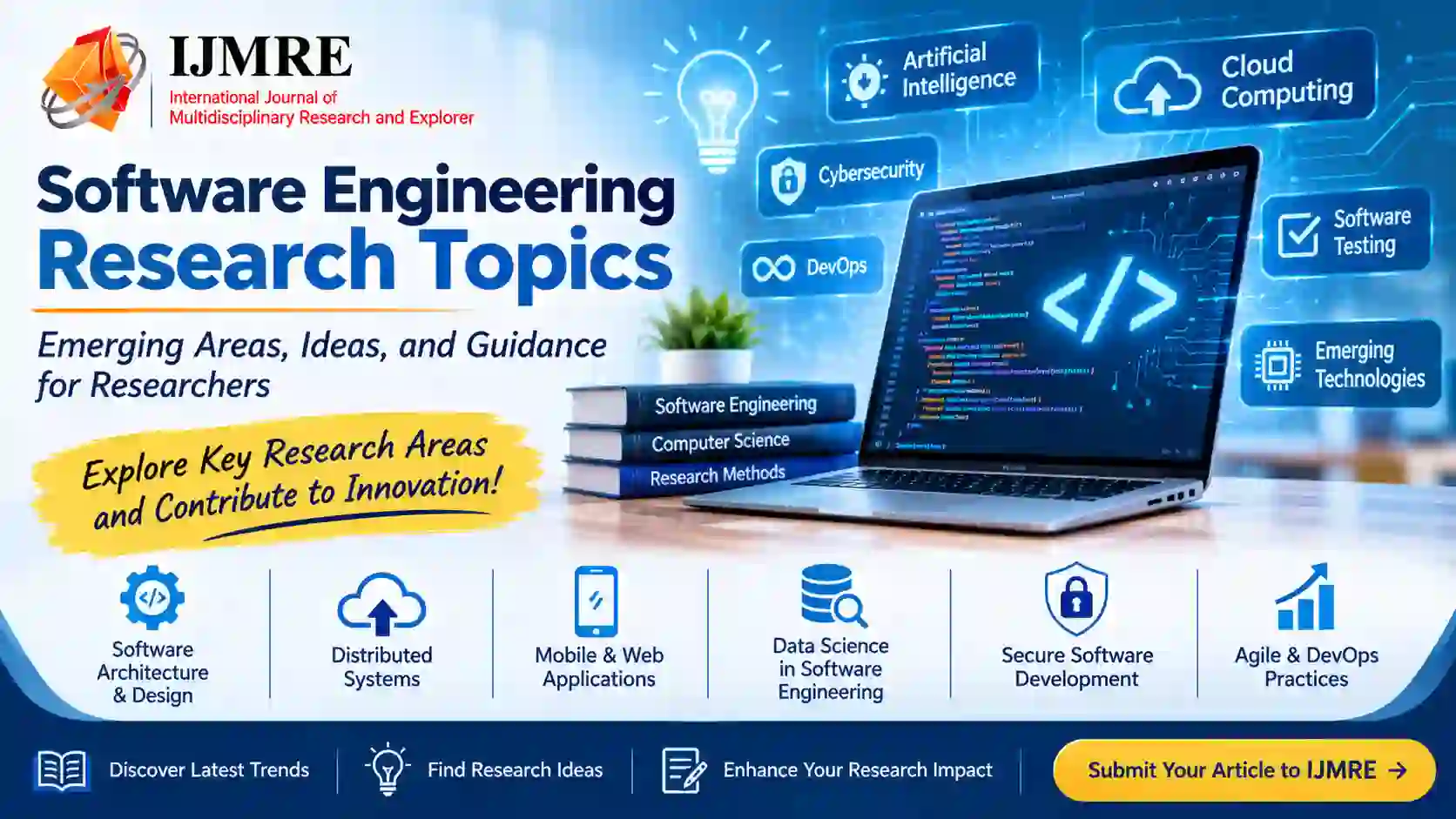
Software engineering is a rapidly evolving discipline that influences how modern software is designed, developed, tested, deployed, maintained, and secured. From artificial intelligence-powered applications and cloud-native platforms to cybersecurity, software automation, and intelligent systems, new technologies continue to create important research opportunities.
For students, doctoral researchers, academics, and industry professionals, selecting an appropriate software engineering research topic is an important first step toward producing meaningful research. A strong topic should address a clearly defined problem, have a practical or theoretical contribution, and be supported by an appropriate research methodology.
This guide presents useful software engineering research topics, including emerging research directions, project ideas, dissertation areas, and interdisciplinary opportunities. It also explains how to select a research problem, evaluate its research potential, and prepare a manuscript for academic publication.
Software engineering research involves the systematic investigation of methods, tools, technologies, processes, and principles used to develop and maintain reliable software systems. It aims to improve software quality, development efficiency, security, scalability, usability, and maintainability.
Unlike a basic software development project, academic research should investigate a specific question or problem and provide evidence-based findings. Depending on the research objective, a study may introduce a new method, evaluate an existing technique, compare different approaches, develop a prototype, or analyze empirical software engineering data.
Common research approaches include:
The following research areas offer opportunities for original investigation. The topics are intended as starting points rather than ready-made research contributions. Researchers should refine each idea into a focused question based on the literature, available data, technical resources, and research objectives.
Artificial intelligence is changing software development through automated code generation, intelligent testing, defect prediction, requirements analysis, and software maintenance. Researchers can investigate how AI-based methods influence development productivity, software quality, and engineering decision-making.
Potential research topics:
Possible research direction: A researcher could compare AI-generated code with developer-written code using defined criteria such as functional correctness, test coverage, maintainability, security weaknesses, and execution performance. The study should use a transparent experimental design rather than relying only on subjective assessments.
Software testing plays a critical role in identifying defects and improving system reliability. Modern applications require testing strategies that can handle distributed architectures, frequent updates, complex user interactions, and rapidly changing requirements.
Potential research topics:
Possible research direction: A study could evaluate different test case prioritization techniques by measuring fault detection rate, execution time, and testing cost across selected software projects.
Cloud computing has transformed the way software systems are developed, deployed, and maintained. Cloud-native applications increasingly use microservices, containers, orchestration platforms, serverless computing, and distributed storage.
Potential research topics:
Possible research direction: Researchers may compare monolithic and microservices architectures using a controlled application workload, evaluating response time, resource consumption, scalability, fault recovery, and deployment complexity.
Security must be considered throughout the software development lifecycle rather than treated as a final testing activity. Secure software engineering investigates methods for preventing vulnerabilities, protecting data, managing access, and improving application resilience against attacks.
Potential research topics:
Possible research direction: A research study could compare static analysis tools for identifying selected vulnerability categories in open-source projects. The evaluation should define the test dataset, vulnerability ground truth, false-positive rate, false-negative rate, and tool configuration.
Agile methods are widely used to manage software projects in environments where requirements evolve and teams need frequent feedback. Research in this area can examine development practices, collaboration, project performance, quality, and the challenges of applying agile methods across different organizations.
Potential research topics:
Possible research direction: A survey-based study could examine the relationship between selected agile practices and project outcomes. Researchers should define the participant population, questionnaire design, sampling strategy, and statistical analysis before drawing conclusions.
Software architecture determines the high-level organization of a system and influences its performance, scalability, security, maintainability, and ability to evolve. As applications become more distributed and interconnected, architecture selection remains an important research area.
Potential research topics:
Requirements engineering focuses on identifying, analyzing, documenting, validating, and managing stakeholder needs. Poorly defined requirements can lead to project delays, additional costs, rework, and software that does not meet user expectations.
Potential research topics:
Software maintenance involves modifying existing systems to correct defects, improve performance, adapt to new environments, and introduce new functionality. As organizations depend on long-running applications, software evolution and technical debt management remain significant research challenges.
Potential research topics:
DevOps integrates software development and IT operations through automation, collaboration, continuous integration, continuous delivery, and monitoring. Research can investigate how engineering practices influence release frequency, reliability, recovery time, and software delivery performance.
Potential research topics:
Mobile and web applications support services in education, finance, healthcare, commerce, communication, and public administration. Research in this area can address usability, performance, accessibility, security, cross-platform development, and user experience.
Potential research topics:
Some of the most interesting research opportunities exist at the intersection of software engineering and other disciplines. These topics can be especially useful for researchers interested in combining computer science, engineering, management, education, healthcare, and data science.
The complexity of a research topic should match the researcher's academic level, available resources, and expected contribution. A topic suitable for a short undergraduate project may not be sufficient for a doctoral dissertation without a deeper research question and a stronger methodological contribution.
| Academic level | Suggested research areas | Expected research focus |
|---|---|---|
| Undergraduate project | Web application testing, mobile app usability, basic defect prediction, software performance comparison | Implementation, testing, comparison, and a clearly documented project outcome |
| Postgraduate dissertation | Automated testing, software quality metrics, cloud application performance, code smell detection | Defined research problem, literature review, methodology, evaluation, and analysis |
| Ph.D. research | Explainable AI for software engineering, automated program repair, secure software supply chains, architecture optimization | Original research question, methodological rigor, reproducible evaluation, and a defensible contribution |
| Industry-oriented research | DevOps optimization, software maintenance, cybersecurity assessment, cloud cost optimization | Practical problem investigation, measurable outcomes, and applicability to real-world environments |
These are general suggestions, not fixed academic requirements. The appropriate scope depends on the institution, discipline, research objectives, and available evidence.
Choosing a research topic requires more than selecting a popular technology. A suitable topic should be specific, researchable, relevant to an identifiable problem, and capable of producing meaningful findings.
Begin with a practical or theoretical challenge. Examples include high false-positive rates in vulnerability detection, slow regression testing, poor software maintainability, or resource inefficiency in cloud applications.
Read recent journal articles, conference papers, systematic reviews, and relevant technical studies. Identify established methods, limitations, contradictory findings, and questions that remain unresolved. Use scholarly databases and reference-management tools to organize the literature.
A research gap should be supported by evidence from the literature. It may involve an underexplored application context, limitations in existing methods, a lack of comparative evaluation, insufficient datasets, or unresolved practical challenges. Avoid claiming that a topic is entirely unexplored without conducting a careful literature review.
A broad subject such as artificial intelligence in software engineering is not yet a research problem. Narrow it into a question that can be investigated using a defined method.
Broad area: AI-based software testing.
More focused topic: Machine learning-based prioritization of regression test cases in large software projects.
Example research question: How does a selected machine learning-based test prioritization approach compare with a baseline strategy in terms of fault detection rate and test execution time on a defined dataset?
Determine whether you can access suitable datasets, source code repositories, development tools, participants, hardware, or cloud infrastructure. Consider licensing, privacy, permissions, and reproducibility before beginning the study.
Choose evaluation measures that directly relate to the research question. Depending on the topic, these may include precision, recall, F1-score, defect detection rate, execution time, response time, energy consumption, maintainability, usability, or development effort.
A research title should communicate the main subject and, where appropriate, the method, application context, or evaluation focus. Avoid unnecessarily broad titles and claims that are not supported by the actual study.
A promising topic becomes a research paper only when it is developed through a systematic investigation. The following structure can help researchers organize their work.
Researchers should report both positive and negative findings. They should also ensure that experiments can be understood and, where possible, reproduced by other researchers. Do not invent experimental results, datasets, references, or performance improvements.
Researchers should select a journal or conference based on the relevance of its scope, publication standards, peer-review process, audience, publication policies, and suitability for the manuscript. A journal's indexing status and other publication claims should always be checked directly through the relevant official database or service.
Before submitting a manuscript, authors should review:
The International Journal of Multidisciplinary Research and Explorer (IJMRE) welcomes original scholarly contributions relevant to multidisciplinary research, including computer science, information technology, engineering, and related applied research areas.
Researchers working on software engineering may consider submitting manuscripts in areas such as:
IJMRE follows a peer-review process and provides an open-access publication platform. Authors should consult the journal's official policies and submission instructions before submitting their work. Submission does not guarantee acceptance; manuscripts are considered according to editorial and peer-review requirements.
Useful IJMRE resources:
Researchers looking for a peer-reviewed multidisciplinary research journal can explore IJMRE's website, review its publication policies, and determine whether their software engineering manuscript is suitable for submission.
Important research areas include AI-assisted software development, automated testing, software security, cloud-native architecture, DevOps, software maintenance, requirements engineering, and software quality assurance. The best topic depends on the research gap, available evidence, and the researcher's objectives.
Potential doctoral research areas include explainable AI for software engineering, automated program repair, software supply chain security, intelligent defect prediction, secure distributed architectures, and energy-efficient software systems. A Ph.D. topic should support a clearly defined original contribution and rigorous evaluation.
Yes. AI can be studied in areas such as code generation, debugging, testing, requirements analysis, defect prediction, and software maintenance. Researchers should carefully evaluate accuracy, reliability, security, bias, and limitations. Any AI assistance used in preparing research should also be disclosed according to the relevant journal and institutional policies.
Conduct a structured review of relevant journal and conference publications. Compare research objectives, datasets, methods, evaluation measures, and limitations. A defensible research gap emerges from evidence of an unresolved problem or a limitation that can be investigated meaningfully.
Yes. Students can prepare manuscripts based on original projects, experiments, empirical studies, case studies, or literature reviews, provided the work meets the target publication's quality, originality, ethical, and formatting requirements.
Check the journal's scope, author guidelines, peer-review process, publication charges, licensing terms, ethics policies, and official indexing records. Ensure that the manuscript is original, properly referenced, methodologically sound, and supported by accurate results.
Software engineering offers a wide range of research opportunities, from artificial intelligence and automated testing to cloud computing, cybersecurity, DevOps, and sustainable software development. However, selecting a popular topic alone is not enough to produce a strong academic paper. Researchers should identify a meaningful problem, examine existing literature, formulate focused research questions, apply appropriate methods, and present evidence-based findings.
Whether you are an undergraduate student, postgraduate researcher, doctoral scholar, or academic professional, a carefully designed software engineering study can contribute to the development of more reliable, secure, efficient, and maintainable software systems.
If you have completed original research in software engineering, computer science, information technology, or a related interdisciplinary area, explore the IJMRE multidisciplinary research publication platform, review the author guidelines, and submit your manuscript for editorial consideration.
The International Journal of Multidisciplinary Research and Explorer (IJMRE) is a non-profit, open-access journal that does not charge any submission, processing, or publication fees. Donations made through this button are entirely voluntary and are used solely to support the maintenance, technical infrastructure, and continued accessibility of open research. Contributions do not influence editorial decisions or the peer review process in any way.