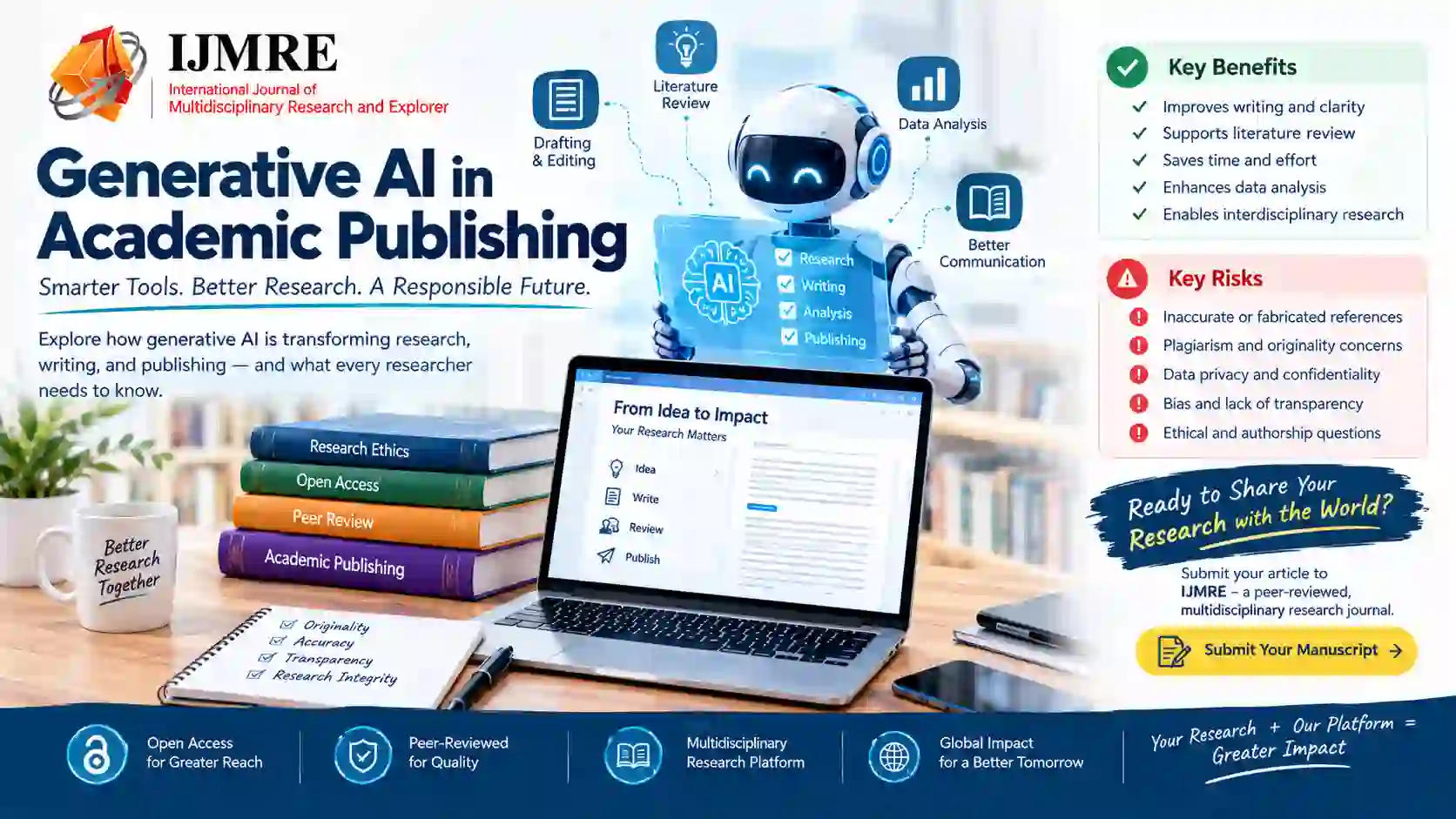
Generative artificial intelligence (AI) is changing how researchers plan studies, organize information, prepare manuscripts, communicate findings, and participate in scholarly publishing. Tools that generate text, summarize documents, assist with coding, or support language editing can make certain research tasks more efficient. However, these capabilities also introduce important questions about accuracy, authorship, transparency, originality, confidentiality, and academic integrity.
For students, early-career researchers, experienced academics, reviewers, and journal editors, understanding generative AI in academic publishing is no longer simply a technical concern. It is part of responsible research practice. The central question is not whether AI can produce academic-looking text, but whether its use helps researchers produce reliable, transparent, and independently verified scholarship.
This guide explains where generative AI can be useful, where it can create problems, how researchers should disclose AI assistance, and what to consider before submitting a manuscript to a scholarly journal. It also outlines practical steps for authors preparing work for a peer-reviewed multidisciplinary publication.
Table of Contents
- What Is Generative AI in Academic Publishing?
- How Researchers Can Use Generative AI
- Potential Benefits of Generative AI
- Risks and Limitations of AI-Assisted Research
- Academic Integrity, Authorship, and AI Disclosure
- Generative AI and Peer Review
- A Responsible AI-Assisted Research Workflow
- Pre-Submission Checklist for Authors
- Choosing a Journal for AI-Related Research
- Submitting Your Research to IJMRE
- Frequently Asked Questions
1. What Is Generative AI in Academic Publishing?
Generative AI refers to computational systems capable of producing new content, including text, code, images, summaries, and other outputs in response to instructions or input data. In academic settings, these tools may support literature organization, manuscript language editing, programming, data exploration, and the preparation of research materials.
AI-assisted academic writing is not a single activity. Correcting grammar is different from generating a literature review, suggesting a statistical method, interpreting experimental results, or drafting an entire manuscript. Each activity carries different levels of risk and requires different levels of human verification.
For example, an author may use an AI tool to improve the readability of a paragraph describing an experiment already performed. The author can compare the revised paragraph with the original and verify that the scientific meaning remains unchanged. By contrast, asking a chatbot to produce references or invent experimental results without checking them creates serious risks to research reliability.
Generative AI should therefore be understood as an assistive technology rather than an independent guarantor of scholarly accuracy. Researchers remain responsible for the claims, evidence, methods, interpretations, and conclusions presented under their names.
2. How Researchers Can Use Generative AI
When used carefully, generative AI can support several stages of academic work. Its suitability depends on the research discipline, the task, the information provided, the tool's limitations, and the journal's applicable policies.
| Research activity | Potential use | Essential human oversight |
|---|---|---|
| Research planning | Brainstorming questions, organizing ideas, and identifying possible research directions | Confirm the research gap through genuine scholarly sources and establish a feasible research design. |
| Literature review | Grouping supplied papers by topic or summarizing material for initial orientation | Read and evaluate the original studies, verify quotations and references, and avoid unsupported claims about the literature. |
| Academic writing | Grammar correction, clarity improvements, and language editing | Check every revision for changes in meaning, terminology, interpretation, or strength of claims. |
| Programming and computation | Explaining code, suggesting debugging approaches, or drafting analysis scripts | Run and test the code, validate calculations, inspect assumptions, and reproduce the results. |
| Data analysis | Helping explain analytical methods or generate preliminary code | Use appropriate methods, verify outputs against the original data, and report limitations honestly. |
| Research communication | Preparing plain-language summaries, presentation outlines, or alternative explanations | Ensure the communication accurately reflects the published evidence and does not exaggerate findings. |
These uses should not be confused with allowing a tool to conduct unverified scholarship on behalf of the researcher. An AI-generated summary is not a substitute for reading relevant studies, and a plausible-looking analysis is not proof that the method is statistically valid.
Researchers who are new to AI-assisted writing can also read IJMRE's guide to the use of generative AI in research paper publication for additional background.
3. Potential Benefits of Generative AI in Academic Publishing
3.1 Improving language clarity
Researchers who write in a second or additional language may use AI-based editing tools to identify awkward sentences, improve readability, and make technical explanations easier to follow. This can help authors communicate their work more clearly, provided the editing does not change the underlying findings or introduce claims that the evidence cannot support.
3.2 Supporting research organization
AI tools can help researchers create preliminary outlines, group supplied notes into themes, and organize questions for further investigation. Such assistance can be useful during early planning, but the final structure should reflect the actual research objectives and evidence rather than a generic template.
3.3 Assisting with technical tasks
In computer science, engineering, and data-intensive disciplines, generative AI may help explain programming concepts, suggest code revisions, or create an initial analytical script. The researcher must still test the code, examine its assumptions, validate outputs, and ensure that the method is appropriate for the research question.
3.4 Making complex findings easier to communicate
Researchers may use AI to prepare an initial plain-language summary or outline for a presentation. Such outputs can help identify where an explanation is unclear. They should be checked against the manuscript to prevent simplification from turning into exaggeration.
3.5 Supporting interdisciplinary collaboration
Multidisciplinary projects often involve researchers from different academic backgrounds. AI may help explain unfamiliar terminology or suggest questions that a team can investigate across disciplines. It cannot replace the domain expertise needed to judge whether those explanations are correct.
Researchers working across fields may benefit from understanding why artificial intelligence research needs multidisciplinary journals, particularly when technical developments have social, educational, ethical, or organizational implications.
4. Risks and Limitations of AI-Assisted Research
Generative AI can produce fluent, confident language even when its output is inaccurate. Its usefulness must therefore be evaluated in relation to the task rather than inferred from the quality of its writing.
4.1 Fabricated or inaccurate references
AI systems can produce references that contain incorrect titles, authors, publication dates, page ranges, or identifiers. In some cases, a cited work may not exist at all. Every reference should be checked against a reliable scholarly record, publisher page, or original publication before it is included in a manuscript.
4.2 Unsupported claims and incorrect summaries
A generated summary may omit important qualifications, confuse findings from different studies, or present an association as a causal relationship. Authors should verify statements against the original evidence and preserve the limitations identified by the researchers who conducted the studies.
4.3 Plagiarism and originality concerns
AI-assisted text may resemble existing material, reproduce source wording too closely, or obscure the provenance of an idea. Authors should maintain accurate citations, use quotation marks where required, paraphrase responsibly, and follow applicable copyright and journal requirements.
AI detection scores should not be treated as definitive proof of misconduct or originality. Such tools can produce false positives and false negatives. Editorial decisions should consider the manuscript, its sources, research evidence, author explanations, and applicable publication policies rather than relying on a single automated score.
4.4 Data privacy and confidentiality
Uploading unpublished manuscripts, identifiable participant information, confidential peer-review reports, proprietary datasets, or restricted institutional material to an external AI service may expose information in ways the researcher cannot control. Before using a tool, review its data-handling terms and obtain any required authorization. Do not upload confidential material unless the use is explicitly permitted and appropriately protected.
4.5 Bias and reproducibility
AI outputs may reflect biases in training data, overlook underrepresented perspectives, or provide inconsistent answers to similar prompts. Where AI materially contributes to an analysis or research procedure, authors should document the relevant tool, version where available, purpose, inputs or settings as appropriate, and verification process. The level of detail should be proportionate to the role AI played in the work.
5. Academic Integrity, Authorship, and AI Disclosure
Responsible AI use requires more than checking grammar or running a similarity report. Researchers should be transparent about the role of AI, preserve human accountability, and comply with the current requirements of their institution, funder, publisher, and journal.
5.1 AI tools should not replace accountable authors
An AI system cannot independently take responsibility for the integrity of a manuscript, answer for undisclosed errors, or reliably guarantee that every statement and citation is correct. Human authors must be able to explain and defend the work, verify the evidence, and take responsibility for the final submission.
5.2 Disclose substantive AI assistance
Authors should check the target journal's current AI policy before submission. Depending on that policy and the extent of assistance, disclosure may be appropriate or required when AI materially contributes to manuscript drafting, analysis, coding, interpretation, or other research activities.
A disclosure should identify the tool and explain how it was used. Authors should not claim that AI was used only for language editing if it also generated substantial manuscript content or contributed to the analysis.
Example disclosure for language editing:
The authors used [name of tool] to assist with language editing and improve the clarity of selected passages. The authors reviewed the revised text, verified the factual content, and take responsibility for the final manuscript.
Example disclosure for a broader contribution:
The authors used [name of tool and version, where available] to assist with [specific task]. The outputs were evaluated and verified by the authors, who remain responsible for the research methods, analysis, interpretation, references, and final manuscript.
These are illustrative templates, not universal requirements. Adapt the wording to describe the actual use of AI and follow the target journal's instructions. Do not use a disclosure statement that inaccurately describes what occurred.
5.3 Distinguish AI assistance from research evidence
Generated prose does not establish that an experiment was performed, a survey was conducted, an interview took place, or a statistical result was obtained. Authors must report only procedures they actually carried out and findings supported by their evidence.
Similarly, AI-generated citations do not replace the original publications. If a tool suggests a source, retrieve and verify the source before relying on it.
5.4 Keep records of important AI-assisted work
For substantial use of AI, maintain a record of the tool, the task performed, relevant prompts or settings where appropriate, changes made to the output, and the verification undertaken. This record can help authors explain their workflow and respond to questions about research integrity.
6. Generative AI and Peer Review
Generative AI may assist with certain editorial tasks, but its use in peer review raises particular concerns. A manuscript submitted for review may contain unpublished findings, confidential information, sensitive data, or commercially valuable ideas. Reviewers and editors must protect this information.
Before using AI during peer review or editorial assessment, reviewers and editors should follow the journal's current policy, their professional obligations, and the confidentiality requirements governing the manuscript. They should not upload confidential submissions or review reports to external AI tools unless the use is explicitly authorized and appropriately safeguards the information.
AI-generated comments also require human evaluation. A tool may misunderstand a method, overlook a contribution, or make an unsupported criticism. The reviewer remains responsible for the fairness, relevance, and accuracy of the assessment.
For a broader explanation of scholarly evaluation, see IJMRE's guide to how peer review works in academic journals and its peer-review policy.
7. A Responsible AI-Assisted Research Workflow
The following workflow helps researchers benefit from AI assistance without transferring responsibility for scholarship to a tool.
- Define the research question. Establish the problem, objectives, and research contribution before using AI to brainstorm or organize ideas.
- Consult primary sources. Use scholarly databases, original publications, and authoritative sources to establish the evidence base.
- Choose an appropriate task. Identify whether AI is being used for language editing, organization, coding, analysis support, or another purpose.
- Protect confidential information. Check data protection requirements and tool terms before entering unpublished, personal, or restricted material.
- Verify every important output. Check citations, equations, code, factual statements, statistical interpretations, and technical claims against reliable evidence.
- Retain human judgment. Evaluate alternative explanations, research limitations, methodological choices, and the meaning of the findings.
- Document material use. Record relevant AI assistance and prepare an accurate disclosure when required or appropriate.
- Review the target journal's instructions. Confirm manuscript structure, ethics requirements, references, disclosure rules, and submission procedures before uploading the paper.
The key principle is simple: AI can support a research workflow, but verification and scholarly judgment must remain part of that workflow.
8. Pre-Submission Checklist for Authors
Before submitting an AI-assisted manuscript, use this checklist to identify common problems.
- Every cited reference has been checked against the original publication or a reliable bibliographic record.
- All factual claims, calculations, tables, figures, and reported results are supported by the actual research.
- The manuscript clearly distinguishes the authors' findings from previously published work.
- AI-generated wording has been reviewed for accuracy, originality, tone, and changes in meaning.
- All necessary permissions, research ethics approvals, consent requirements, and data protections have been addressed.
- AI use has been disclosed accurately in accordance with the target journal's policy.
- No confidential manuscript, peer-review material, or sensitive data has been shared with an unauthorized service.
- The manuscript follows the journal's author guidelines, reference style, formatting requirements, and submission instructions.
- The authors can explain and defend the methods, results, and conclusions in the submitted paper.
- The selected journal's scope, peer-review process, publication fees, and indexing claims have been checked using reliable sources.
For additional preparation, read IJMRE's Author Guidelines and its guide to selecting the right peer-reviewed journal.
9. Choosing a Journal for AI-Related Research
Research involving generative AI may fit different journals depending on its central contribution. A technical paper on model architecture may suit a specialized computer science journal, while a study of AI-supported learning may be better aligned with education research. Work examining AI governance, organizational change, or the social effects of automated systems may require a different readership.
When selecting a journal, consider the following factors:
- Scope: Does the journal publish work in your discipline or accept genuinely interdisciplinary studies?
- Peer review: Is the evaluation process clearly described, and are editorial responsibilities explained?
- Publication ethics: Are policies available for authorship, plagiarism, conflicts of interest, corrections, and AI use?
- Costs: Are all publication charges and additional fees stated clearly before submission?
- Access and licensing: Can readers access the paper under terms appropriate for your needs and funder requirements?
- Discoverability: Are claims about indexing verifiable directly in the relevant database?
- Audience: Is the journal likely to reach researchers who can use, evaluate, or build on the findings?
Do not choose a journal solely because it advertises rapid publication, displays an ISSN, or assigns a DOI. These details do not independently establish editorial quality or inclusion in a particular indexing database. Authors should verify each claim separately.
For further reading, see IJMRE's articles on Scopus-indexed journals versus peer-reviewed journals and how to avoid misleading Scopus journal claims.
10. Submit Your Research to the International Journal of Multidisciplinary Research and Explorer (IJMRE)
Researchers studying generative AI may approach the subject from computer science, information technology, education, management, social sciences, engineering, or other fields. Where a manuscript connects multiple disciplines, a multidisciplinary journal may be worth considering, provided the paper fits its published scope and scholarly standards.
The International Journal of Multidisciplinary Research and Explorer (IJMRE) is a peer-reviewed, open-access multidisciplinary journal. Authors considering submission should first review the journal's scope, editorial and peer-review information, licensing terms, author instructions, and current publication-fee policy.
Potential topics for multidisciplinary AI research include:
- Generative AI applications in higher education and teaching practice.
- AI-assisted software development, testing, and cybersecurity.
- Human oversight and reliability in AI-supported decision-making.
- Generative AI, research integrity, and scholarly communication.
- Ethical, legal, and social implications of AI adoption.
- AI-supported engineering design, optimization, and interdisciplinary innovation.
- Empirical evaluations of AI tools using transparent methods and reproducible evidence.
These examples are possible research directions, not guarantees of suitability or acceptance. A strong submission should identify a clear research question, explain its methods, engage with relevant literature, report verifiable results, and discuss limitations honestly.
Researchers can visit the IJMRE peer-reviewed multidisciplinary research journal homepage to learn more about the journal and its publication platform. Before submitting, review the Author Guidelines, consult the Peer-Review Policy, and check the Licensing Terms.
Ready to prepare your manuscript? Visit the IJMRE submissions page and follow the current submission instructions. Make sure your work is original, properly referenced, ethically prepared, and transparent about any substantive use of generative AI.
11. Frequently Asked Questions
What is generative AI in academic publishing?
Generative AI in academic publishing refers to the use of AI systems to assist with activities such as manuscript drafting, language editing, research organization, coding, and scholarly communication. Its use requires appropriate human verification and compliance with relevant publication policies.
Can researchers use ChatGPT or other AI tools to write a research paper?
Whether and how AI tools may be used depends on the journal's policy, the task, and the research context. Authors should not rely on generated text without checking its accuracy, sources, originality, and consistency with their actual research. They should disclose material AI assistance when required or appropriate.
Does using generative AI automatically mean a paper is plagiarized?
No. AI use and plagiarism are different issues. However, AI-assisted writing can create plagiarism, attribution, copyright, or originality problems if source material is reproduced improperly or ideas are presented without appropriate credit. Authors must follow citation rules and the journal's publication-ethics policy.
Can AI-generated references be trusted?
Not without verification. AI tools can generate inaccurate or nonexistent references. Authors should confirm each reference using the original publication, a publisher website, or a reliable bibliographic database before citing it.
Should authors disclose AI use in a manuscript?
Authors should consult the target journal's current policy and provide an accurate disclosure when required or appropriate. The disclosure should describe the tool and the actual task performed rather than using a generic statement that understates the extent of AI assistance.
Can AI replace peer reviewers or journal editors?
AI may assist with limited editorial tasks, but it cannot remove the need for accountable human evaluation. Confidentiality, disciplinary expertise, critical judgment, and responsibility for editorial decisions remain important considerations.
How can I select a journal for research on generative AI?
Compare the journal's scope, peer-review process, ethics policies, publication charges, licensing, readership, and verifiable indexing status. Choose a journal that fits the paper's actual contribution rather than relying only on promotional claims.
Can I submit AI-related research to IJMRE?
Potentially, if the manuscript fits the journal's multidisciplinary scope and meets its editorial, methodological, ethical, and submission requirements. Authors should review the official IJMRE Author Guidelines and submission instructions before submitting.
Conclusion
Generative AI offers researchers useful ways to organize ideas, improve language, assist with coding, and communicate complex work. Yet fluent output is not the same as reliable evidence. Incorrect references, unsupported conclusions, confidentiality risks, bias, and unclear disclosure can undermine the quality of an otherwise promising manuscript.
The most responsible approach combines appropriate AI assistance with human expertise, careful verification, transparent reporting, and respect for publication ethics. Researchers should understand what a tool contributed, check the resulting work, protect confidential information, and remain accountable for the final paper.
For authors preparing work in artificial intelligence or related interdisciplinary fields, the next step is to identify a clear research contribution and select a journal whose scope and policies match the manuscript. Explore the International Journal of Multidisciplinary Research and Explorer (IJMRE), review its author requirements, and submit your research for editorial consideration when it is ready.
Editorial note: AI tools and publisher policies change over time. Authors should consult the current requirements of their institution, funder, target journal, and relevant publishers before submission.